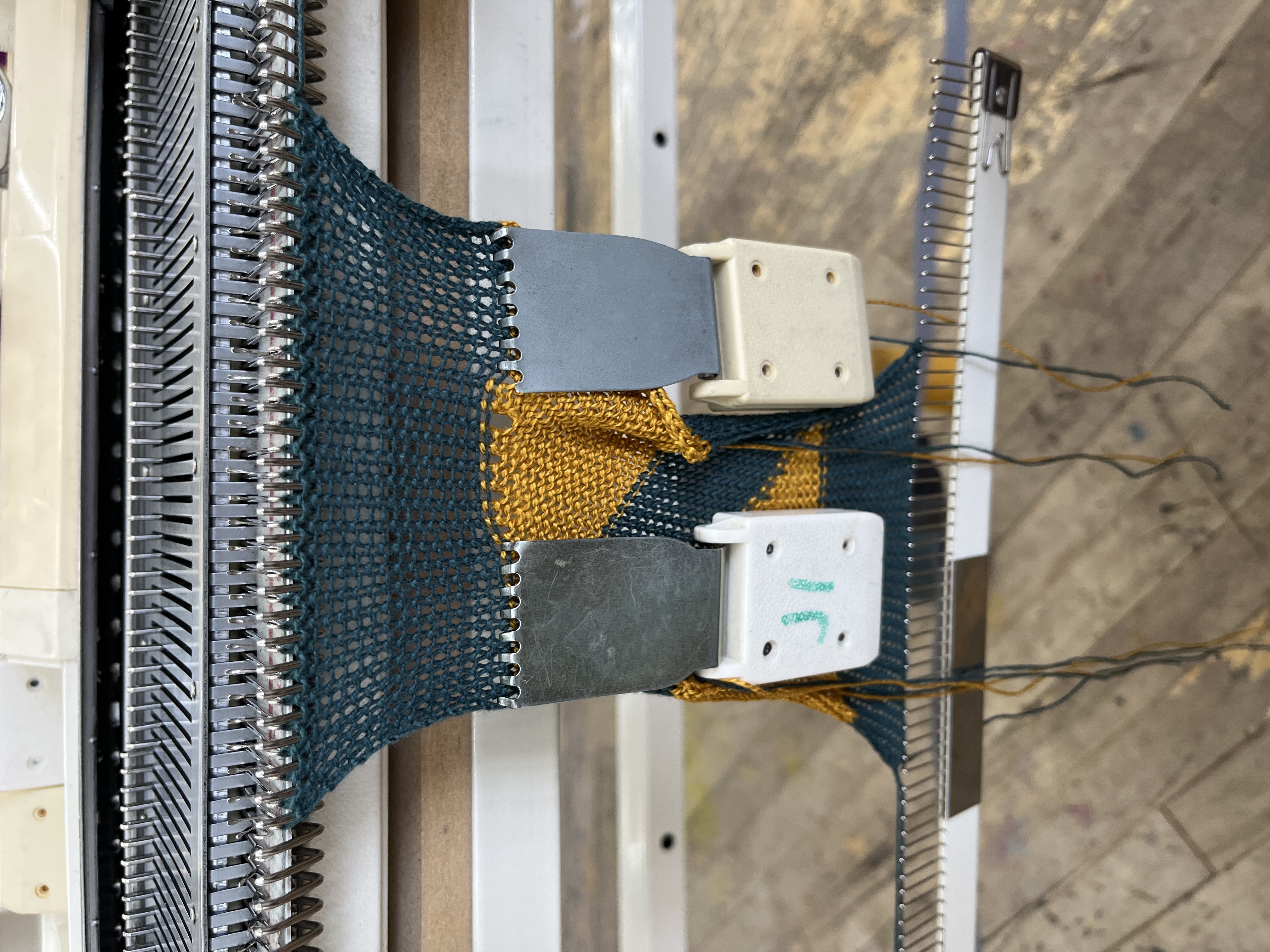
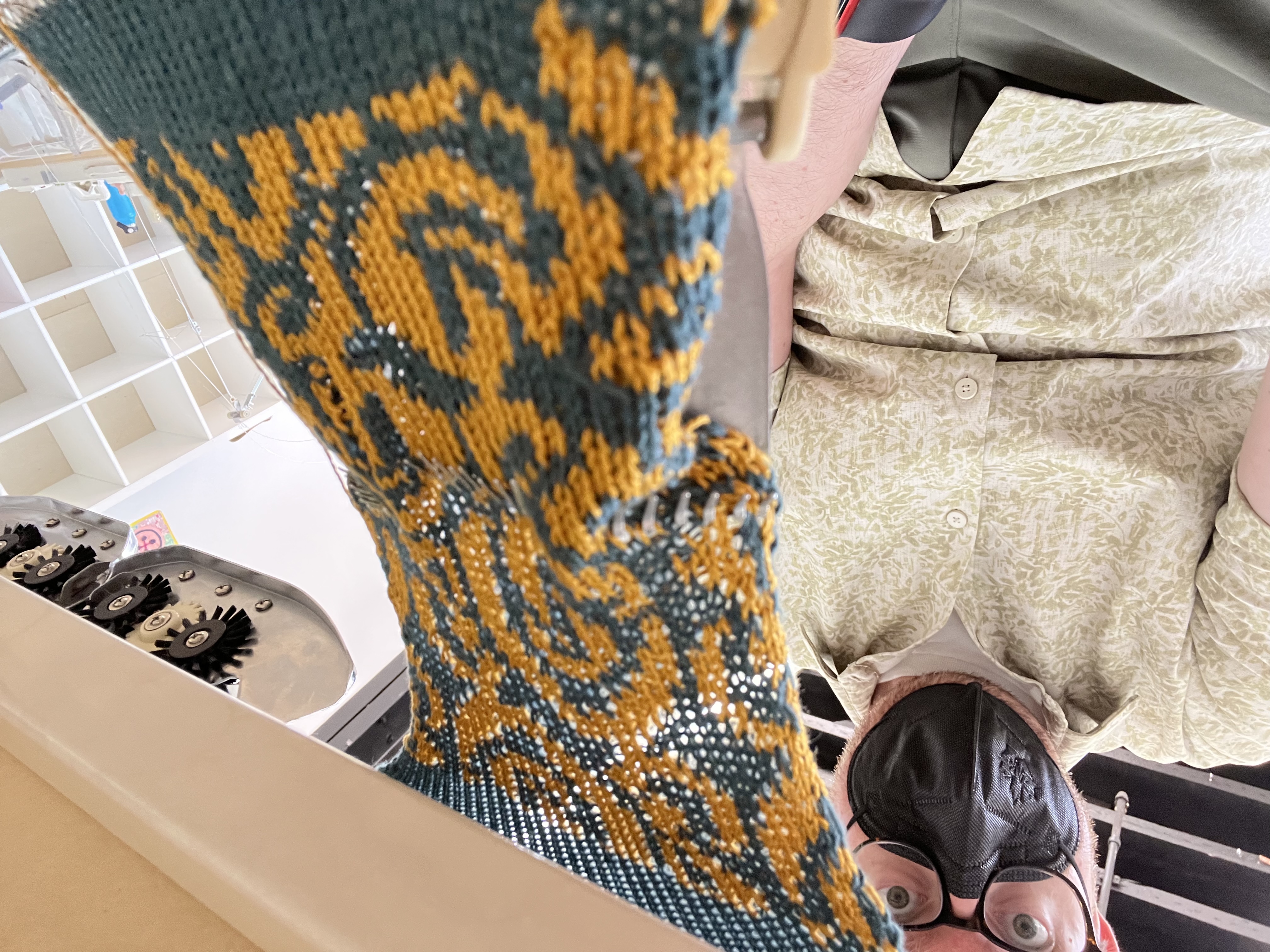
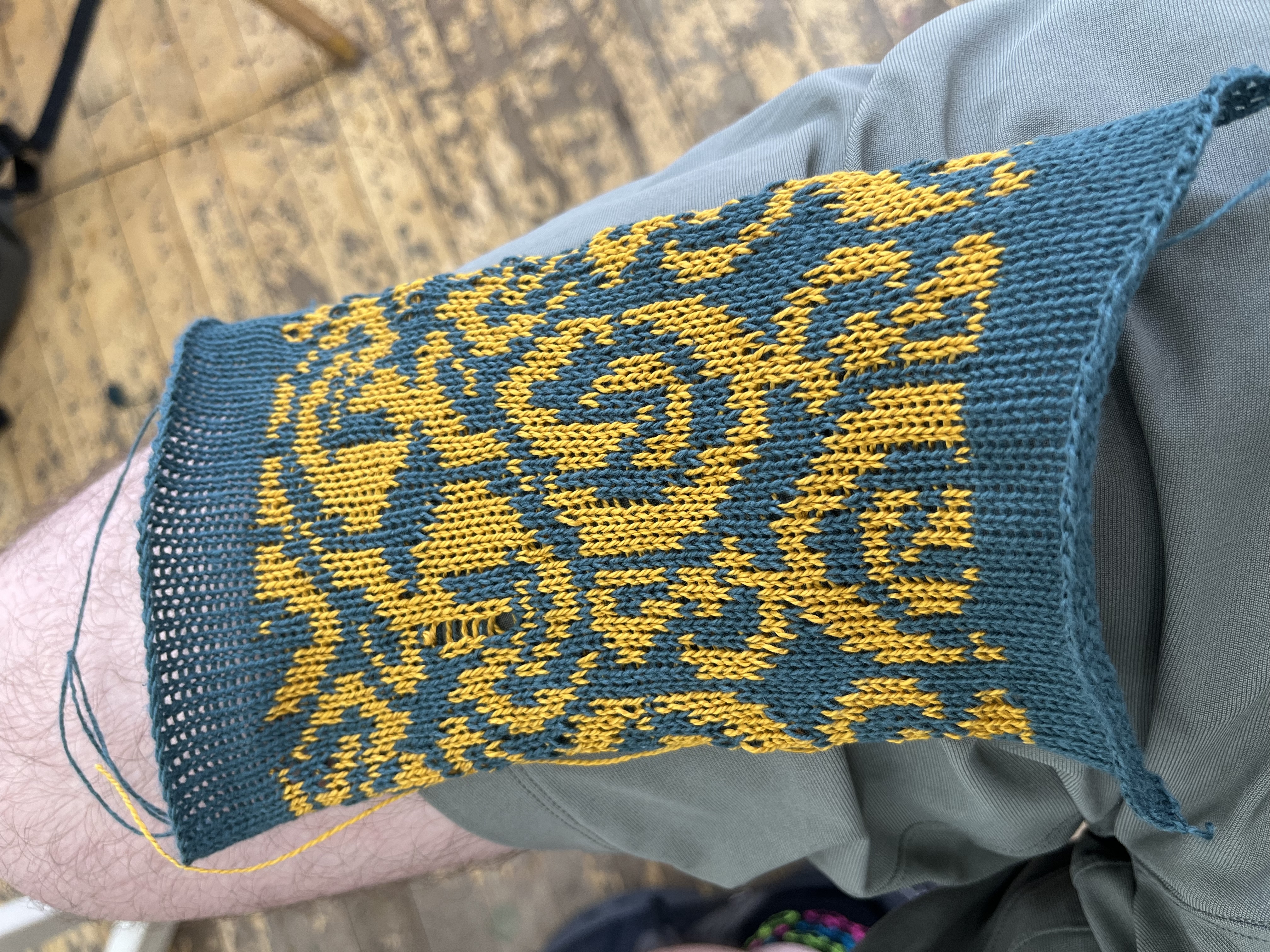
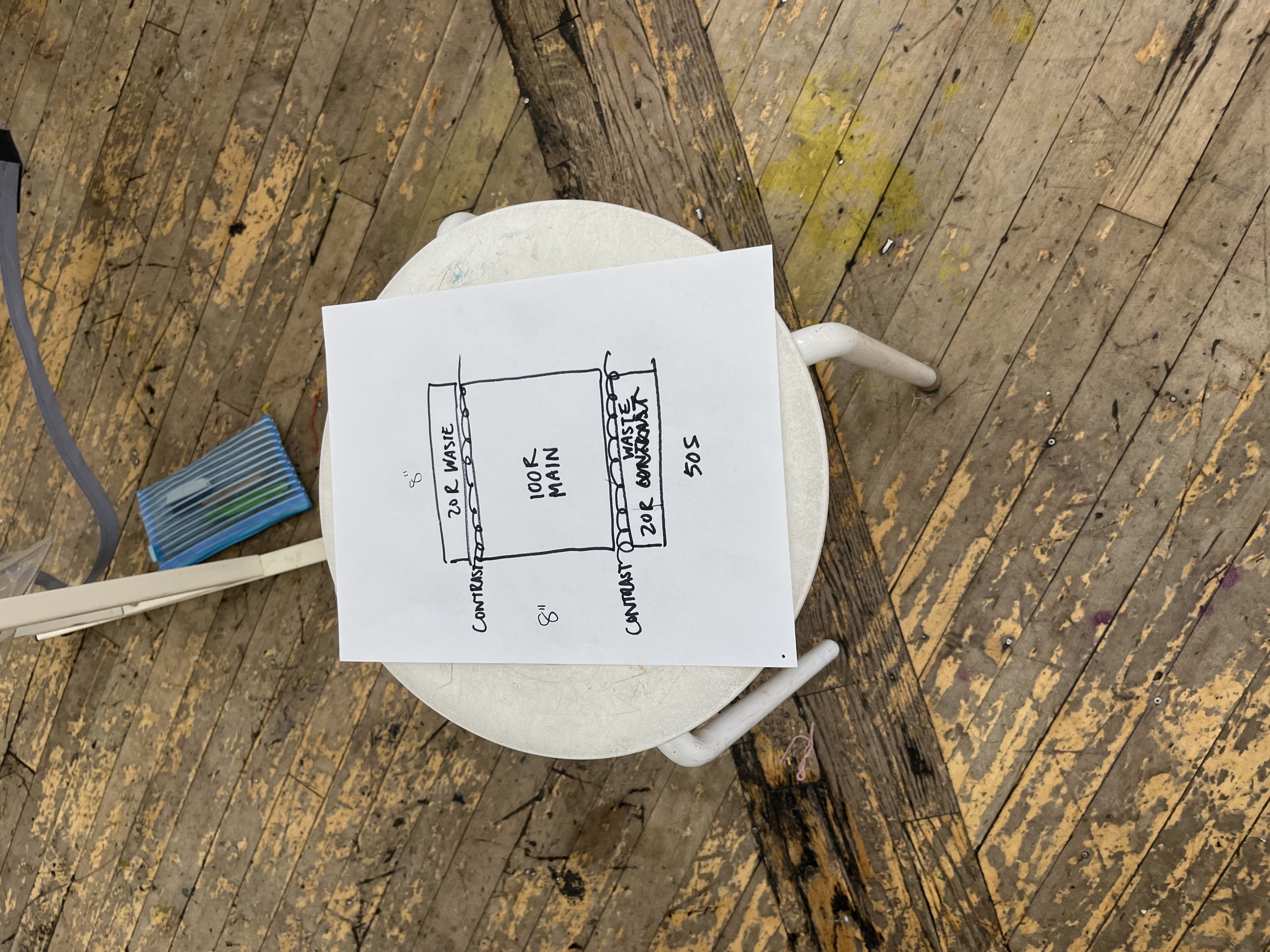
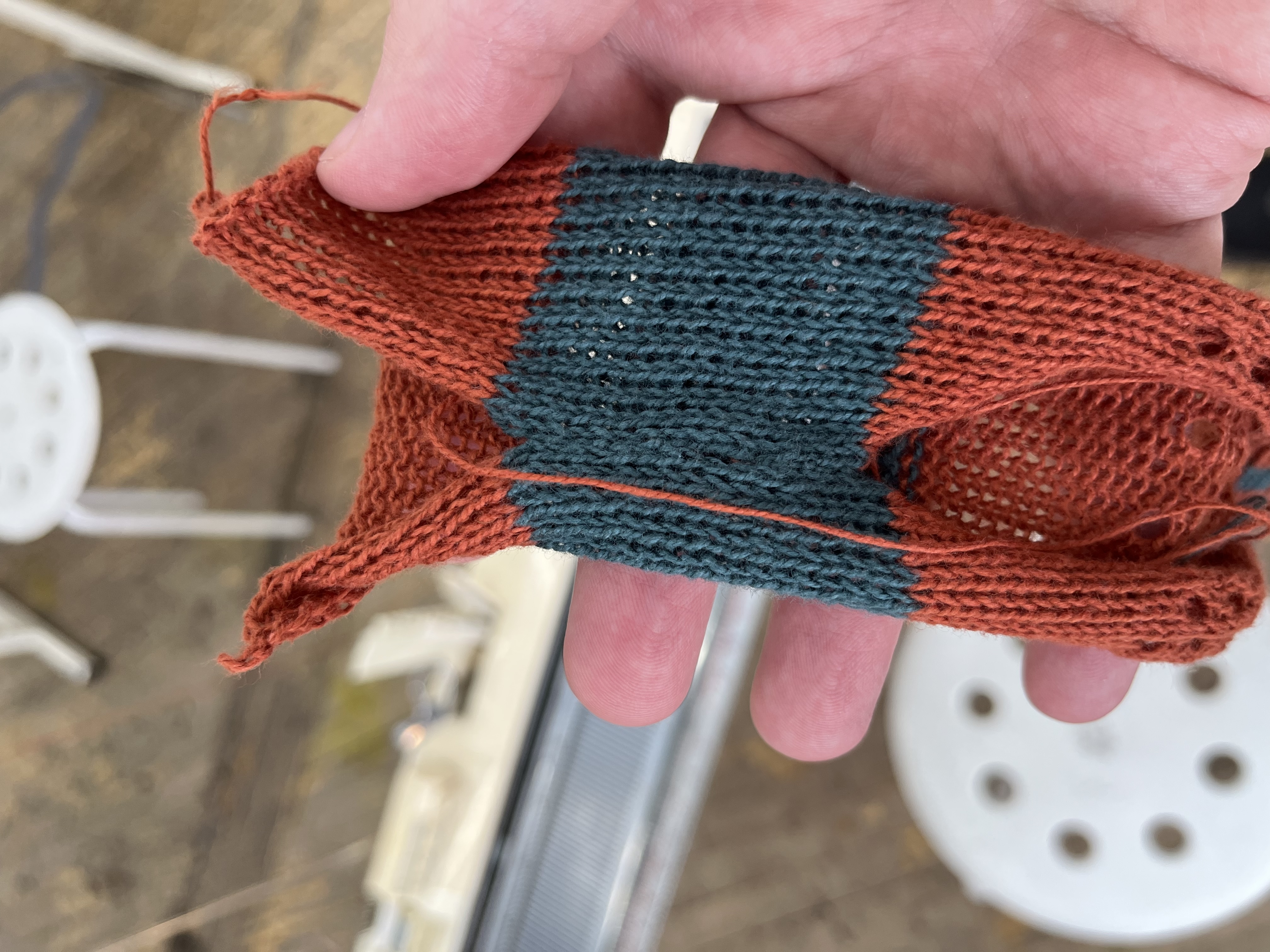
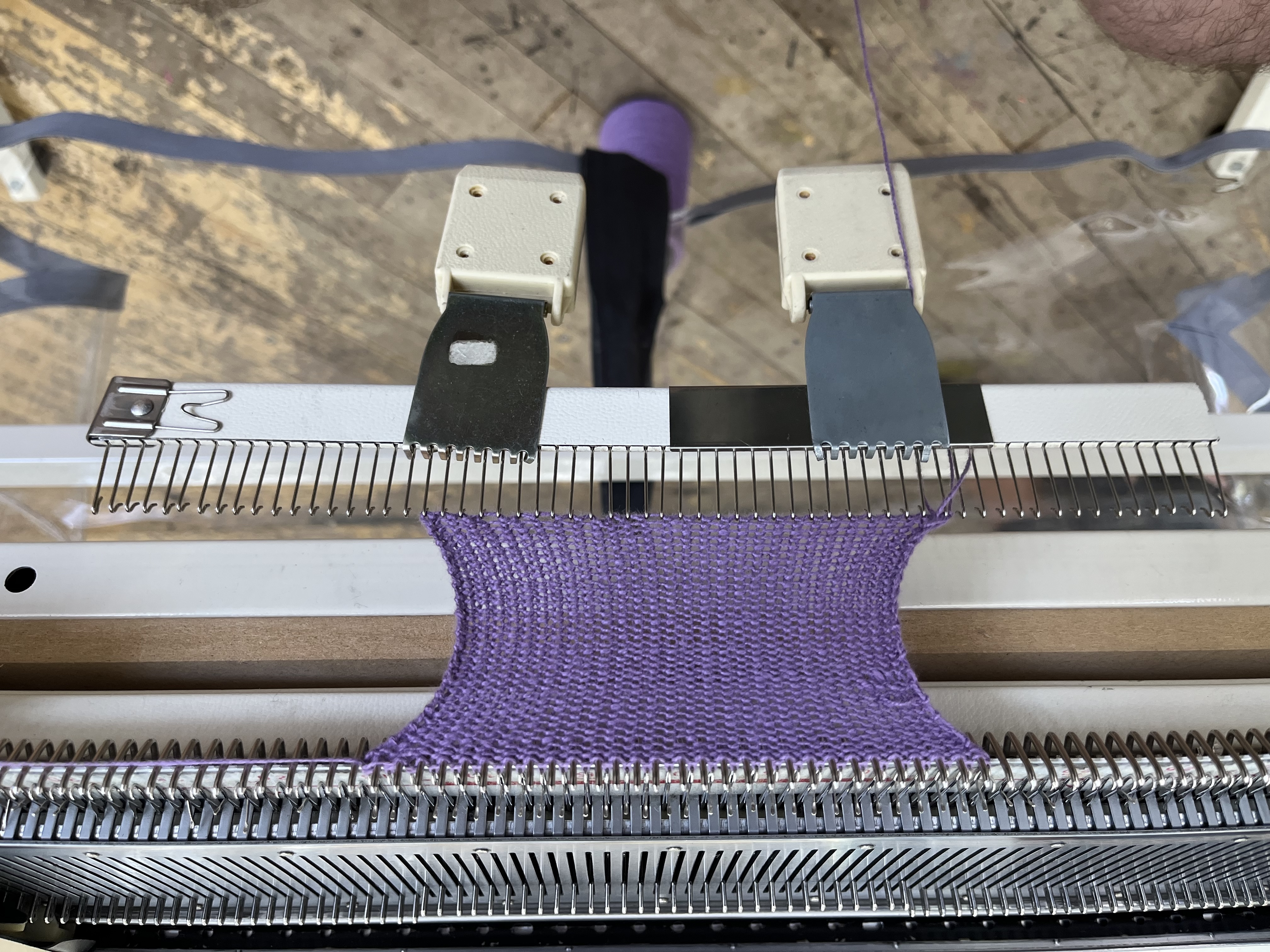
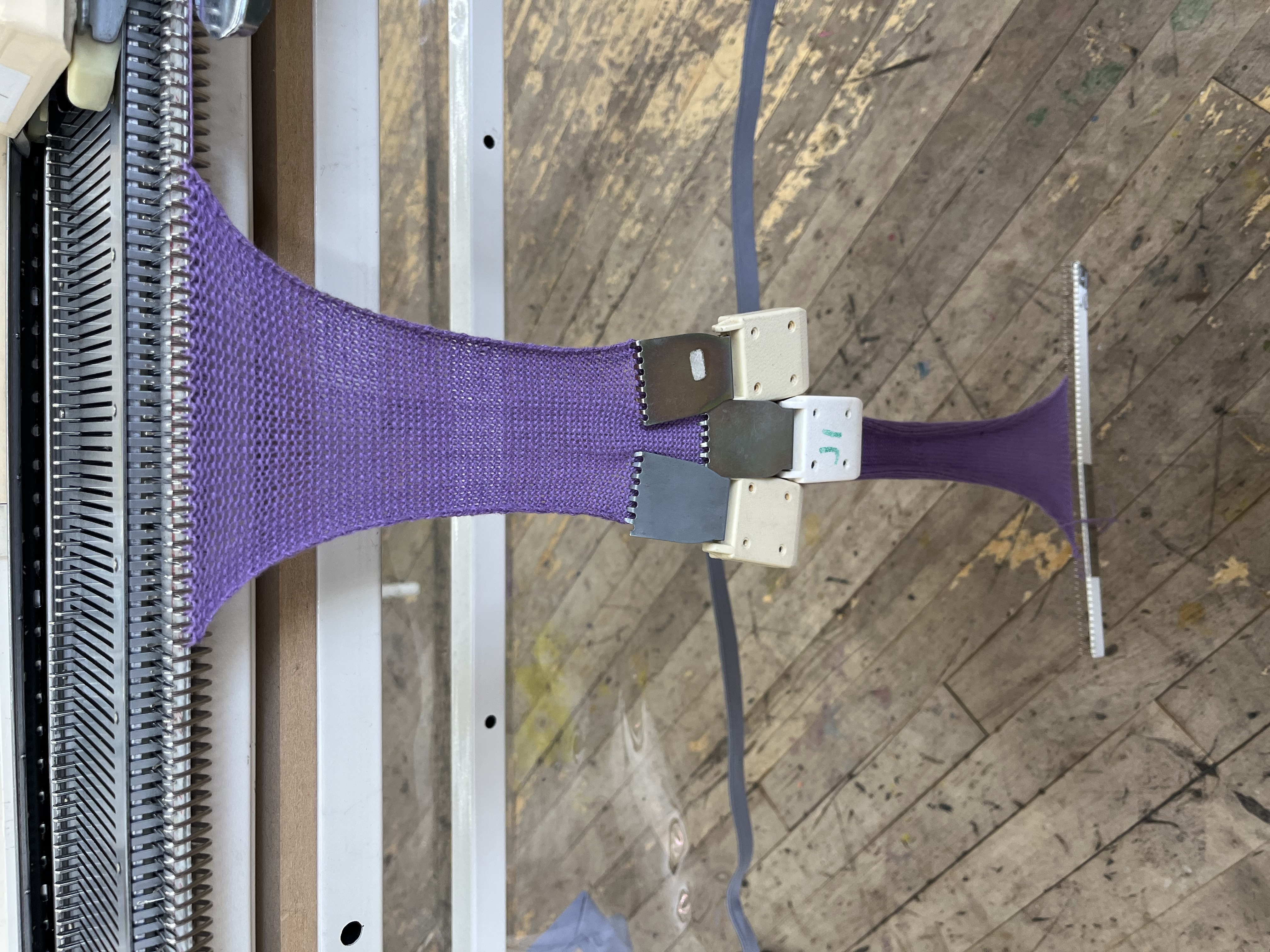
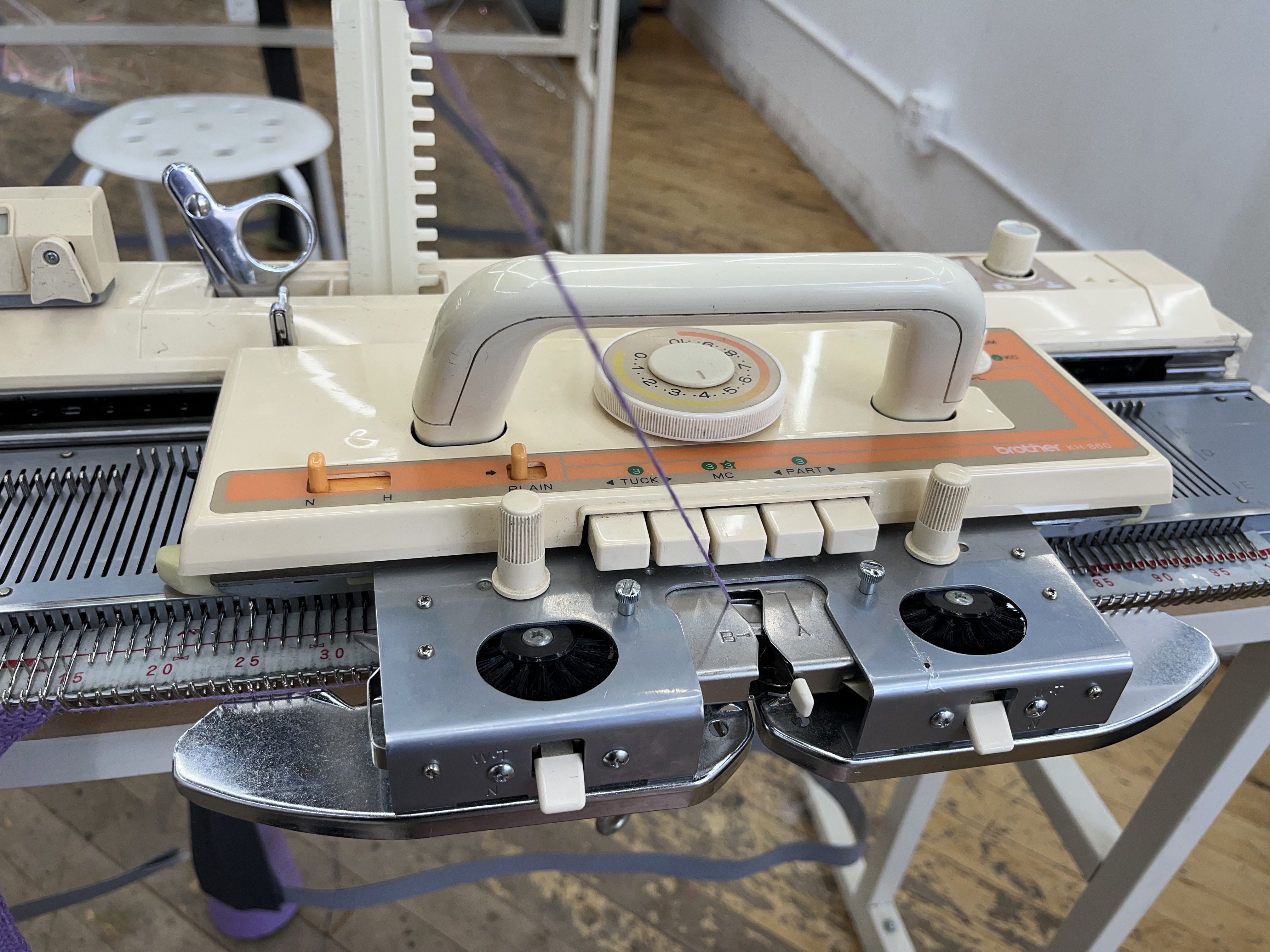
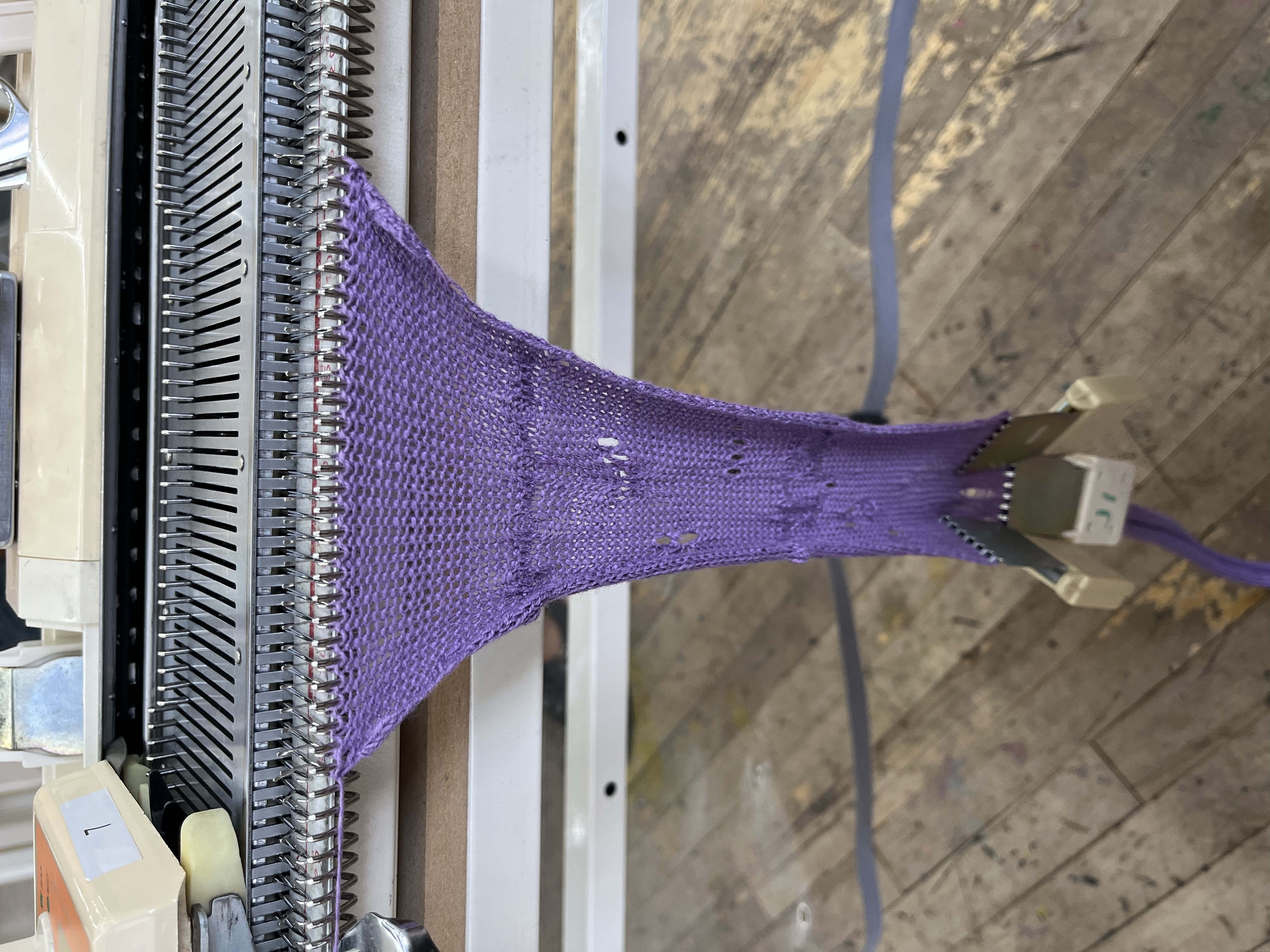
There are so many techniques to learn (and practice!) when learning to
machine knit. I thought it would be fun to solicit some smaller projects,
so I “opened” “commissions” by asking some friends if they had any small
project ideas after showing them a successful hat.
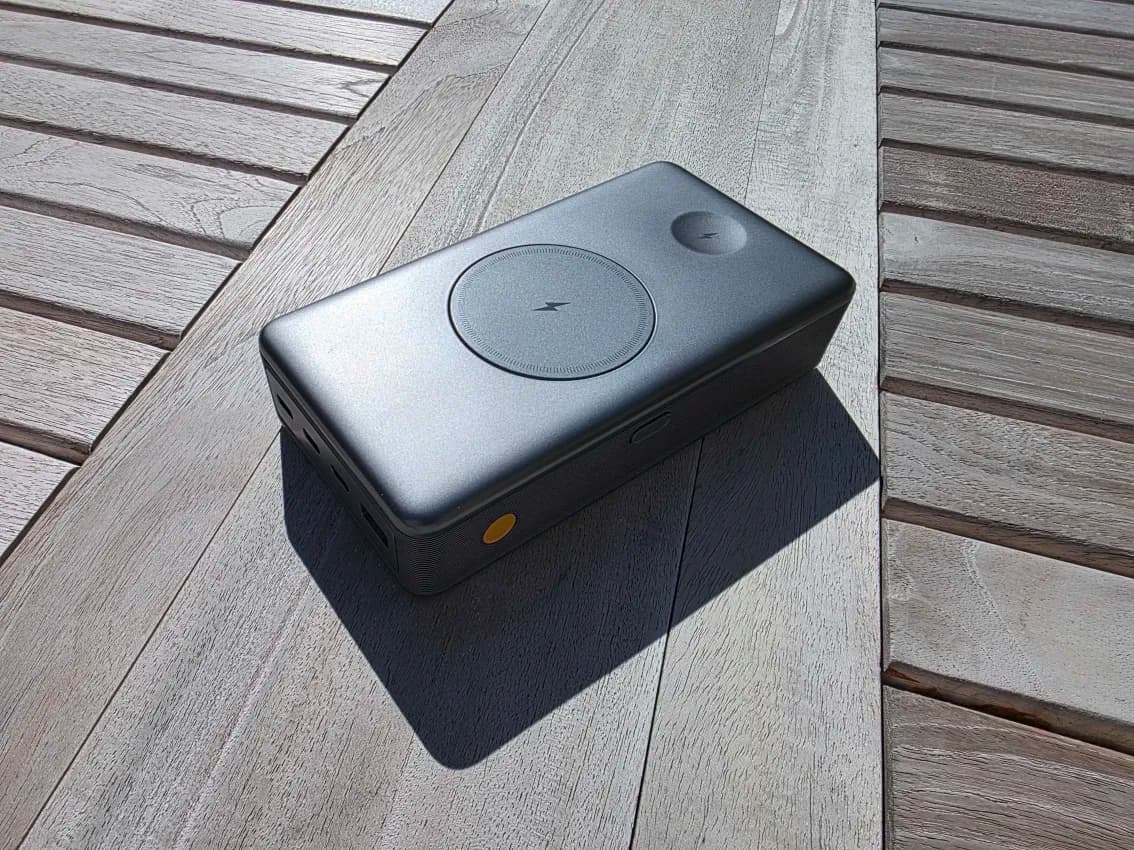
By buddy Chris took me up on it! He has a large power brick that he found
was getting scratched up in his luggage and asked if I could make a cover
for it.
This sounded like a totally doable project, so I decided to take it
extremely seriously.
I asked Chris to send me some measurements and a reference photo.
Now that's a reference photo!
I used the measurements and photos to 3D print a test-dummy brick.
Time-lapse video of a Bambu Labs printer making a purple plastic brick.
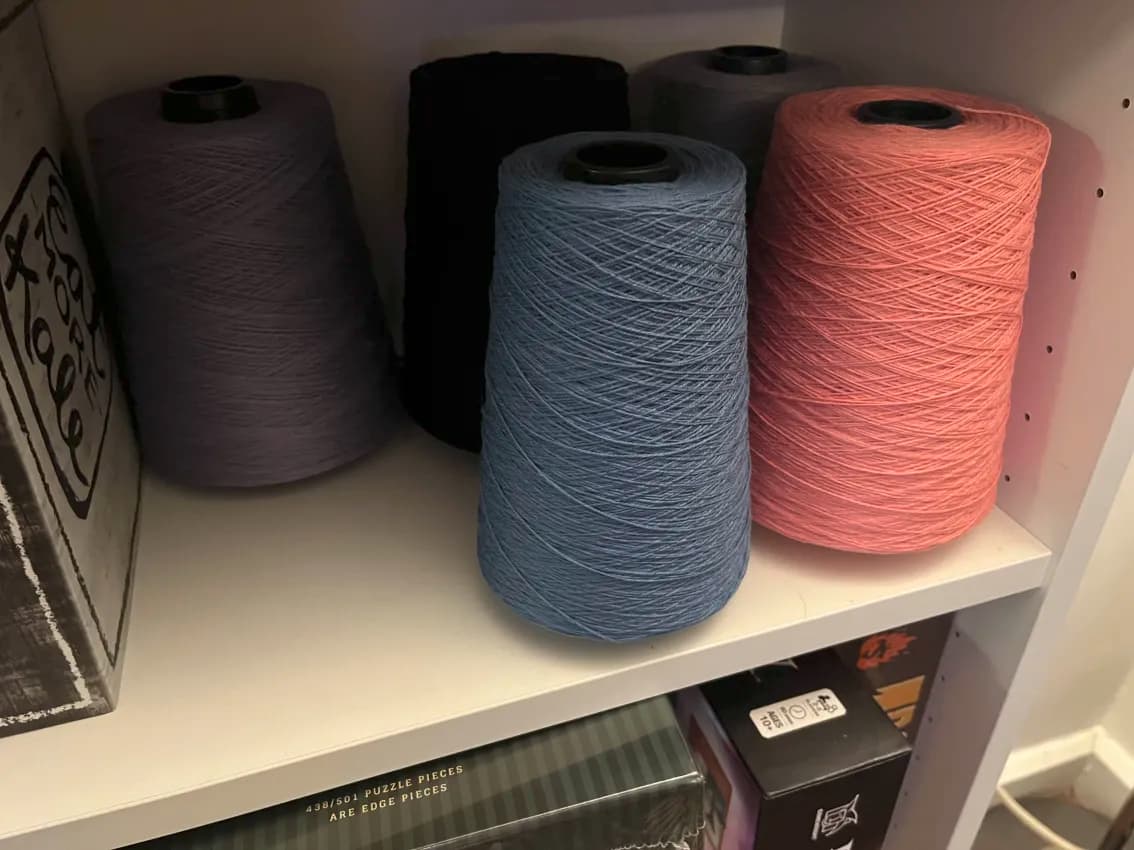
I offered up some terrible photos of my yarn stash to pick colors, and some
patterning options to cover the bag.
I used these selections to make a gauge swatch at a few different yarn tensions.
Always make a guage swatch!
With the gauge chosen, I measured out the number of stitches and rows per inch.
Then it was time to write up a pattern.
"Good enuff?" We'll see!
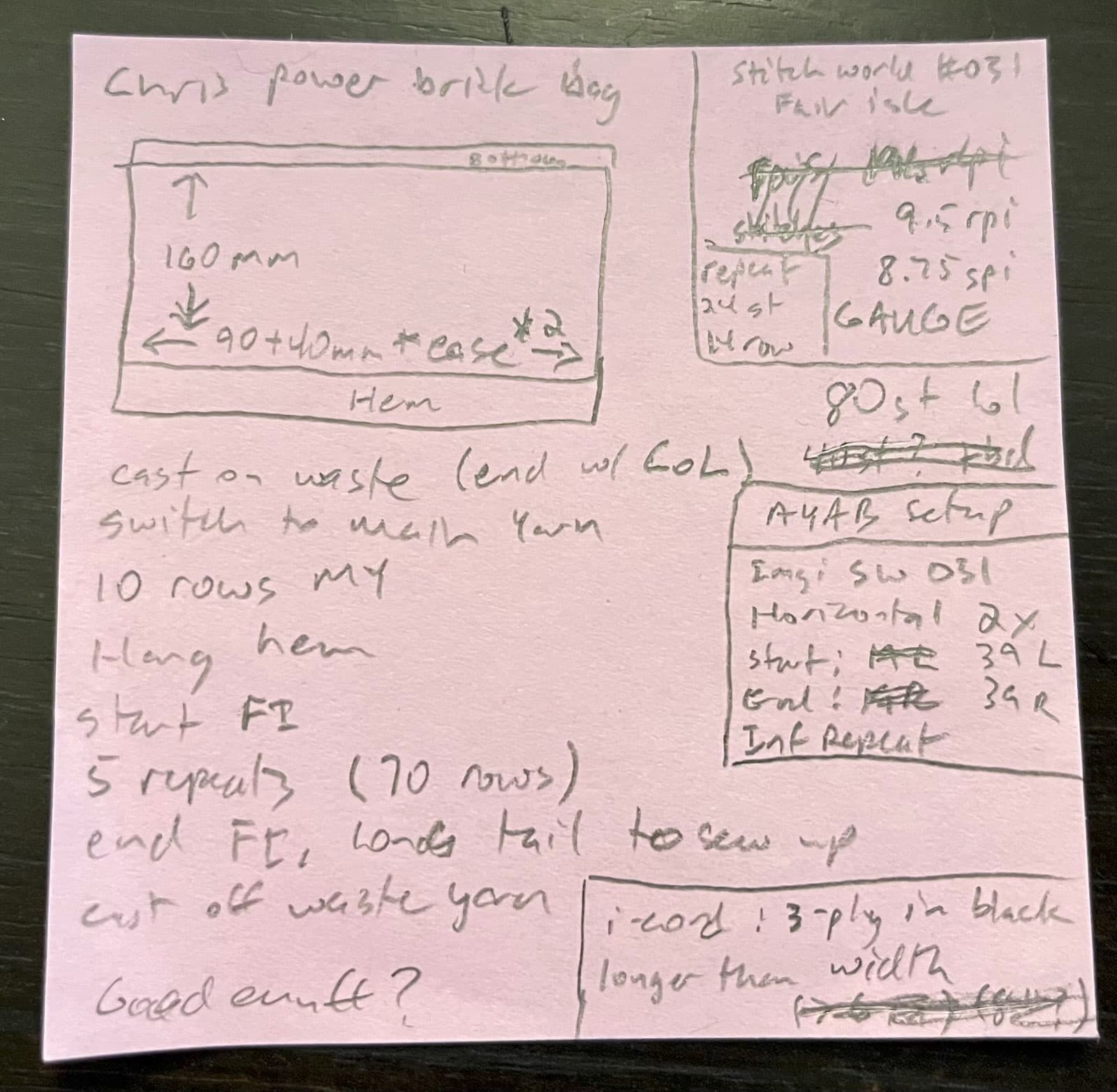
This bag is knit as a rectangle from the top down.
Start by casting on enough stitches to go around the two short sides (actually,
a little less, since we want it to be snug).
A half-inch hem is made by starting with an inch of knitting, then folding it
over and re-hanging the initial stitches to form a tube. A cord will go
through this hem to let us pull the bag closed.
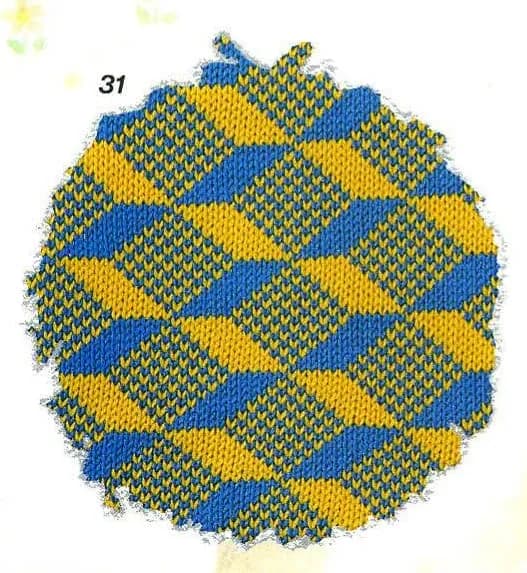
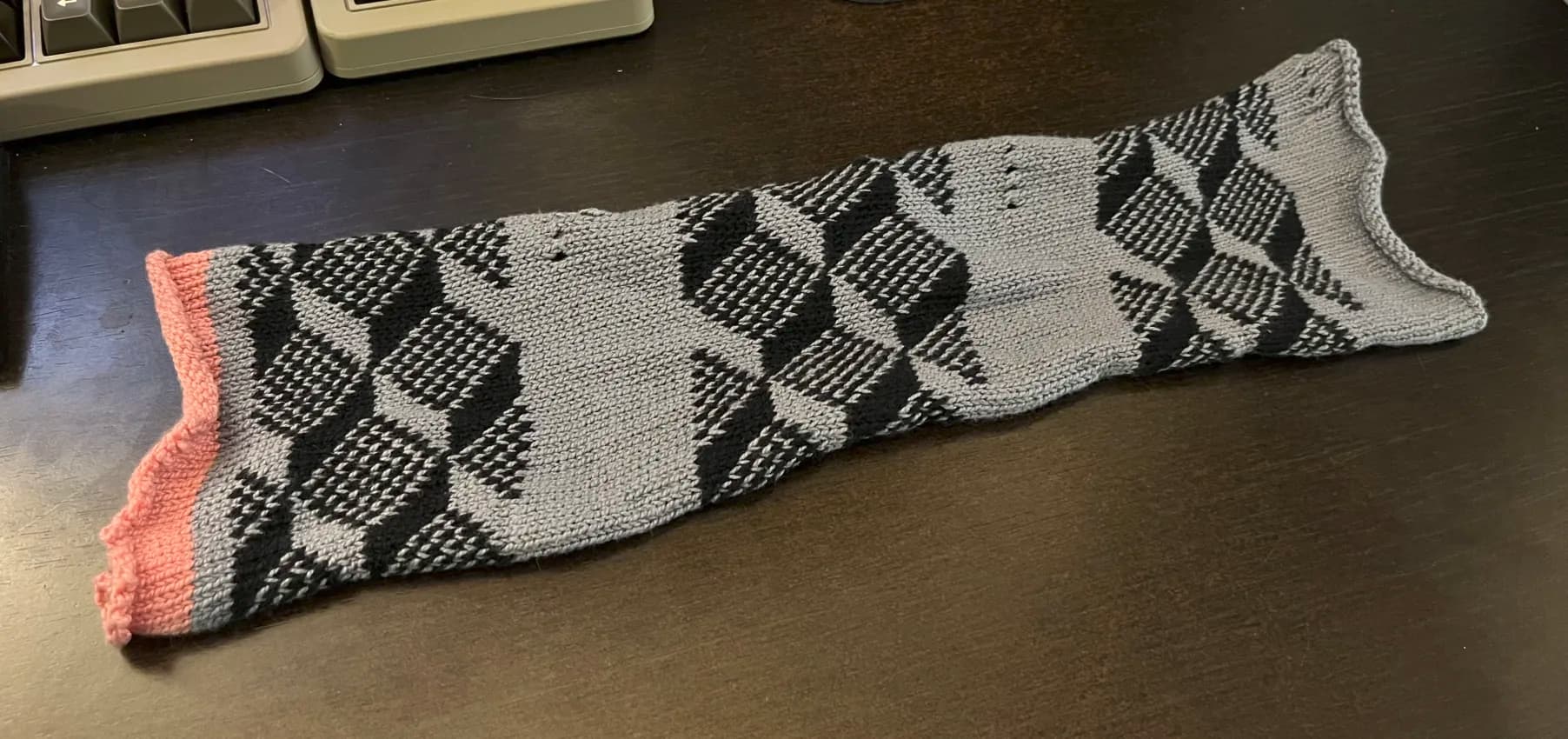
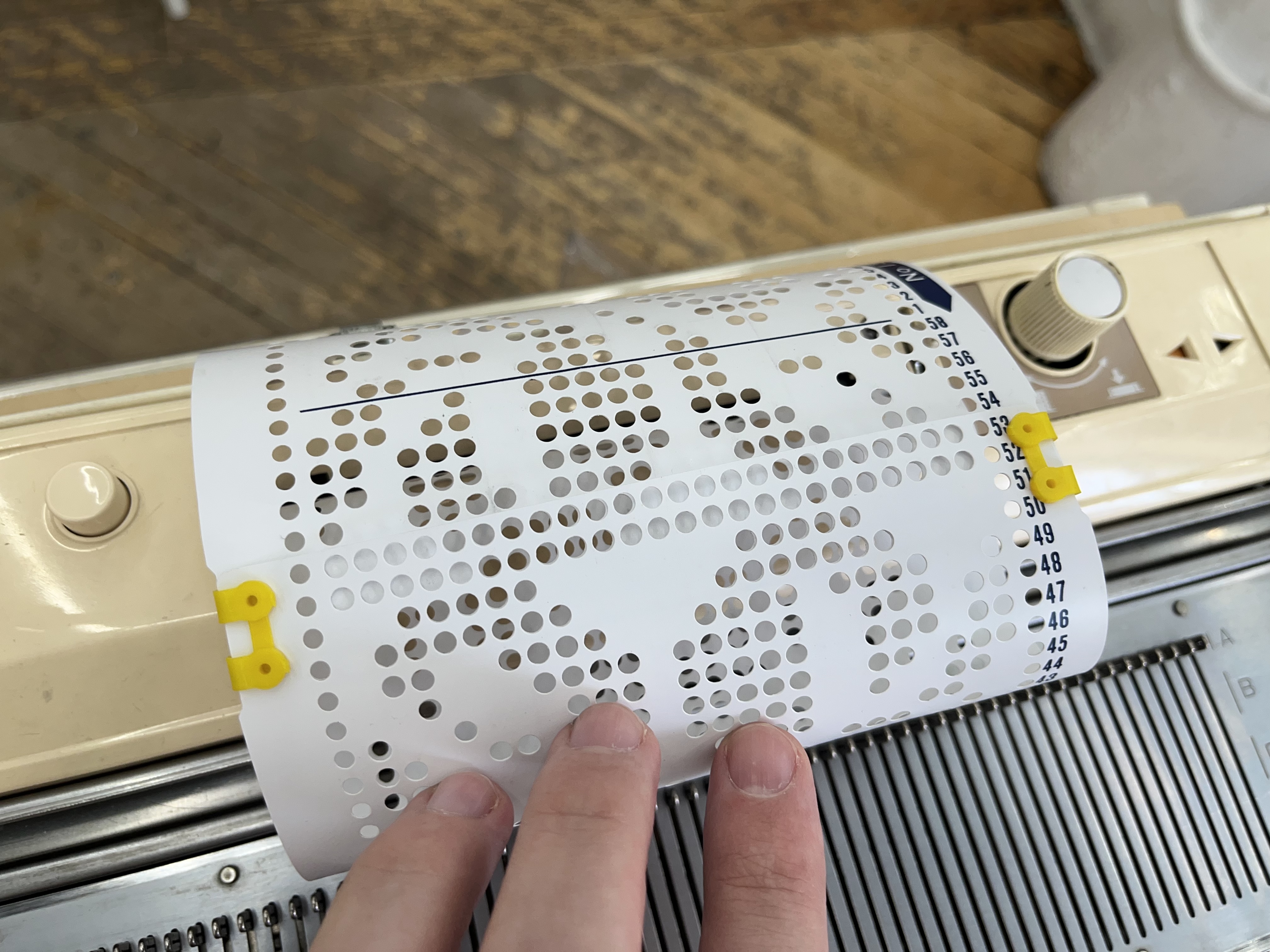
The main body of the bag is then knitted in two colors using Fair Isle
pattern number 031 from Brother’s Stitch World. It’s as long as the long side
of the brick, plus a little extra for the bottom, which will be stitched shut.
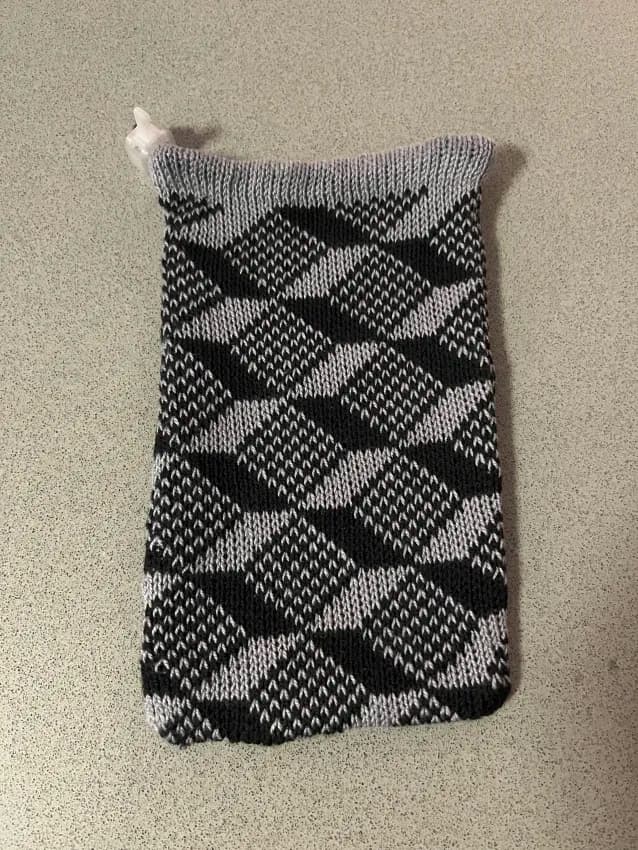
The bag is formed by sewing up the rectangle on two sides. I found this a little
tricky on the bottom, as I had the pattern go all the way to the edge, so it’s
a little lumpy!
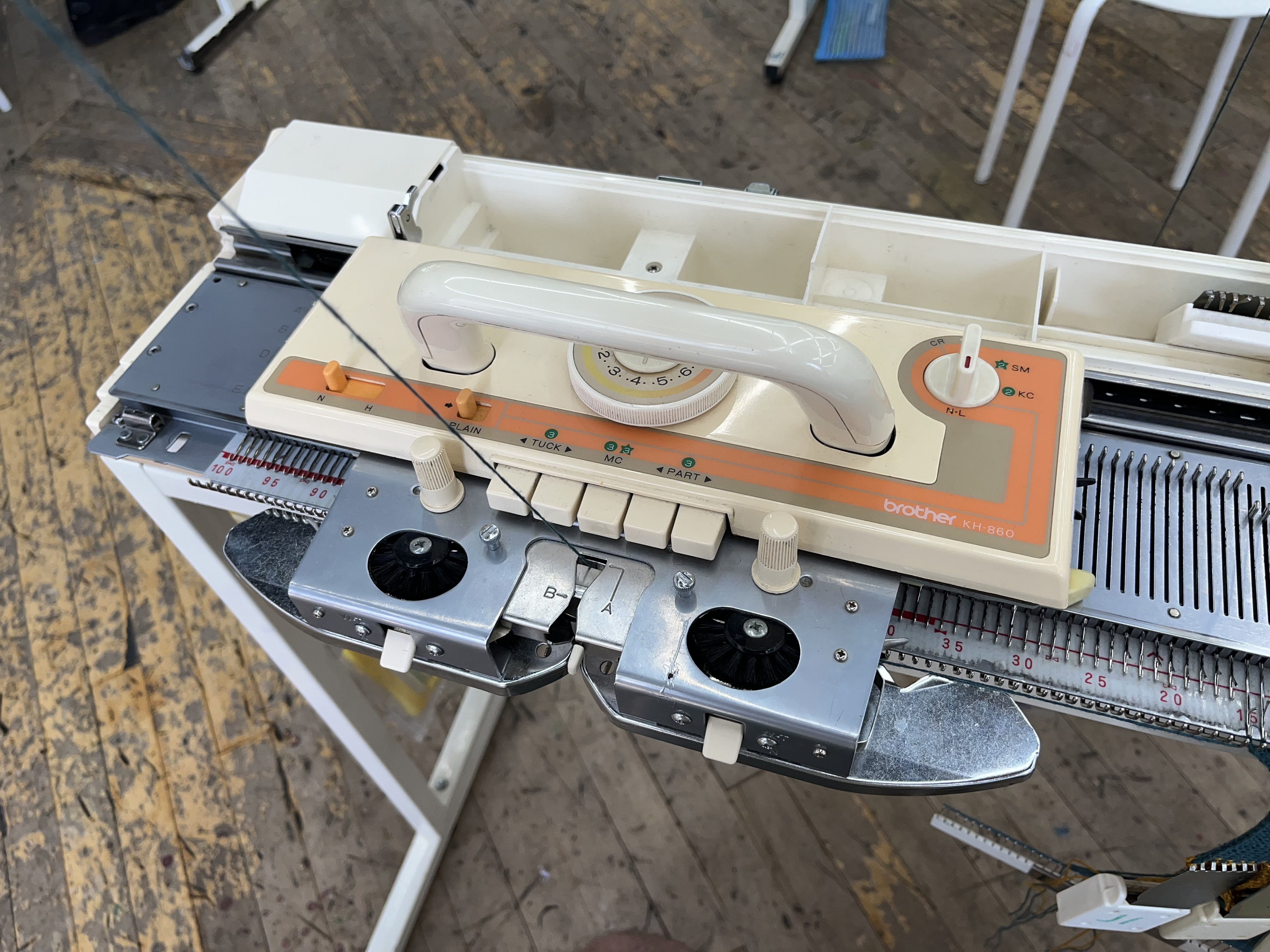
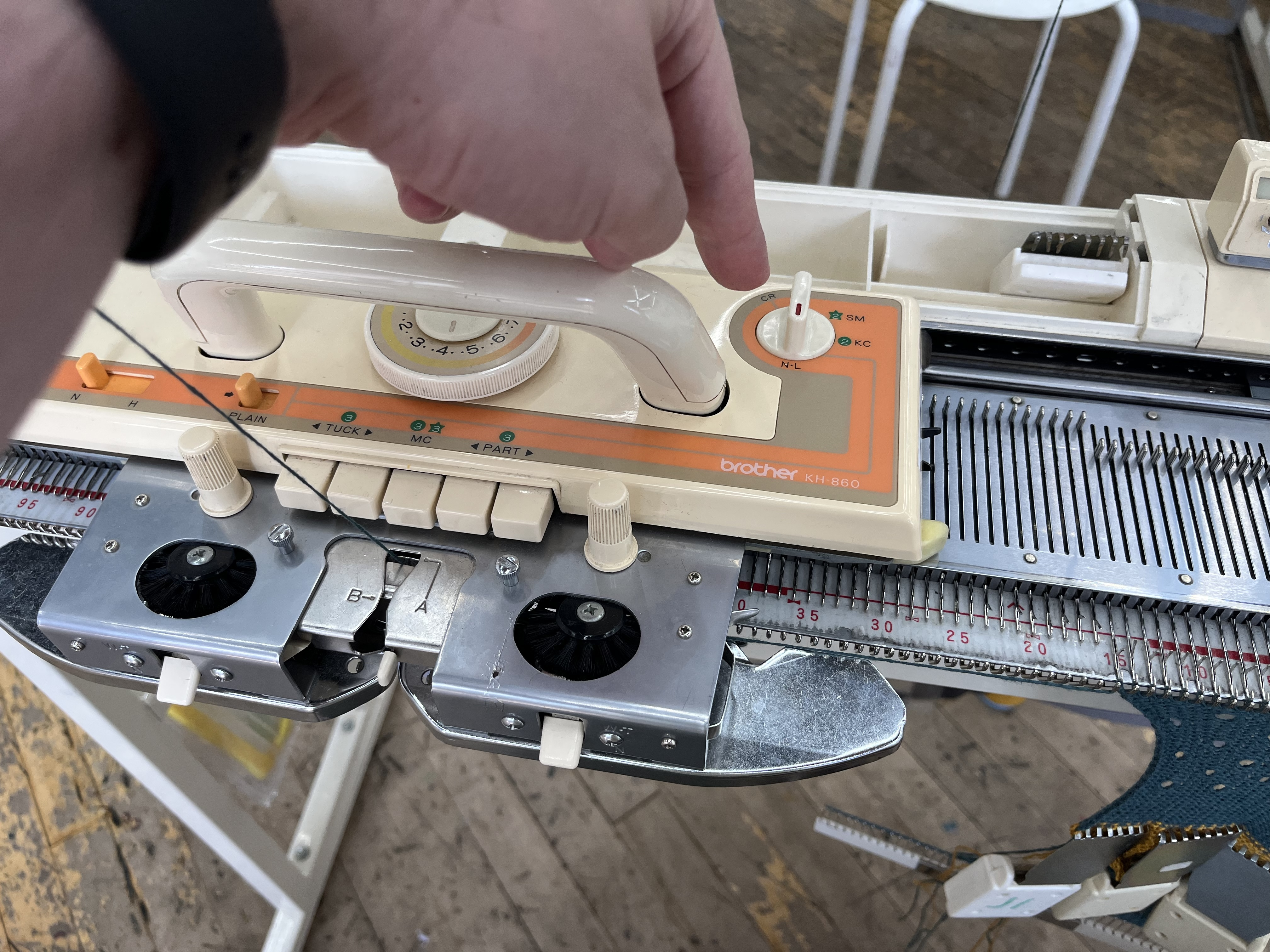
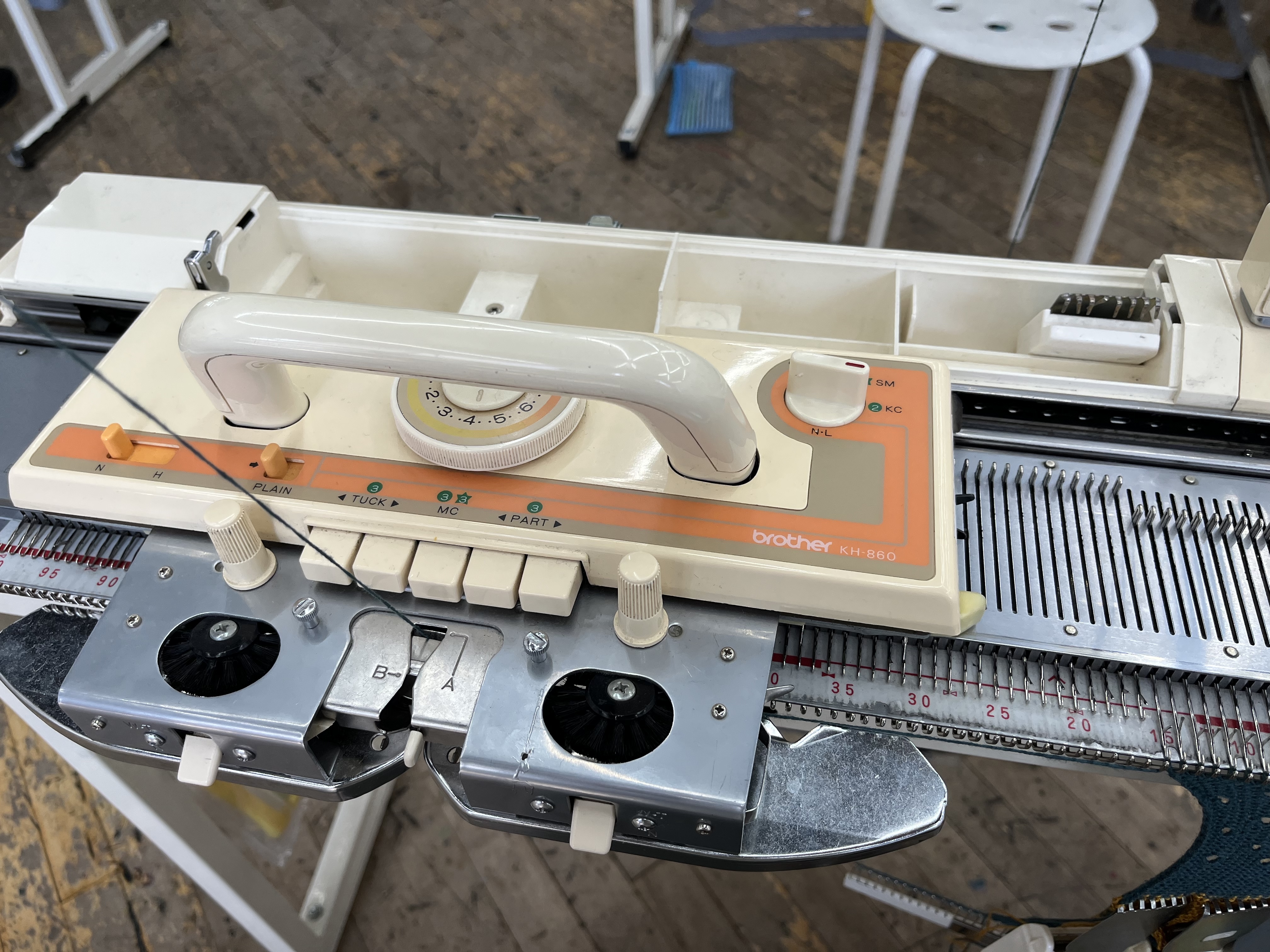
The cord for the bag is knit on the machine by casting on 3 stitches, setting
the carriage to tuck in one direction, then knitting a bunch of rows until it
seemed long enough.
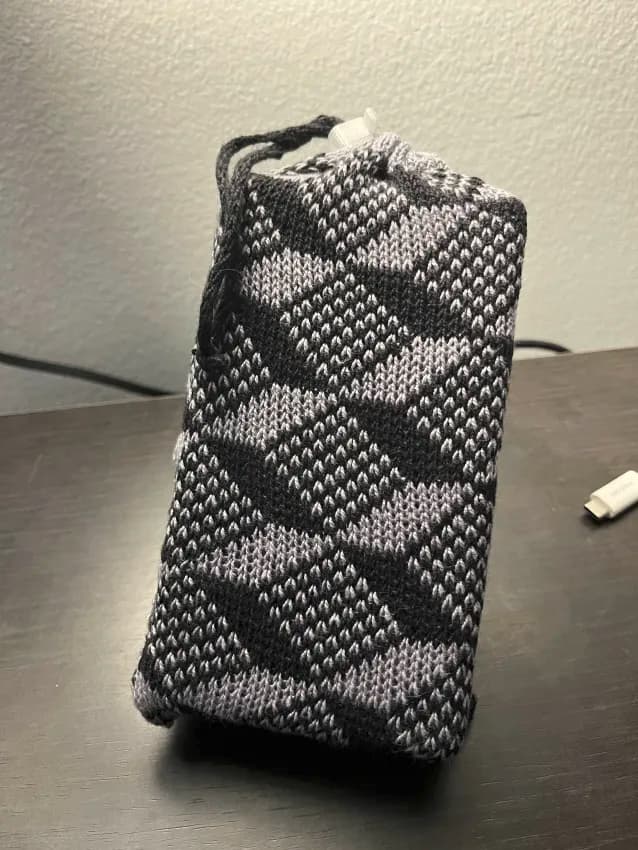
I added a 3D printed lace lock to hold the cord in place when the bag is pulled tight.
Click through to see the full-sized photos.Video demonstration of sliding the test brick into the bag and cinching it up.
I did a bit of a knit-finishing crime, here. Specifically, I had washed my guage
swatches before measuring them, but I did not wash the finished bag. By the
time I had sewn it up and added the cord I was ready to be done with the project.
So, the final bag is slightly larger than intended, unless and until it gets
washed or steamed to let the fibers relax and shrink up.
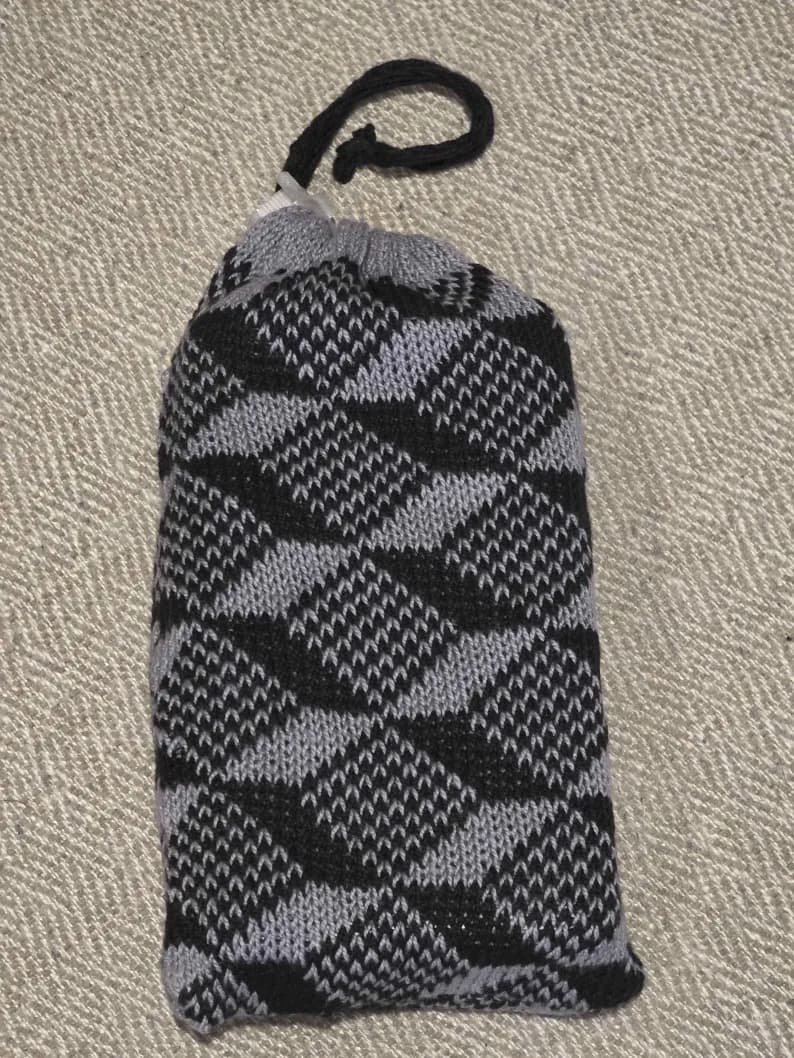
But, whatever, it’s a finished object! I sent it to Chris, who sent back this
photo!
This photo was sent to me with the caption "Great success!"
It was super fun to go over the top on this project. While it might feel like
a “simple” one, it gave me good practice thinking about each step and not
cutting corners. Well, not cutting corners until I decided not to wash and block
the finished bag!
Many thanks to Chris for humoring me on this project, sending encouragement
as I overshared process photos and video, and giving me permission to share this
project on my site!
My knitting commissions are closed at the moment, as I have a good number of
things I want to work on. Stay tuned in case they open up again, though. 😉
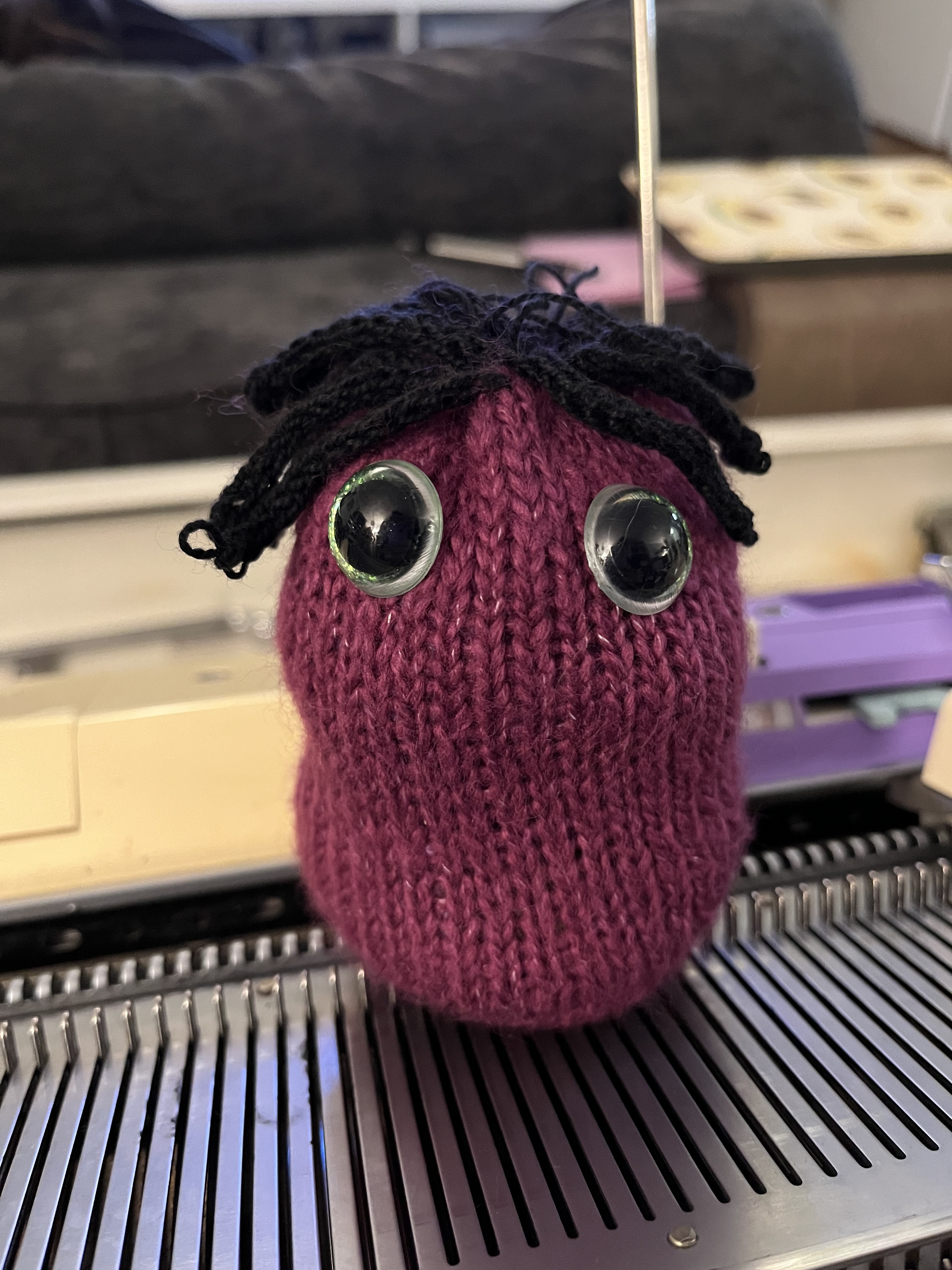
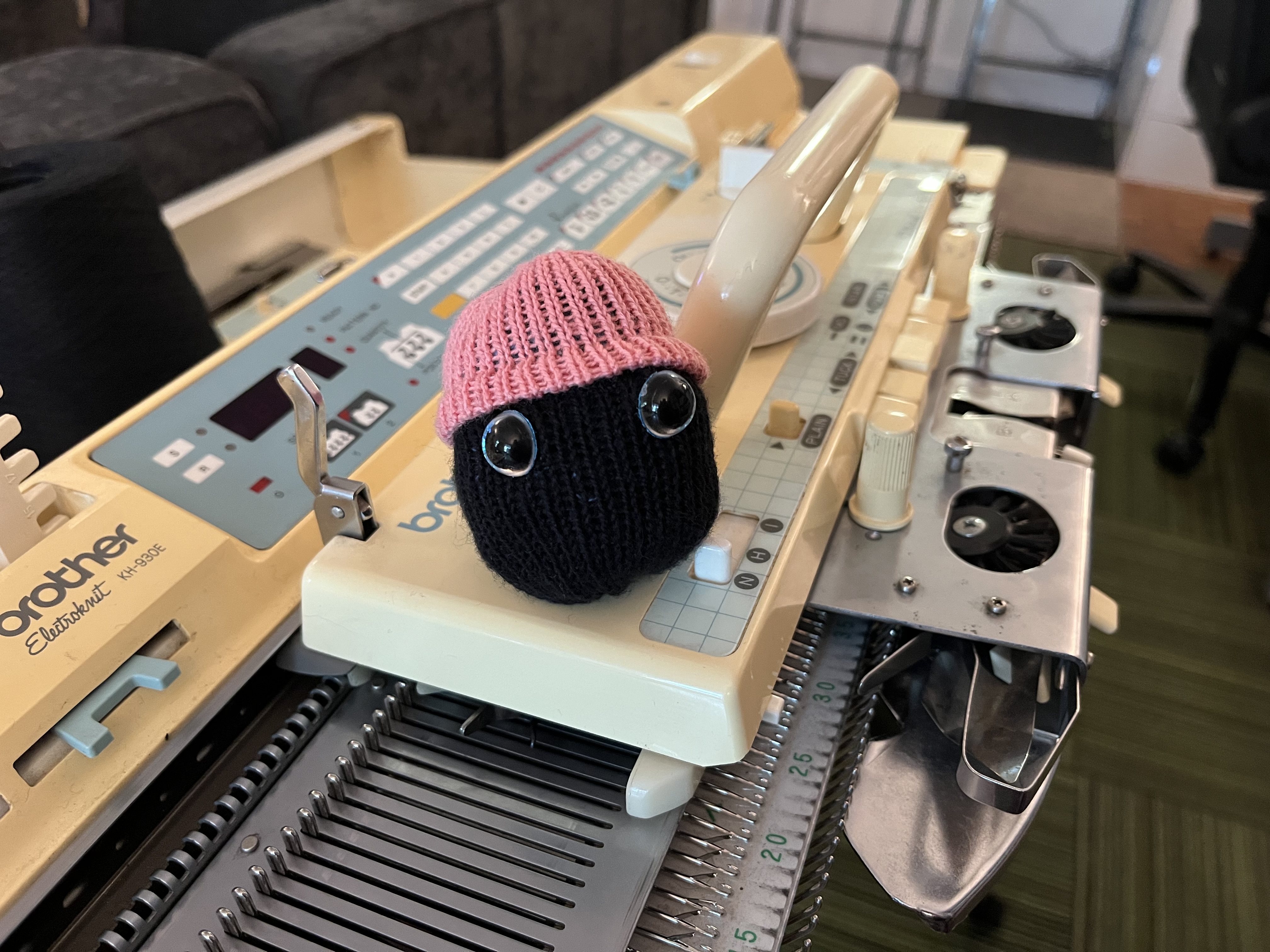
Today was a good day, I think, for making a little guy.
I started with the base pattern from Machine Knitting Monthly Oct 2025,
intending to make the little guy without the hat. Instead of subtracting the
rows for the folded brim in the pattern, I left them in, so he became extra looooong.
I ended up stuffing some of the body rows inside during the sewing-up process,
but he’s still kind of a tall bean.
Instead of the hat, I made a little mop of i-cord hair, inspired by
KnitMachineImpl’s “Megan Donner hat” video.
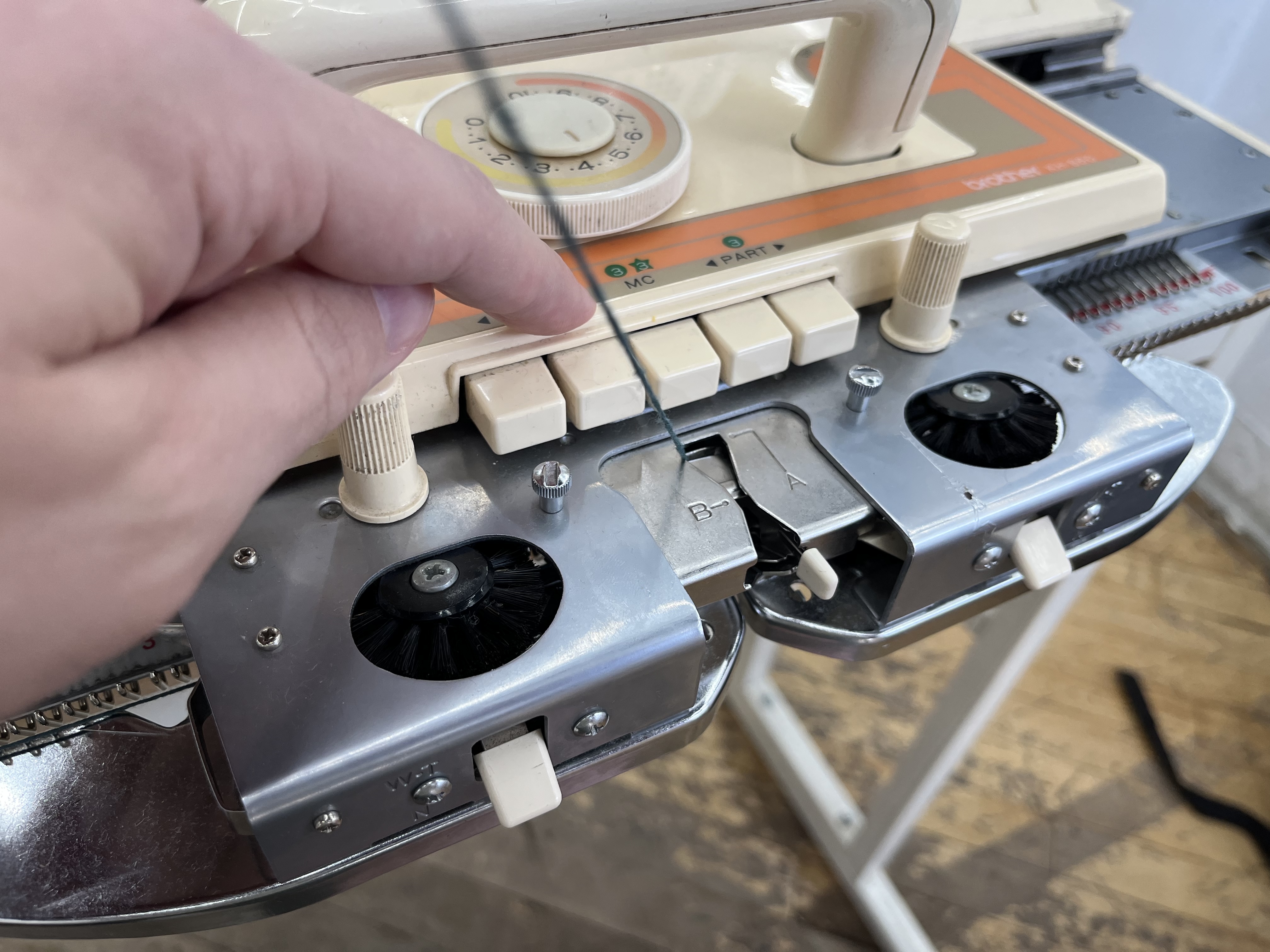
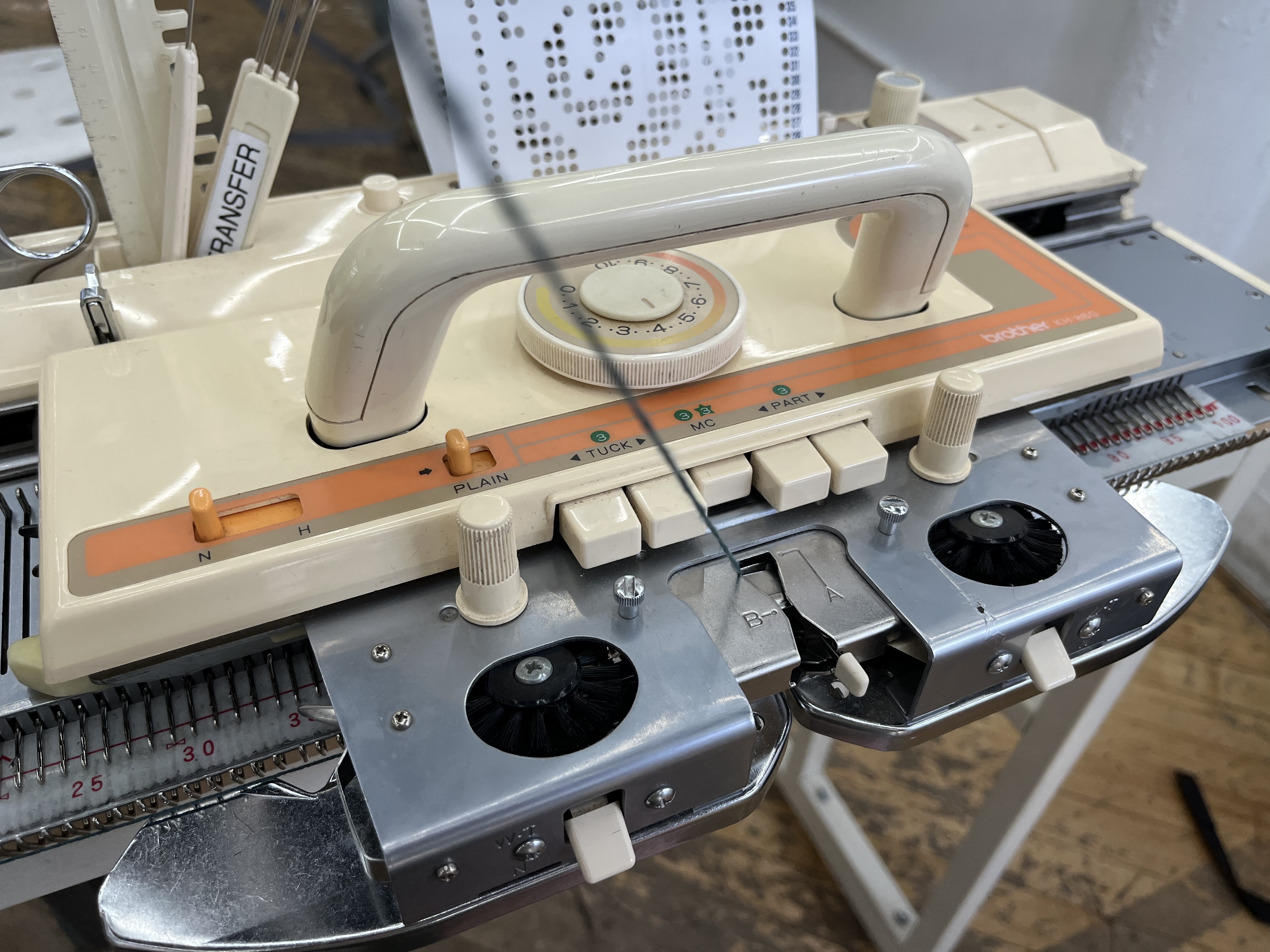
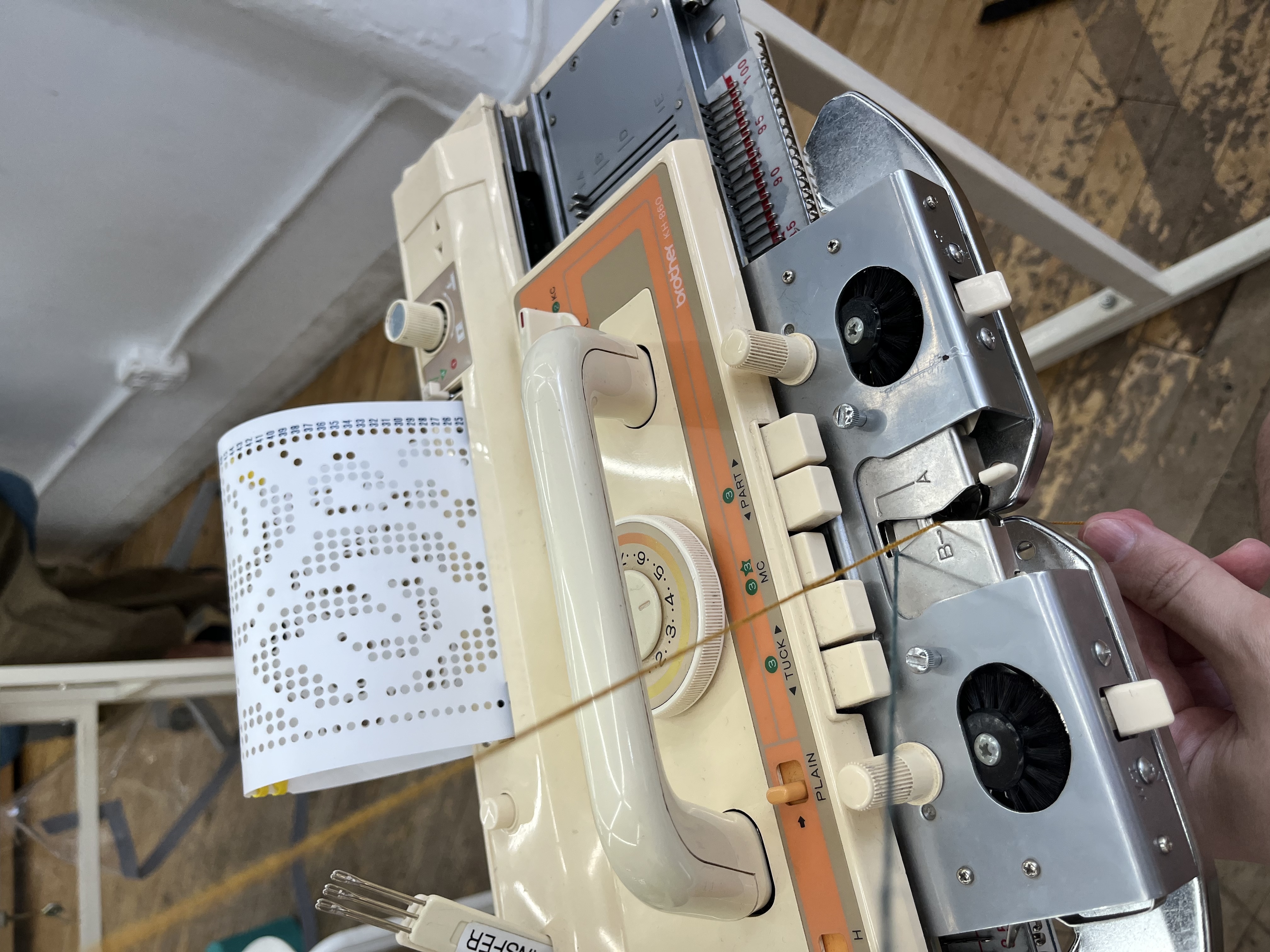
As mentioned in my first-hat and forbidden socks posts my Brother KH-930e knitting machine was unable to knit two-color Fair Isle patterning due to two cam buttons being stuck together.
I didn't really know where to start with figuring this out. I remember doing some semi-fruitless web searching, before finally deciding to learn how to disassemble the carriage enough to look at it and see if I could find something obvious.
I started by hunting down the service manual PDF for my machine and following the instructions there. Those instructions and diagrams helped me get the handle and the cover off, as well as most of the way to removing the cartridge-like structure that mounts the cam control buttons. I was scared off by the "remove these springs" steps, as I did not see a way to remove the small springs without bending them.
At the end of this process I was able to determine that the buttons themselves were not stuck together. It was the plates that each of these buttons controls. If I wanted to get inside to see what was going on, I would definitely have needed to get those springs out, and plan for some messier and more fiddly work.
Disappointed and anxious, I reassembled the carriage. Thankfully, it still worked, though still without Fair Isle support. Between the mess of old oil and grease, and my anxiety about getting the carriage apart and together again, I didn't even take photos of this part of the process.
That's when I found the videos that would have saved me all the trouble!
This Cleaning Brother Carriages from theanswerladyknits on YouTube has so much information about Brother (and other) knitting machines, in-depth disassembly and cleaning videos, lists of what to buy, and even explanations about common issues like the exact button-sticking problem I was facing. I cannot stress enough how relieving and exciting it was to find these videos.
I went a little overboard and bought their whole deep-clean-and-restore shopping list, which ended up being a little over $100 worth of oils and solvents and lubes and oil-soaking rags. I only planned to use 2 or 3 of these, in order to unstick the button cams, but wanted the other stuff on hand in case I needed to go further.
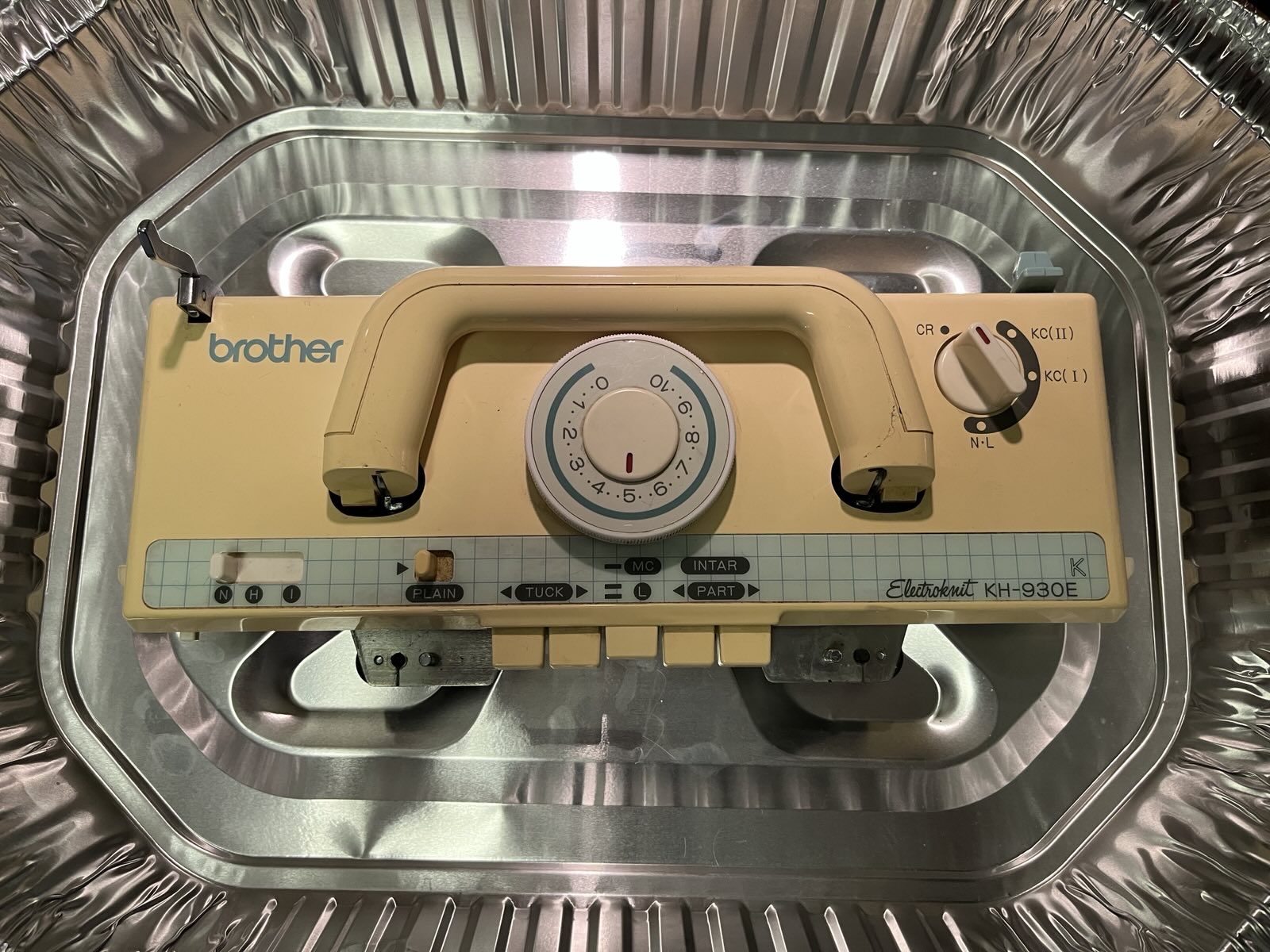
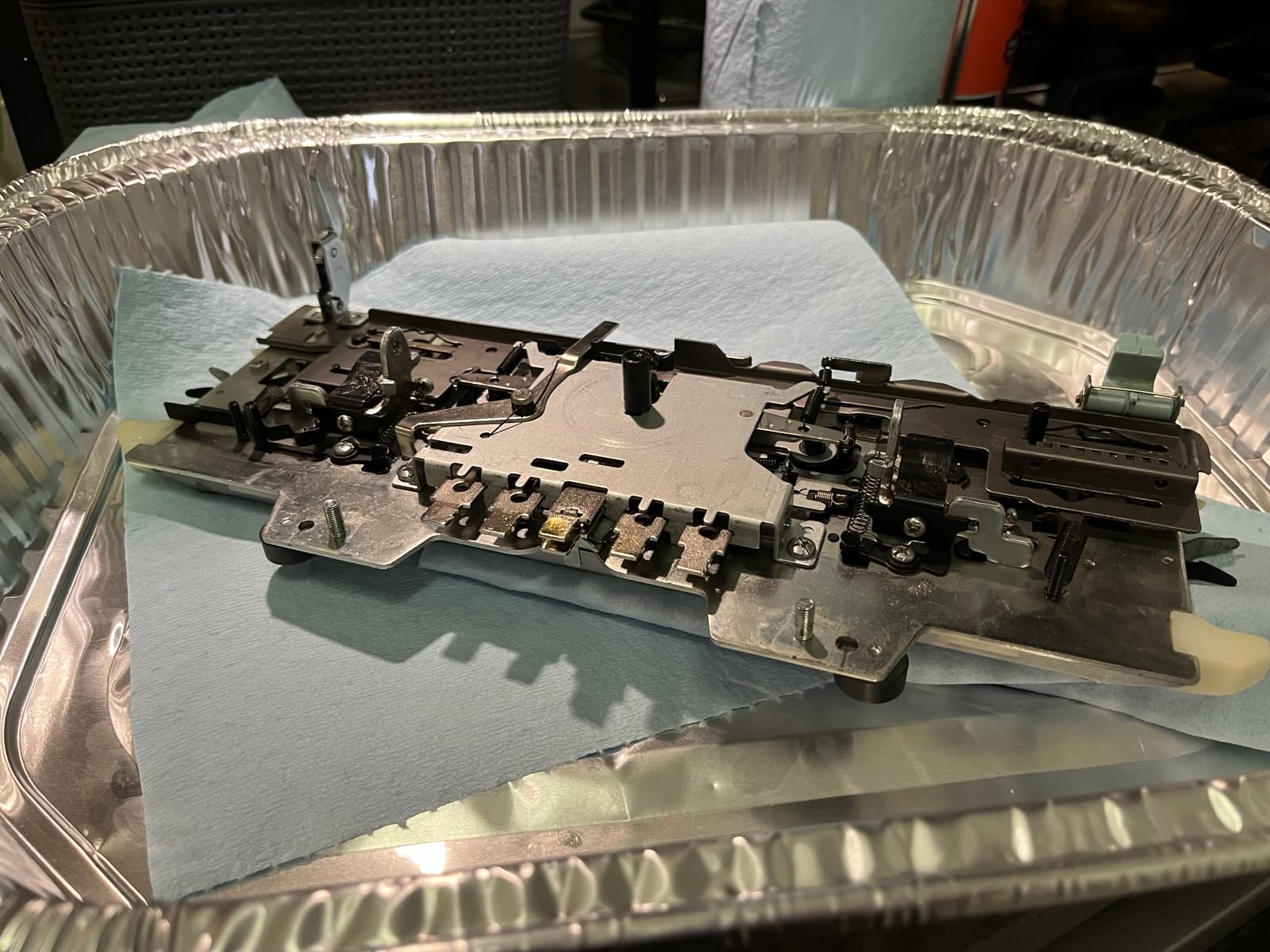
Once I had all the fluids, I picked up an aluminum turkey pan as a portable work tray. This served to keep all the oil and gunk away from the surfaces in our small apartment, let me spray next to a window for better ventilation, and store it out of the way as I let things soak.
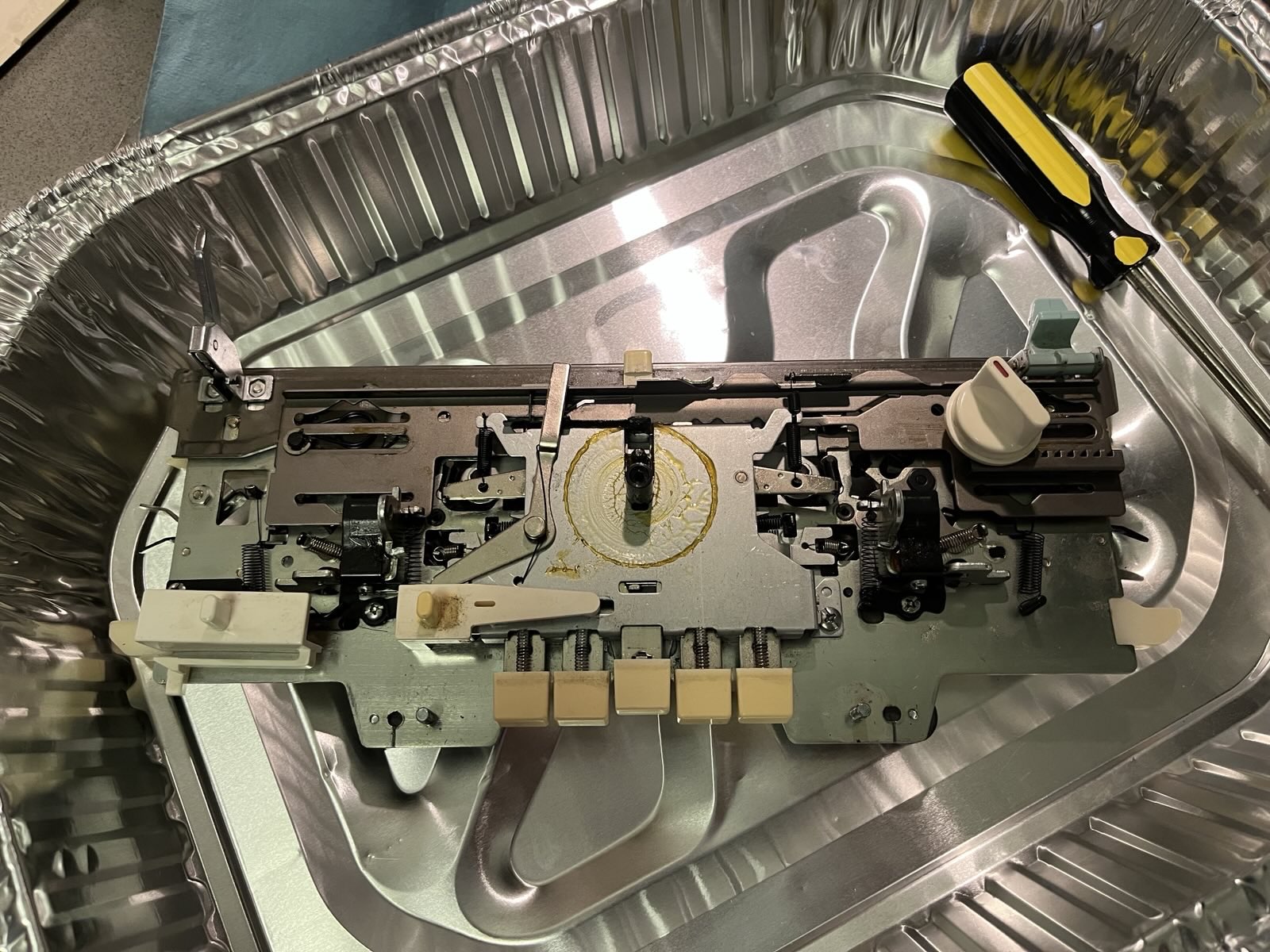
Brother KH-930e carriage in a turkey pan. Let's... cook?Metal internals of the carriage with the top handle, tension dial, and plastic cover removed. Yellow-orange grease is visible around the tension dial.
Our carriage was pretty clean, overall, but with old yellow-orange grease pretty visible. According to the videos on theanswerladyknits channel, this is old lithium grease, likely from when the carriage was first assembled. That suggests our machine had not seen much use since its early days.
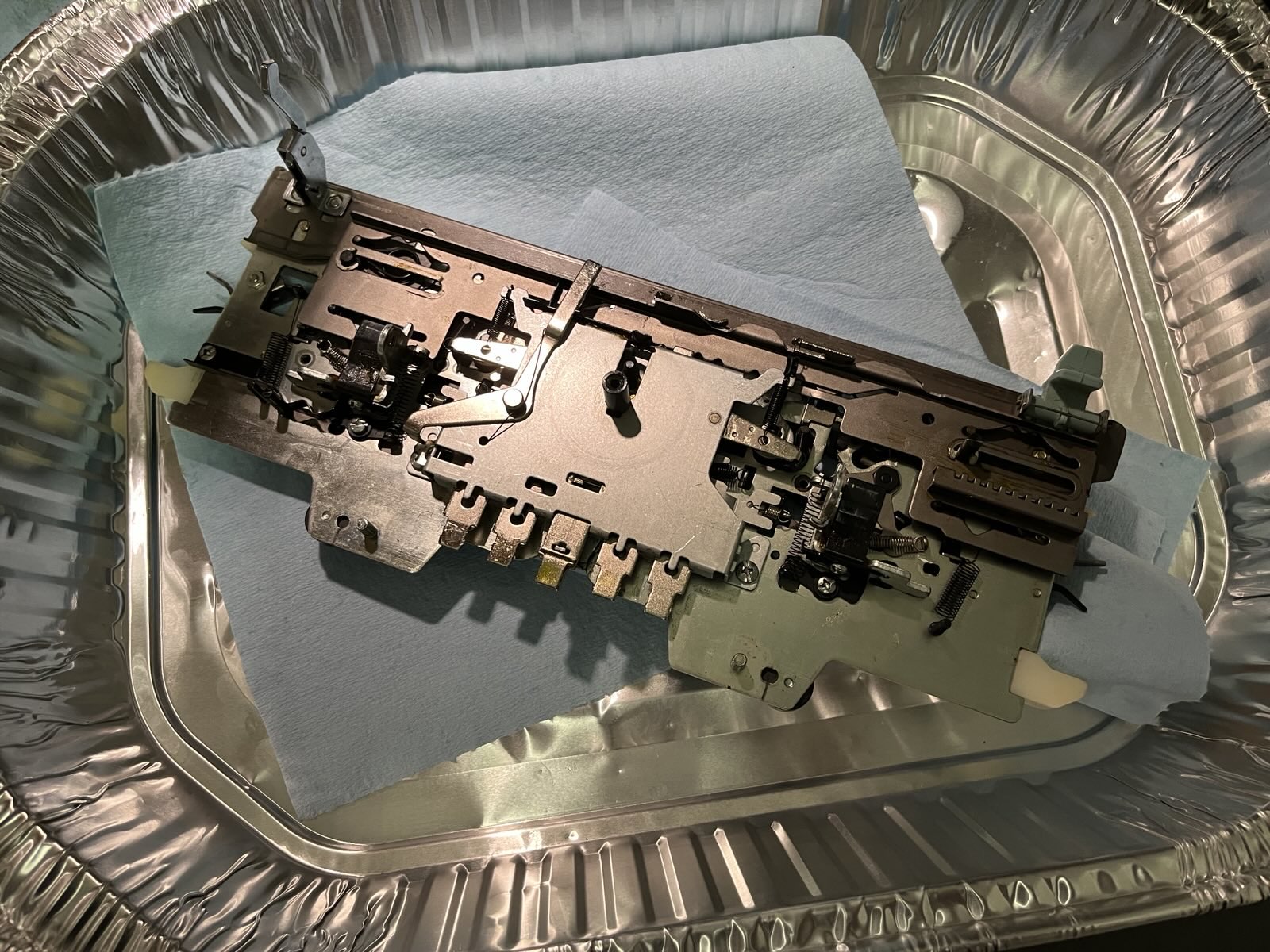
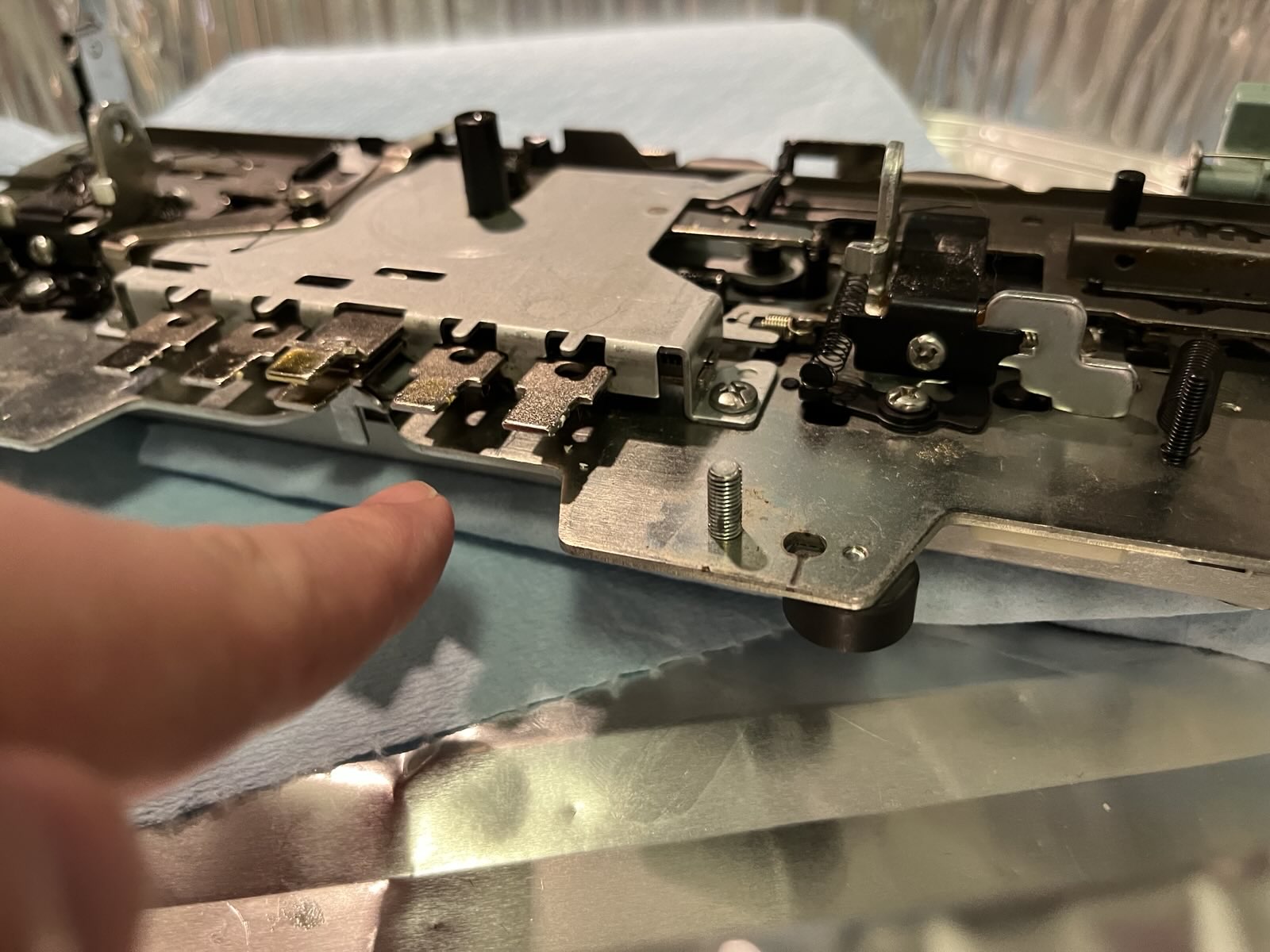
Carriage resting on blue shop towels with white plastic dial and button covers removed. Visible grease has been wiped away.Angled view to better show the cam button assembly. There are 6 metal tangs. Two pairs on either end are side-by-side, while the middle pair are stacked vertically.A finger indicates the space between the cam cartridge and the carriage bottom, where oil will be applied.
I removed the plastic parts for the buttons and knobs for hand-cleaning and wiped away the visible globs of grease that I could see, then sprayed "aero kroil" into the cam button assembly, especially focusing on the bottom area where the "tuck" "multicolor" cam plates need to slide past one another. Within minutes, the kroil had done its work and I was able to slide the two plates independently, hooray!
I let the kroil work overnight. As theanswerlady's husband "Ask Jack" tells it, kroil a "creeping oil" that works its way over and between metal parts, freeing them up, then also works its way out. However, he also says that we don't want to leave any hydrocarbon oils inside the machine.
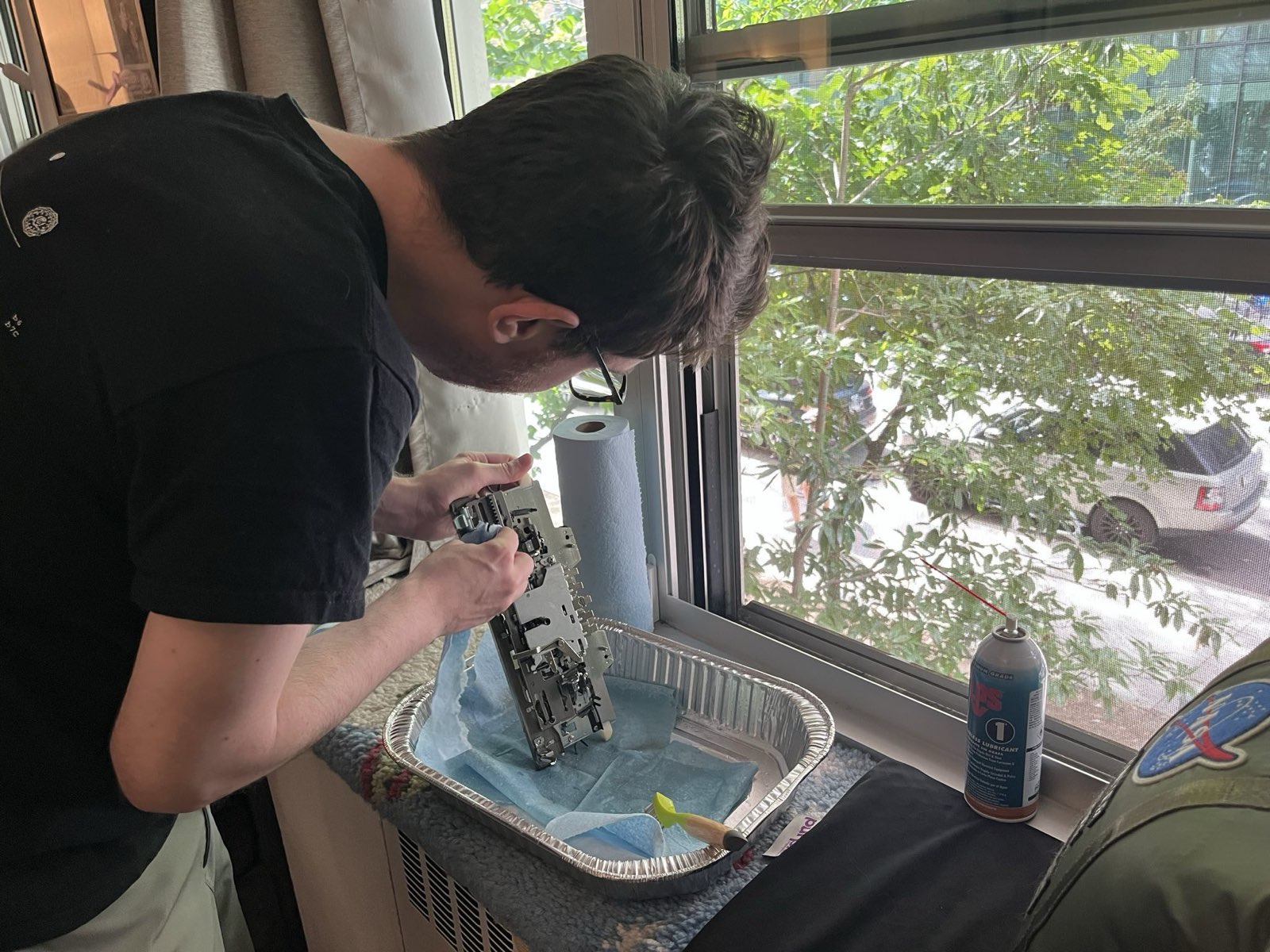
So the next day, it was time to chase out all the kroil, and as much of the old lithium grease and any other "crud" it had freed up. I used a can of LPS-1 to spray into and through all the nooks and crannies of the carriage that I could get to, using a stiff brush and blue towels to try and "mop out" all the gunk I could reach.
Me holding the carriage as I mop out some gunk with a blue towel. My turkey-pan work station is on a window sill by an open window. Blue towels soaked in oil and silicone lubricant line the pan. A small brush, roll of blue shop towels, and spray can of LPS 1 are visible.
After the scrubbing I propped up the carriage for an hour or so to let the LPS 1 drip out before flipping it over to let it drip some more. I bagged and tossed the soaked shop towels and used some fresh ones to lightly blot away obvious pools and drips as I re-assembled the carriage.
Before testing things out, I sprayed the underside of the carriage, as well as the machine's needle bed, with "ask Jack"'s recommended "LPS FG" food-grade dry silicone lube, and gave everything a good wipe down.
After a couple of false starts I got things going and everything moved much more smoothly than before. I set up some waste cotton yarn across all 200 needles and knit a long swatch at varying tensions, working the mechanisms and soaking up any excess lube and junk that might come out.
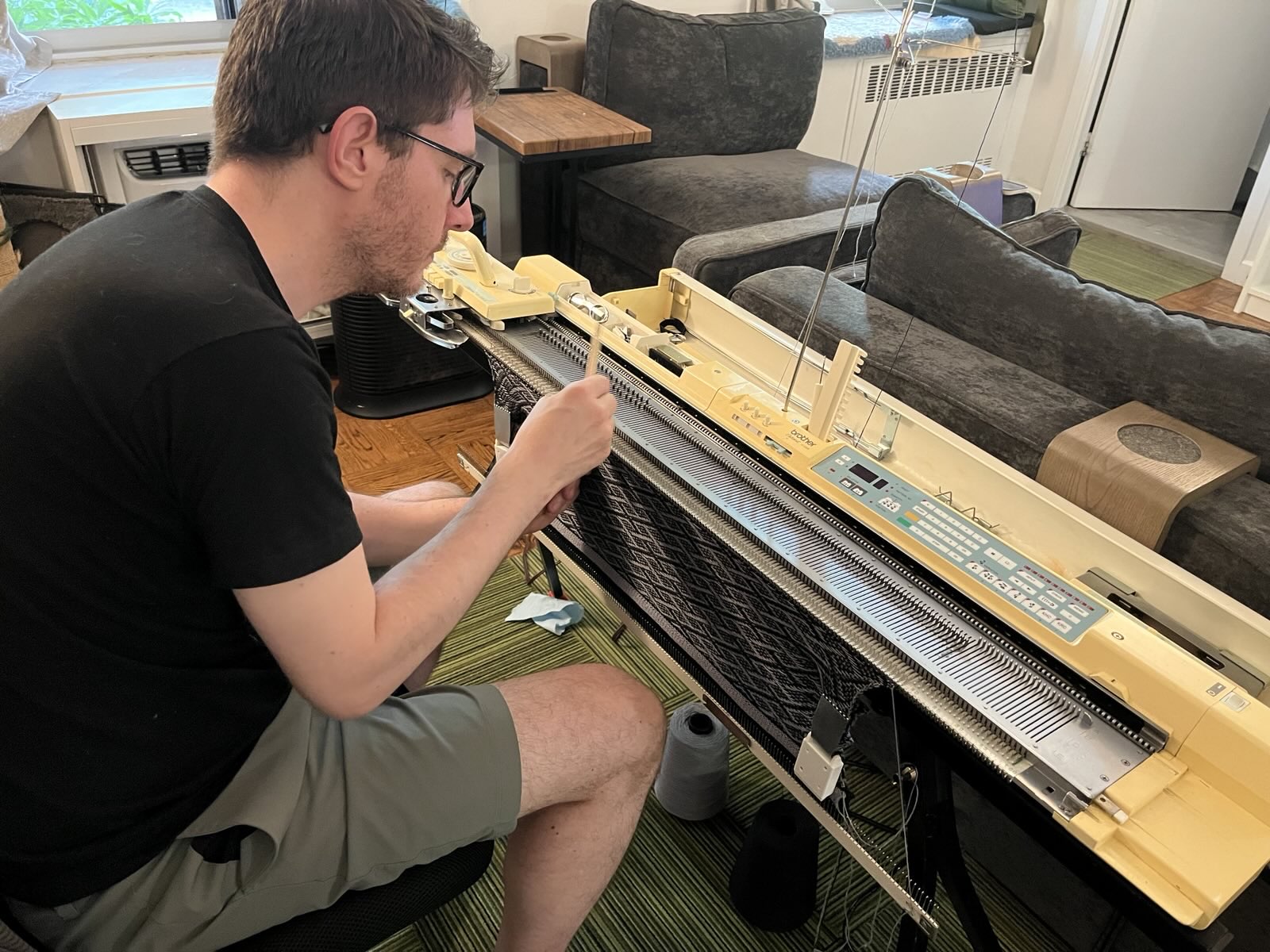
Finally, I pulled out the hat pattern I had worked out for Producer Amy a couple of weeks before, knit the hem, and engaged two-color Fair Isle pattern knitting...
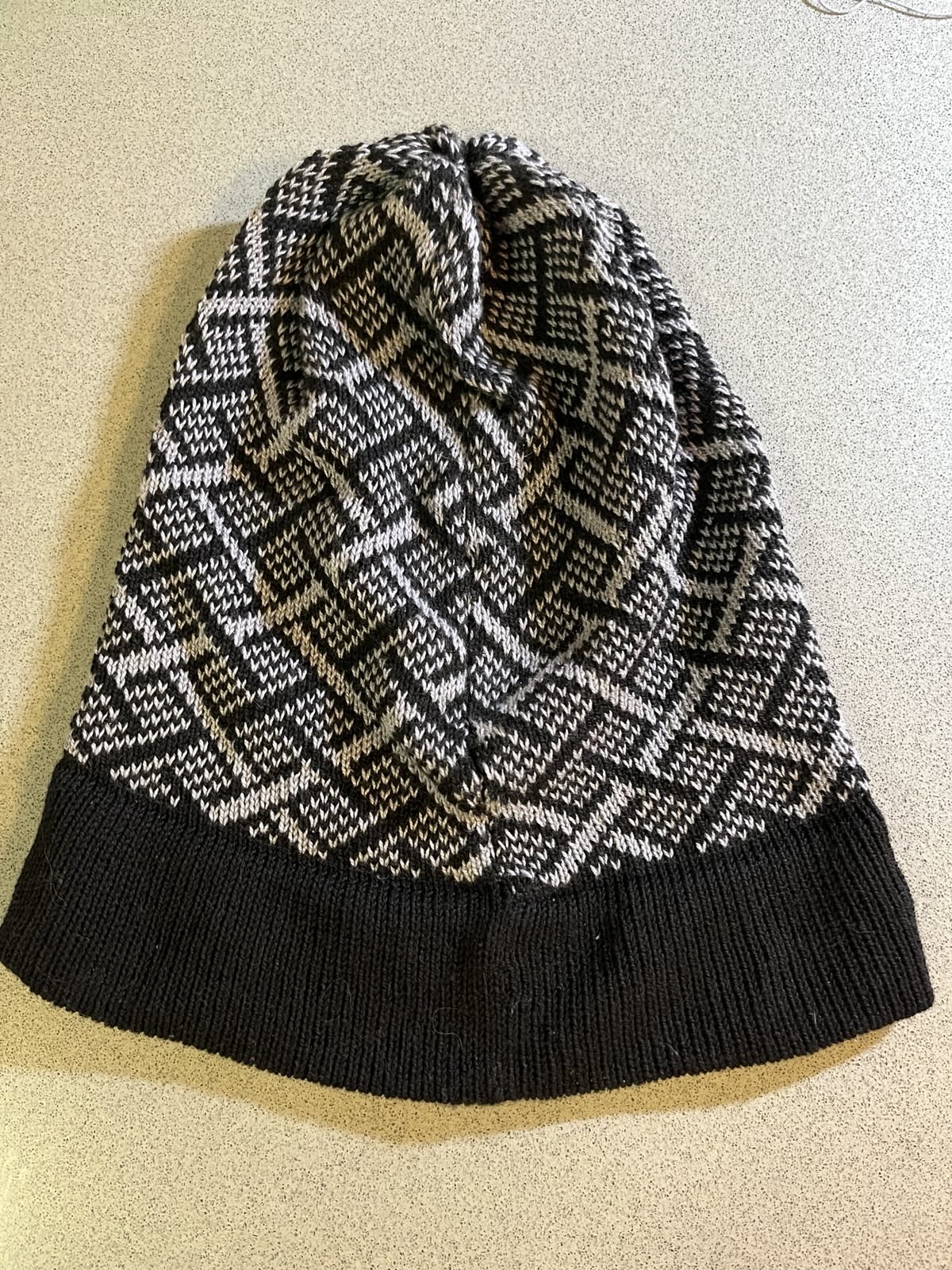
Me hunched over the machine, transfer tool in hand. A wide rectangle of black and gray knitting hangs from the needle bed.A black and gray beanie with a black brim. The main body of the hat has a clear pattern featuring a diagonal grid.
I think we're in business!!
Returning to my original "curriculum":
✅ Do some swatching
✅ Make a single-color hat
✅ Make a two-color hat with a Fair Isle pattern
🔜 AYAB time
Looks like I have "no excuses" left not to disassemble the on-board electronics to replace them with AYAB. 😳
In truth, I would like a bit more practice with Fair Isle using the "vanilla" machine. Specifically, the hat above is done with an overall repeating pattern, but there are different techniques if you want to do a "motif" that is constrained to just one part of the knitting. I want to make some swatches with isolated patterns and end-needle selection, practice managing floats, get used to the way pattern knitting row counts feel "off by one", see how Fair Isle affects the finished gauge of the fabric, etc.
Meanwhile, I've started a basic sweater with hilarious results. Stay tuned, like and subscribe, etc. etc. etc. 😎
One of my main goals with machine knitting is to be comfortable enough with the machine and techniques required to make custom two-color patterns with AYAB. To that end, I had given myself a very short syllabus:
✅ Do some swatching
✅ Make a single-color hat
❌ Make a two-color hat with a Fair Isle pattern
🔜 AYAB time
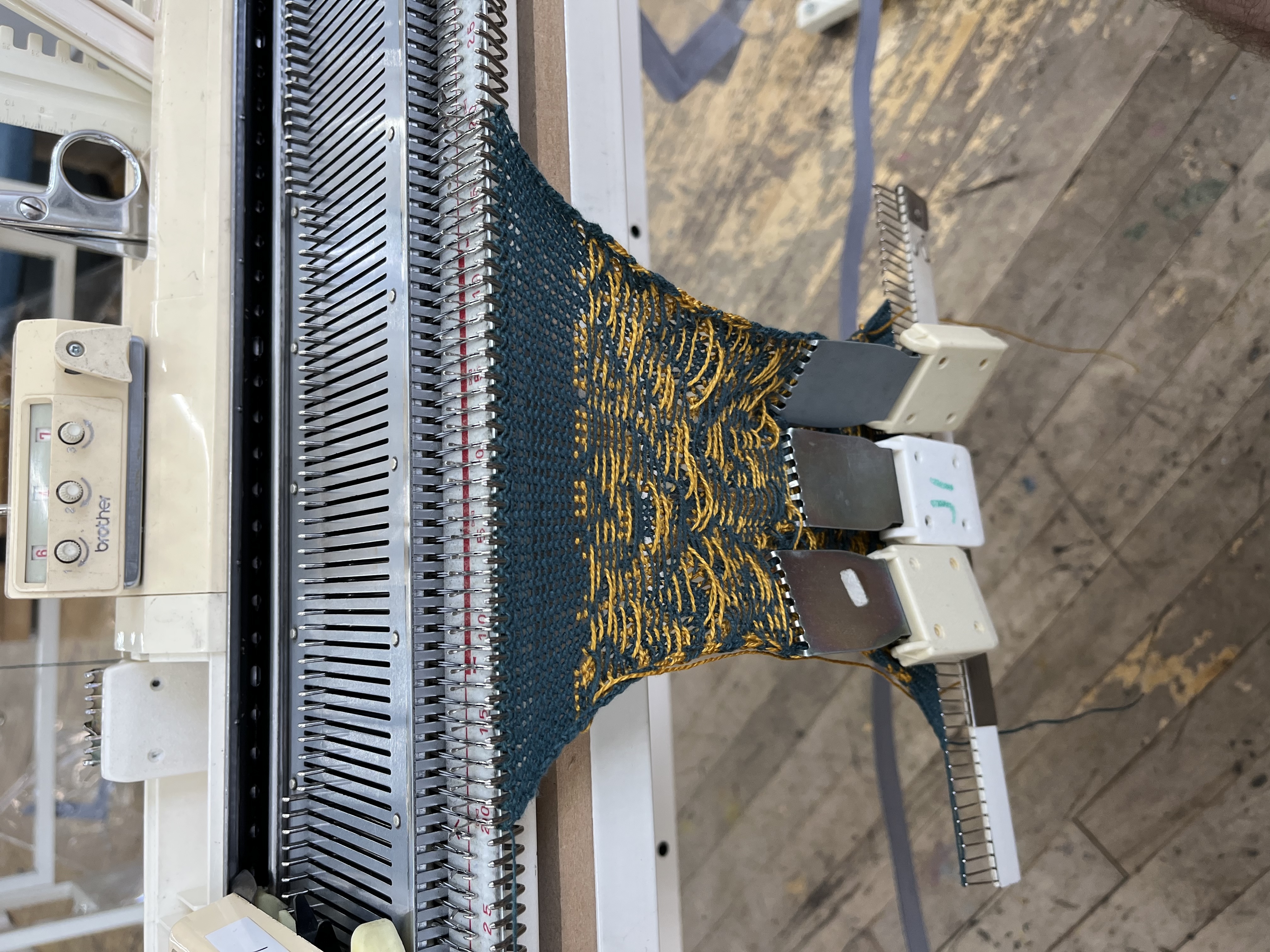
My attempt at a two-color Fair Isle patterned hat came out as a cool-but-wrong tuck stitch patterned hat. The "MC" button that activates multicolor Fair Isle knitting sits right over the "T" (tuck stitch) button, and they were well and truly frozen together. I will save that story for another time.
Meanwhile, the machine could definitely still knit, so I had no excuse not to keep learning and practicing.
Which brings me to socks.
As knitting project go, socks would appear to be small, fast, and easy. Depending on whose pattern you are following, there are a few techniques to learn. Plus you have to make two of them, so you are tested on your consistency.
Unfortunately, a lot of sock-knitting content is for circular knitting machines, or double-bed knitting machines with ribbing attachments, or for hand knitters.
These socks are designed to be made on a single bed standard gauge knitting machine - like mine! They are knit top-to-bottom, back-to-front starting at the rear ankle hem, going down to a rounded heel, across the foot bottom, and around the toe. At that point, you switch techniques, picking up the stitches from previous rows to work your way back up and over the top of the foot, ankle, and hem. When it comes off the machine, it's a whole sock. You just need to hide the end threads, wash it, and block it.
While my machine matched the pattern requirements, Diana's pattern calls for thicker wool-blend sock yarn than what I have on-hand. In my "practice phase", I'm using thinner two-ply cotton, which means I have to adjust the row and column counts from Diana's pattern by a conversion factor - a multiplier based on the ratio of Diana's sock yarn gauge measurements with my own.
While some of this is easy multiplication, some of the techniques require adding or removing stitches at some "rate". In this case, creating the curved heel and tow areas involves "short rows", where more and more end needles are held at their current row while more rows are added to the middle. When the number of rows and stitches changes, you've also got to change instructions like "add one stitch into hold at the end of each row". Thankfully, my gauge's stitches-per-inch measured "close enough" to Diana's pattern, so I only needed to deal with the difference in rows - my thinner yarn came out to about 1.5x rows-per-inch compared with Diana's.
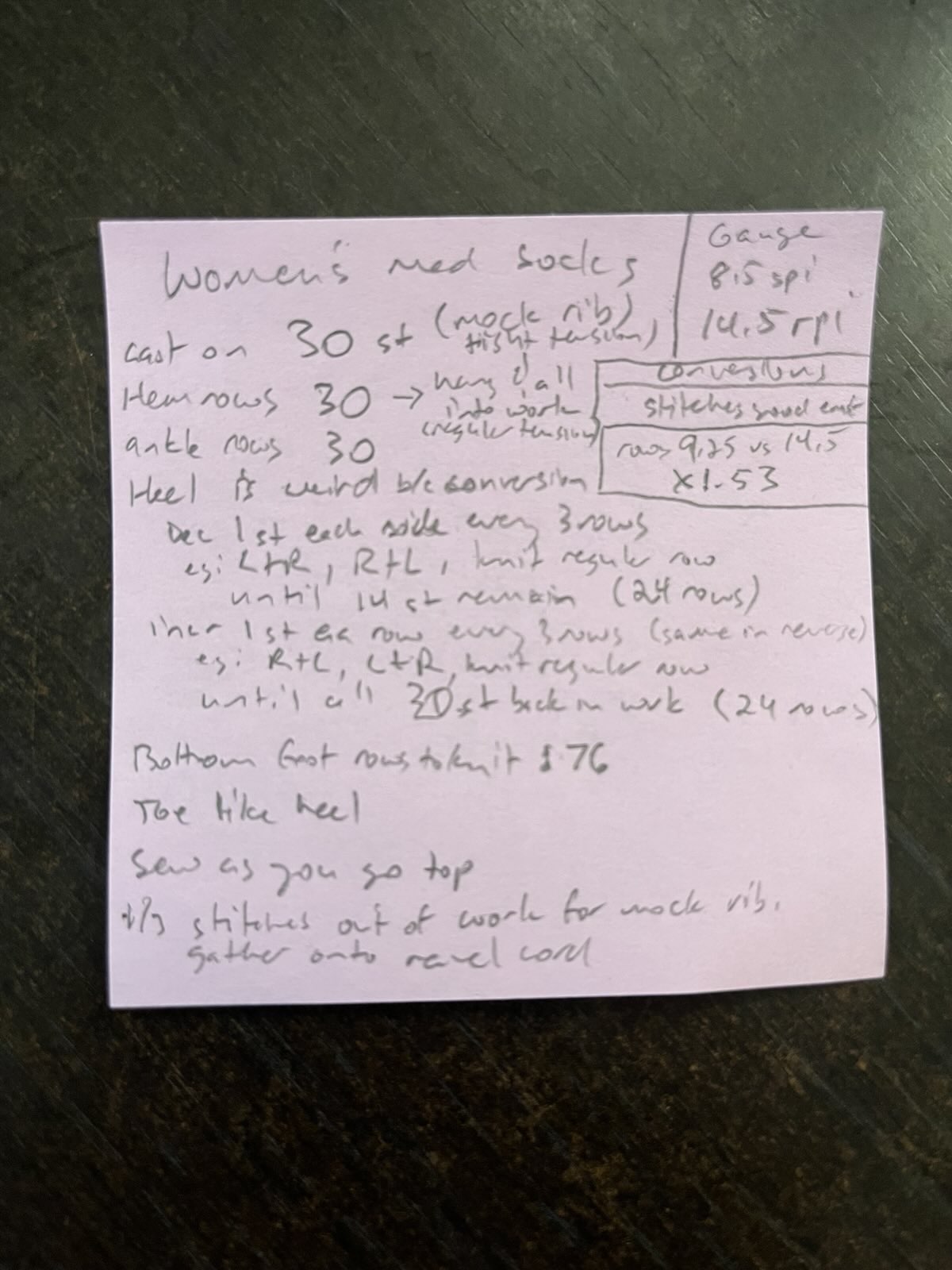
I did my best! Here's the pattern I came up with to try and make socks for Producer Amy.
Pink sticky note with calculations and knitting instructions in pencil.
My pattern mostly follows Diana's until we get to the short rowing. Here, she calls for putting one needle into hold on each side as you knit each row, down to a certain number of needles, then short row back out at the same rate. The one-to-one ratio really simplifies the technique. Comparatively, I would need to knit 1.5x the number of rows with my thinner yarn. So I came up with a three-step waltz that moves two needles out of (or into) work every 3 rows.
With carriage on the right, put the left-most needle in hold position and knit right-to-left.
With carriage on the left, put the right-most needle in hold position and knit left-to-right.
Leaving needles alone, knit back right-to-left.
With carriage on the left, put the right-most needle in hold position and knit left-to-right.
With carriage on the right, put the left-most needle in hold position and knit right-to-left.
Leaving needles alone, knit back left-to-right.
Repeat! (And when short-rowing out, put needles back into work rather than into hold.)
The resulting socks have some holes of various sizes in the short row areas. Being new to this technique I can't be sure whether each hole is from a mistake I made in the technique or because my two-stitches-per-three-rows adjustment needed an extra needle wrapped here or there.
Anyway. Sock photos.
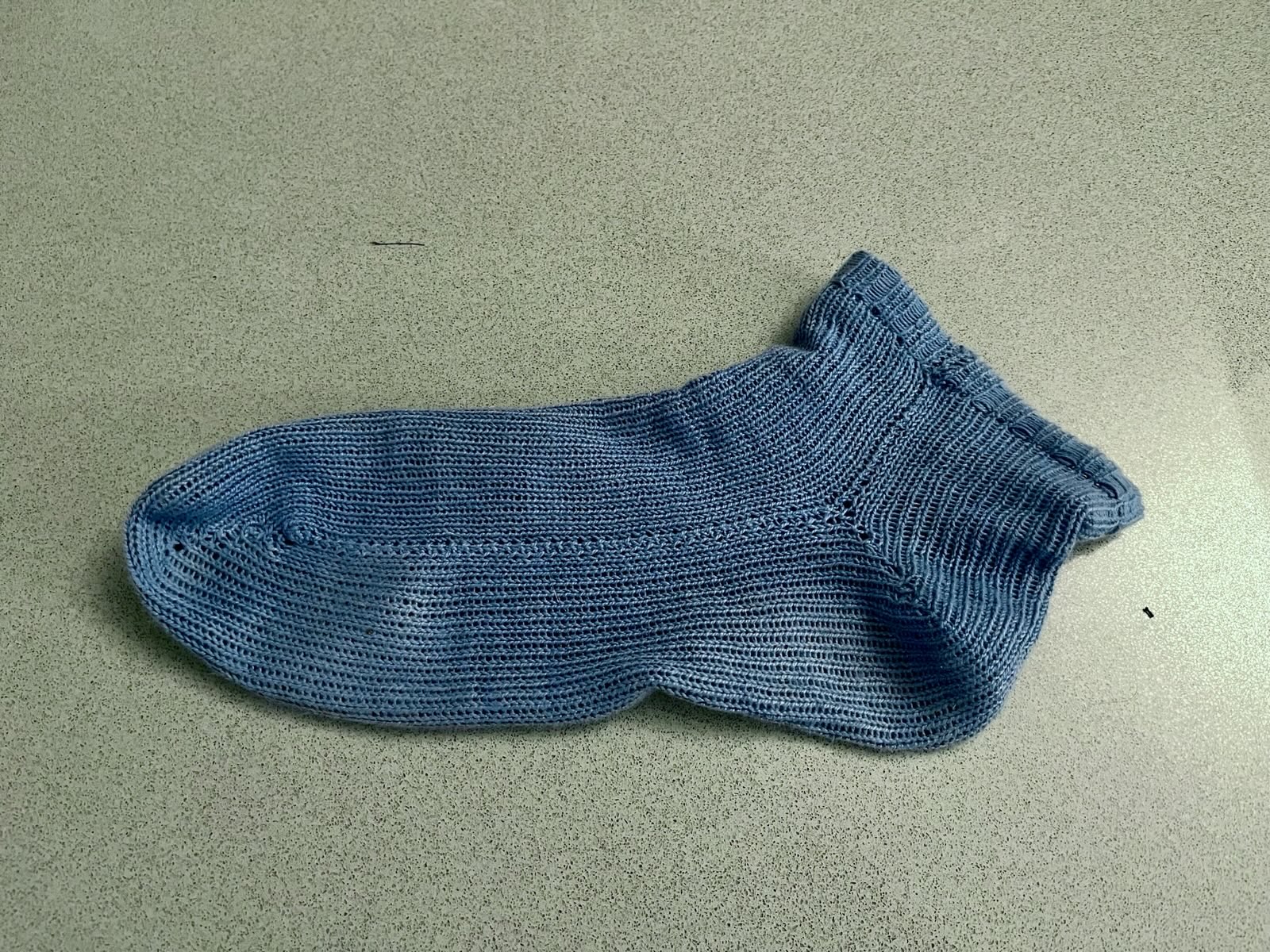
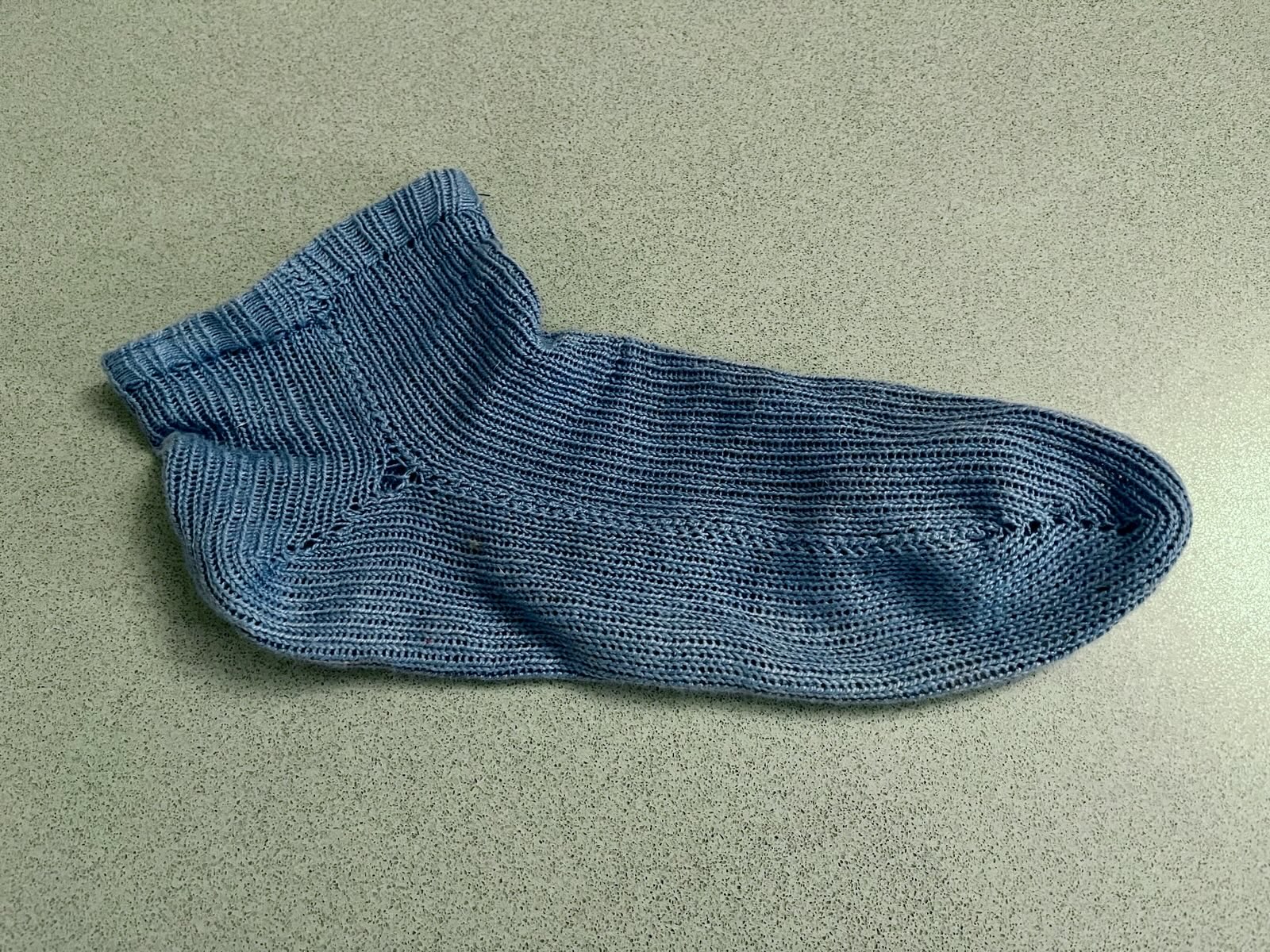
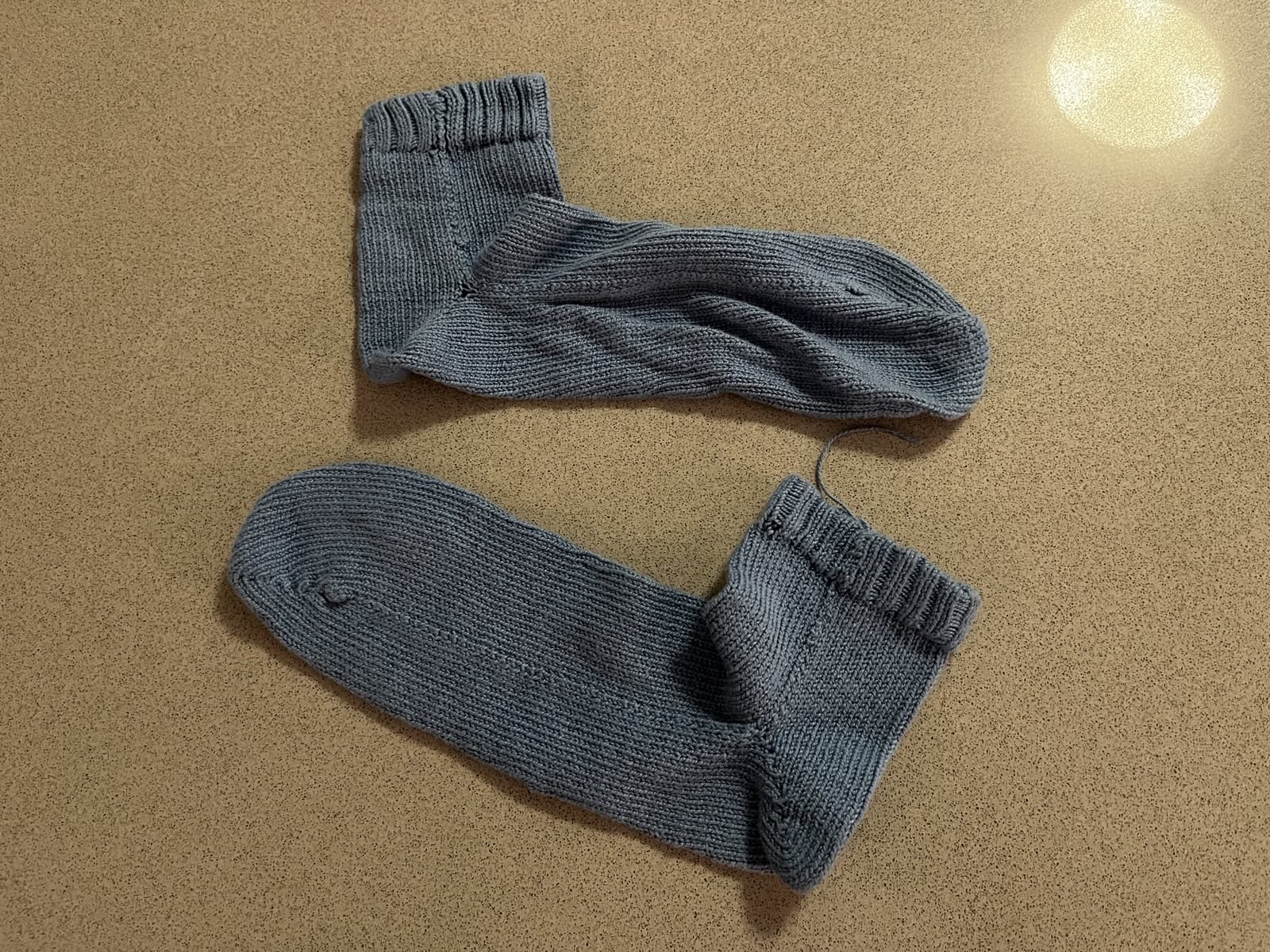
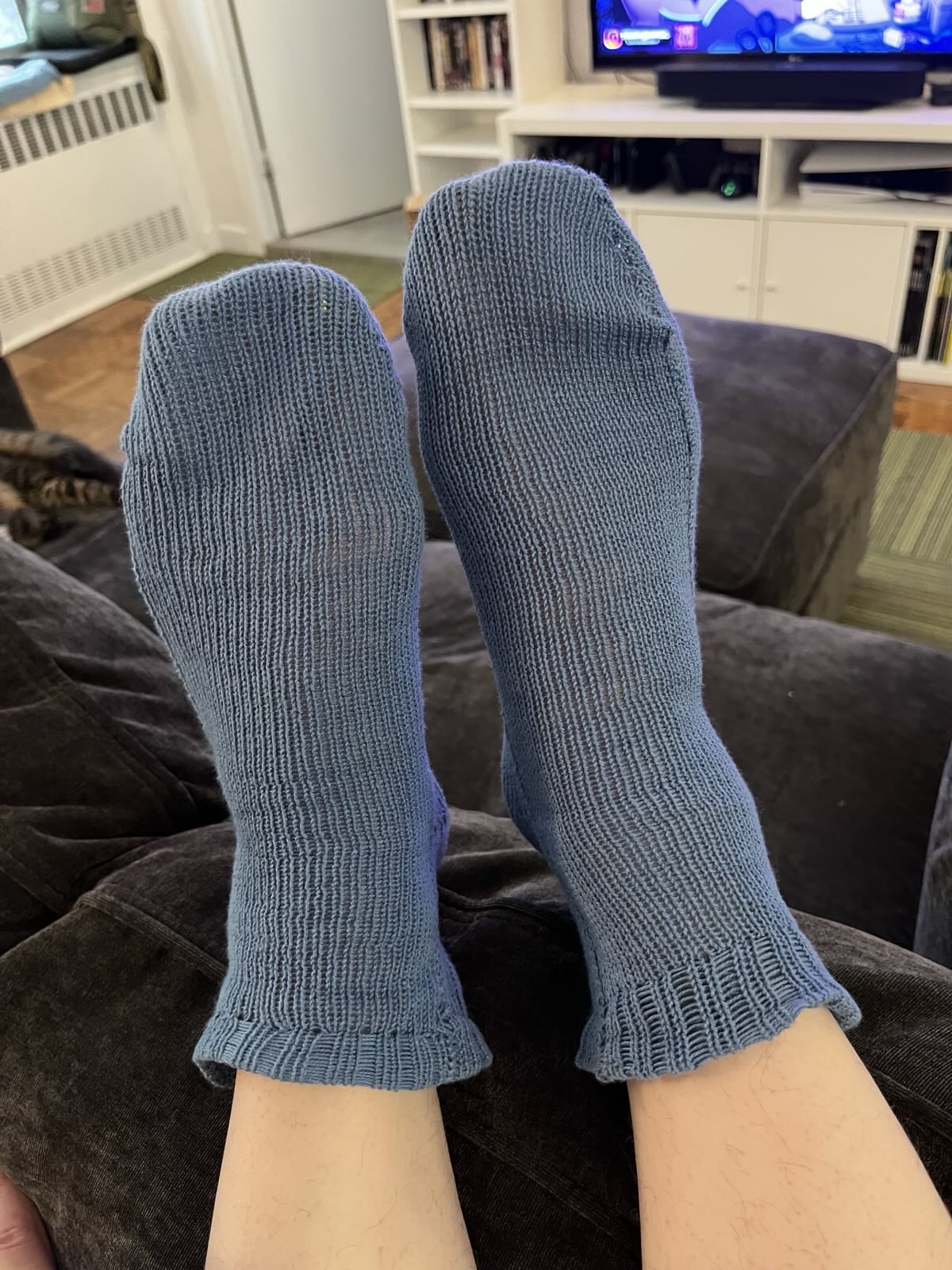
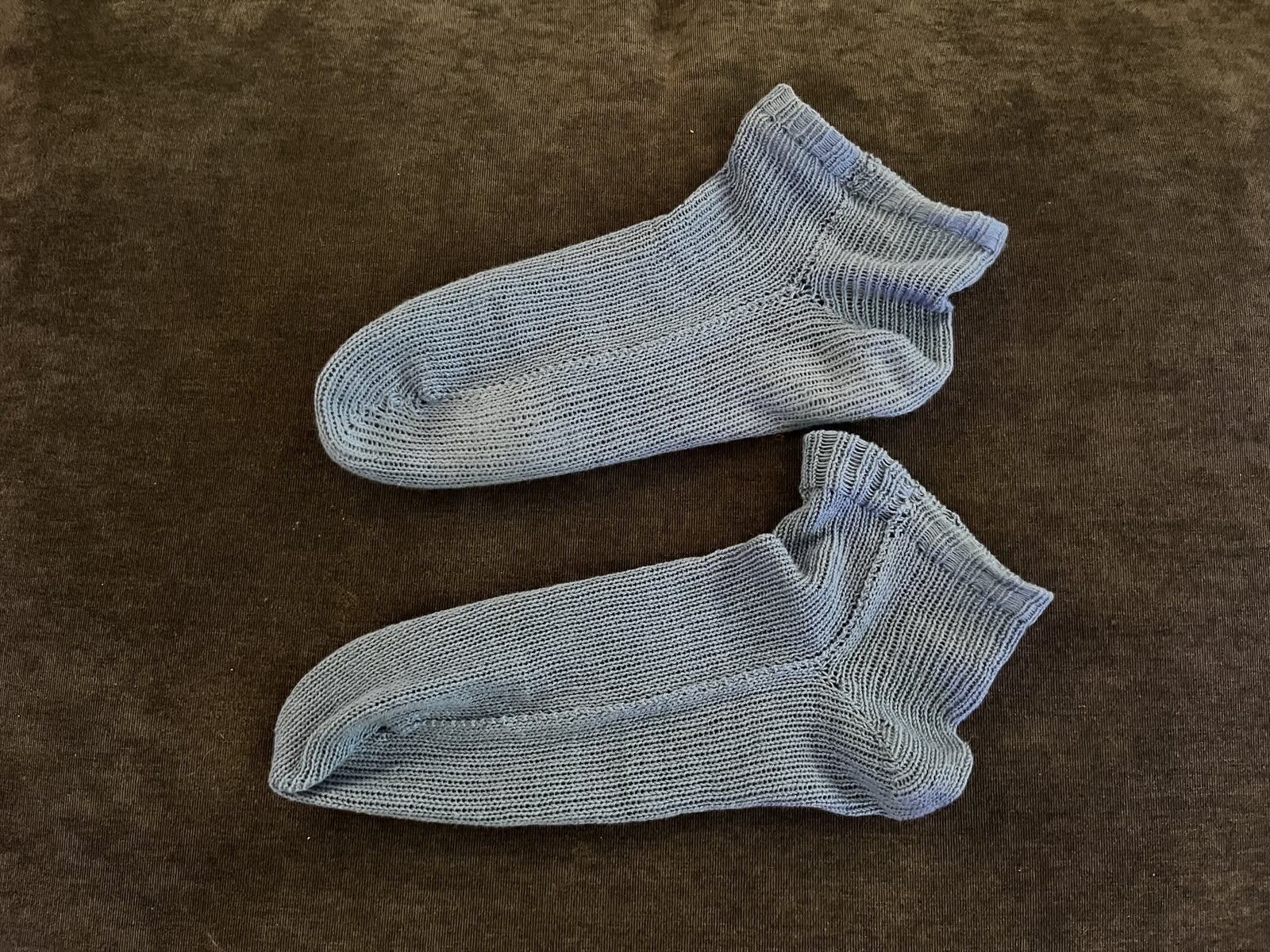
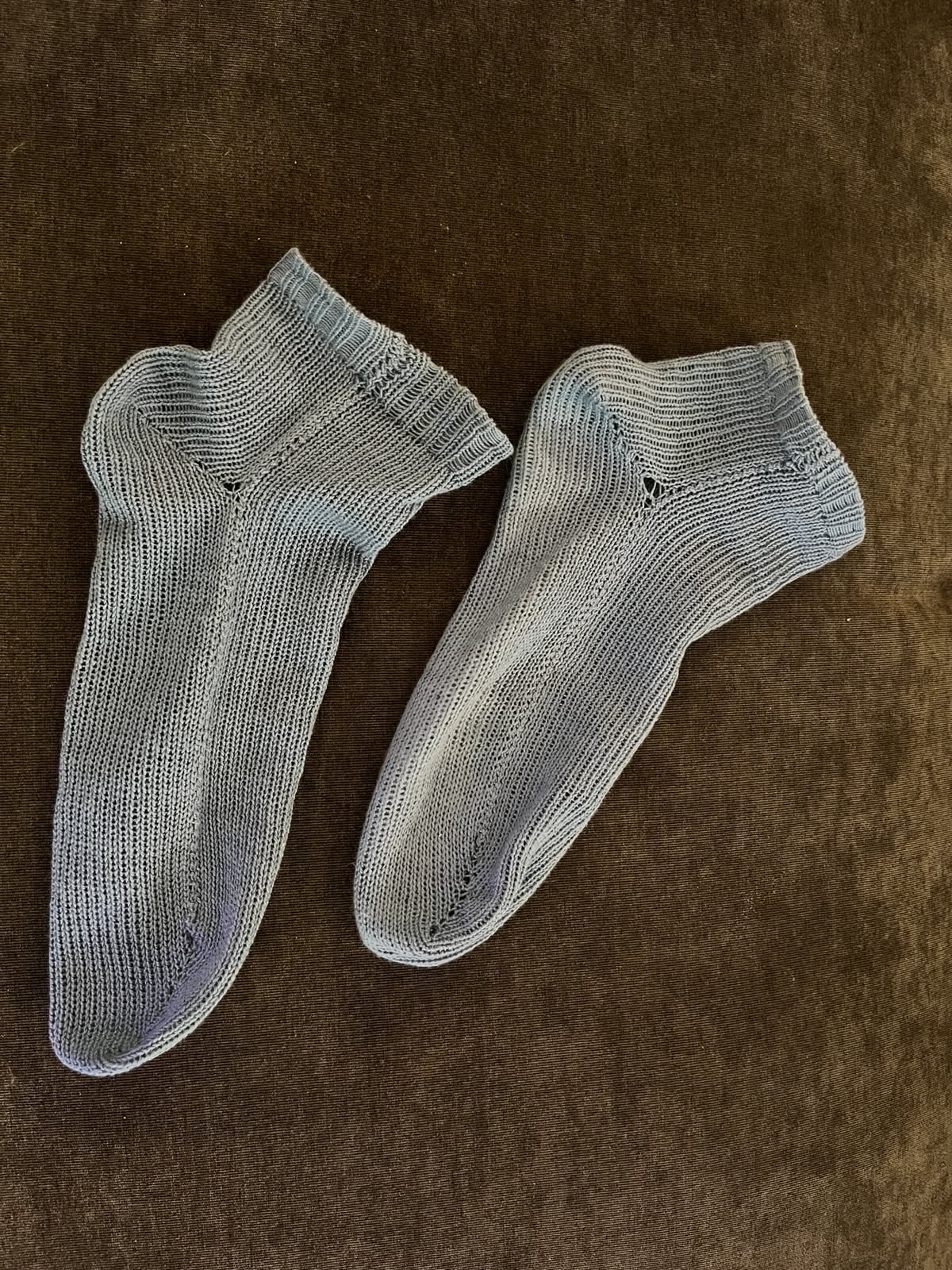
First sock, "good" side. It's ankle length in blue yarn. Sew-as-you-go and short-rowing seams are subtle but visible.First sock, "bad" side. A large hole is visible where the heel seam meets the sew-as-you-go seam, and there are several small holes in the toe area.Both finished socks. The top sock in the image is the second one I knitted. There are fewer issues with holes, but the front hem is very loose because I forgot to adjust the tension for the hem.
Despite some issues, they look like socks! But do they sock??
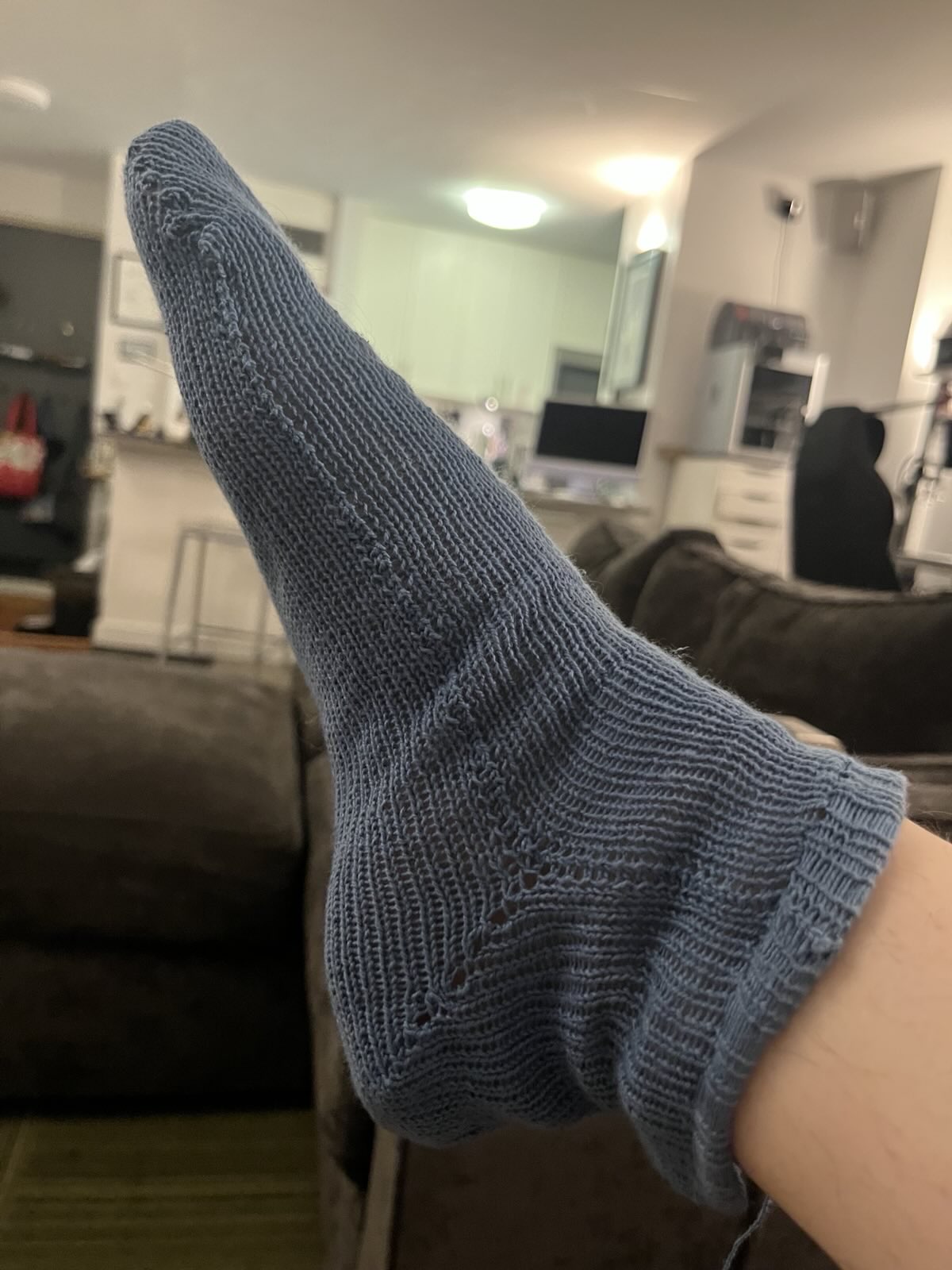
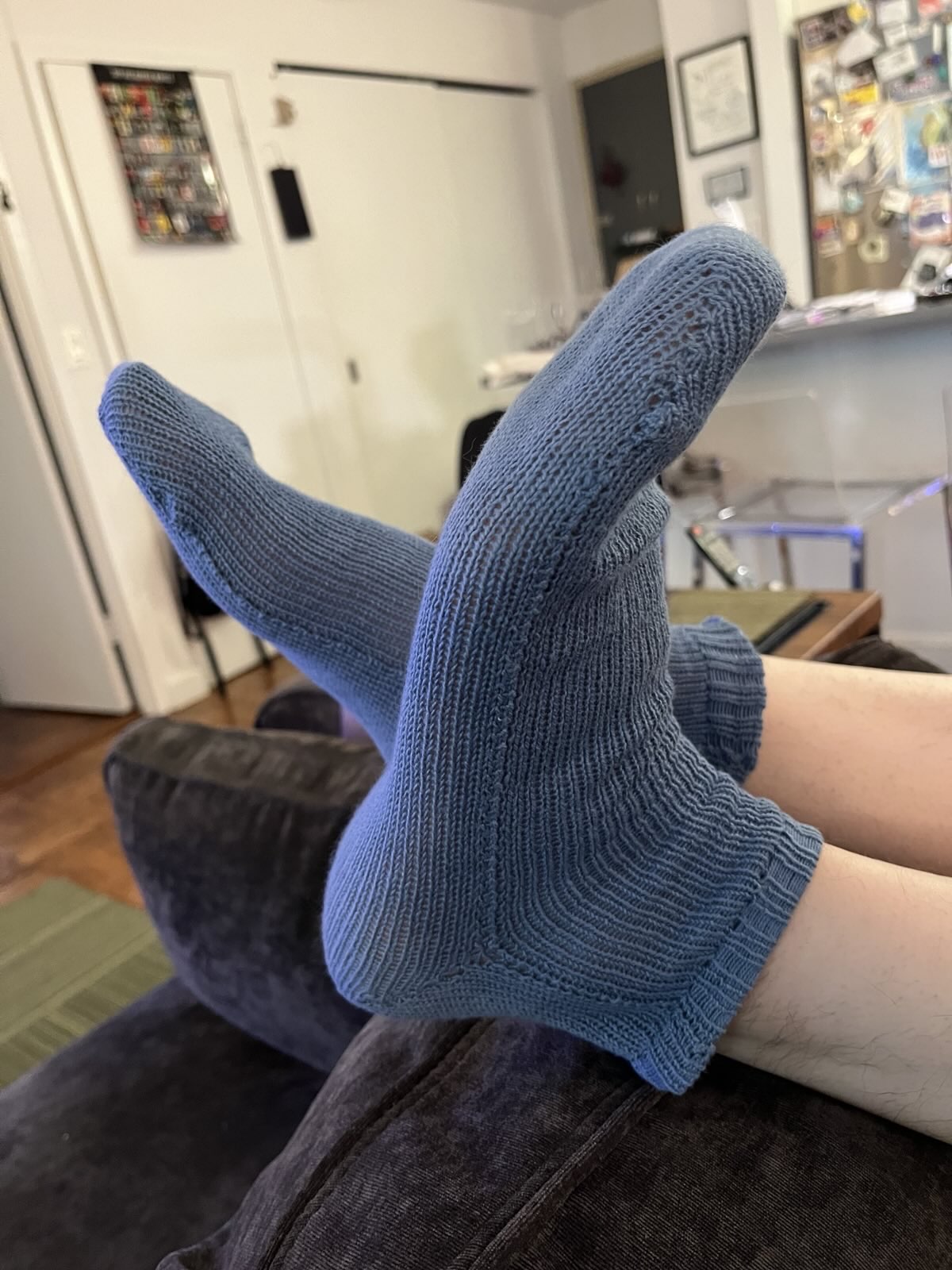
A socked foot in the air viewed from the side. The sock seems to fit well in the foot area but is loose around the hem.Two socked feet viewed from the side.Two socked feed viewed from above. Both seem to fit well, but a little loose, in the foot but are loose around the hem. The sock on the right has the overly-loose front hem.
Something is... not right with the final seam inside the front hem of the socks. I think perhaps I am finishing them off the machine too tightly. Or perhaps a different yarn would have more give. Whatever the reason, these were really difficult for Producer Amy to get on her feet, stretching only up to a point and no further. These photos were taken before washing and blocking, which I knew would shrink the final socks further.
After washing, these look a little better! The fibers have pulled together. The too-loose front hem on one sock is more visible.
Neither of these are wearable now, unfortunately. But I learned a lot and got experience with some important techniques. I look forward to trying again with some actually-meant-for-socks yarn that more closely match the pattern. And some more practice!
In my apartment we are lucky enough to have a big countertop, open on three sides, creating a nice flat project surface for even sprawling projects.
However, we also have a lot of projects that compete for this space! Producer Amy is often working on increasingly complex sewing projects that require the entire surface. Likewise, the knitting machine occupies an entire edge of the space. Both of these are time consuming, with potentially complex setup and teardown procedures. How can we accommodate both fiber arts hobbies?
You may not be surprised to find that I found inspiration from Carson (@KnitFactoryImpl) on YouTube. In her videos I noticed a low-profile metal stand that basically amounts to a single horizontal bar and four splayed legs, clamped together by a couple of big screws. She mentioned briefly that they aren't manufactured anymore, but you can find them on eBay "from time to time".
With the fear of scarcity in my heart, I jumped when I found a similar one on eBay a few days later.
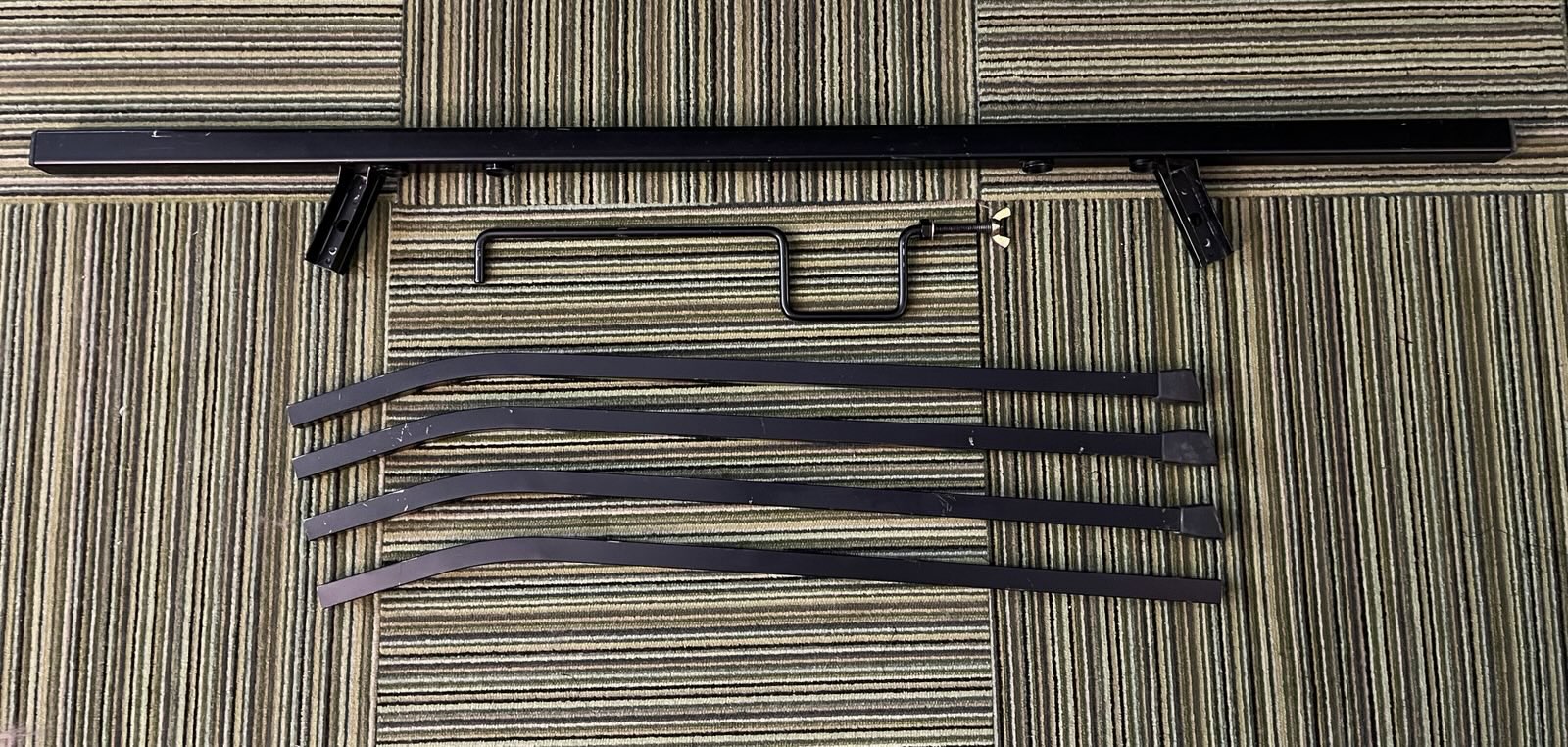
Black metal stand parts organized on a background of green carpet tiles.
As you can see in the photo, the stand can break down quite small! Pictured here are 5 of the 6 parts required for it to work. The long body bar has circular recesses where the knitting machine can be securely clamped, as well as slots for the legs. Each leg splays out at an angle to withstand the force of moving the machine back and forth. The body bar and legs are held together with a pair of screws and wingnuts, and the screws are at the end of long bent metal bars which do double-duty to provide some stability for the mounted knitting machine, as well as providing a place to rest the top of the knitting machine.
You may note that I said "5 of the 6" in the previous paragraph. One of the screw/bar pieces was missing. Thankfully the seller had simply misplaced it and, after contacting them, they found it and mailed it to me.
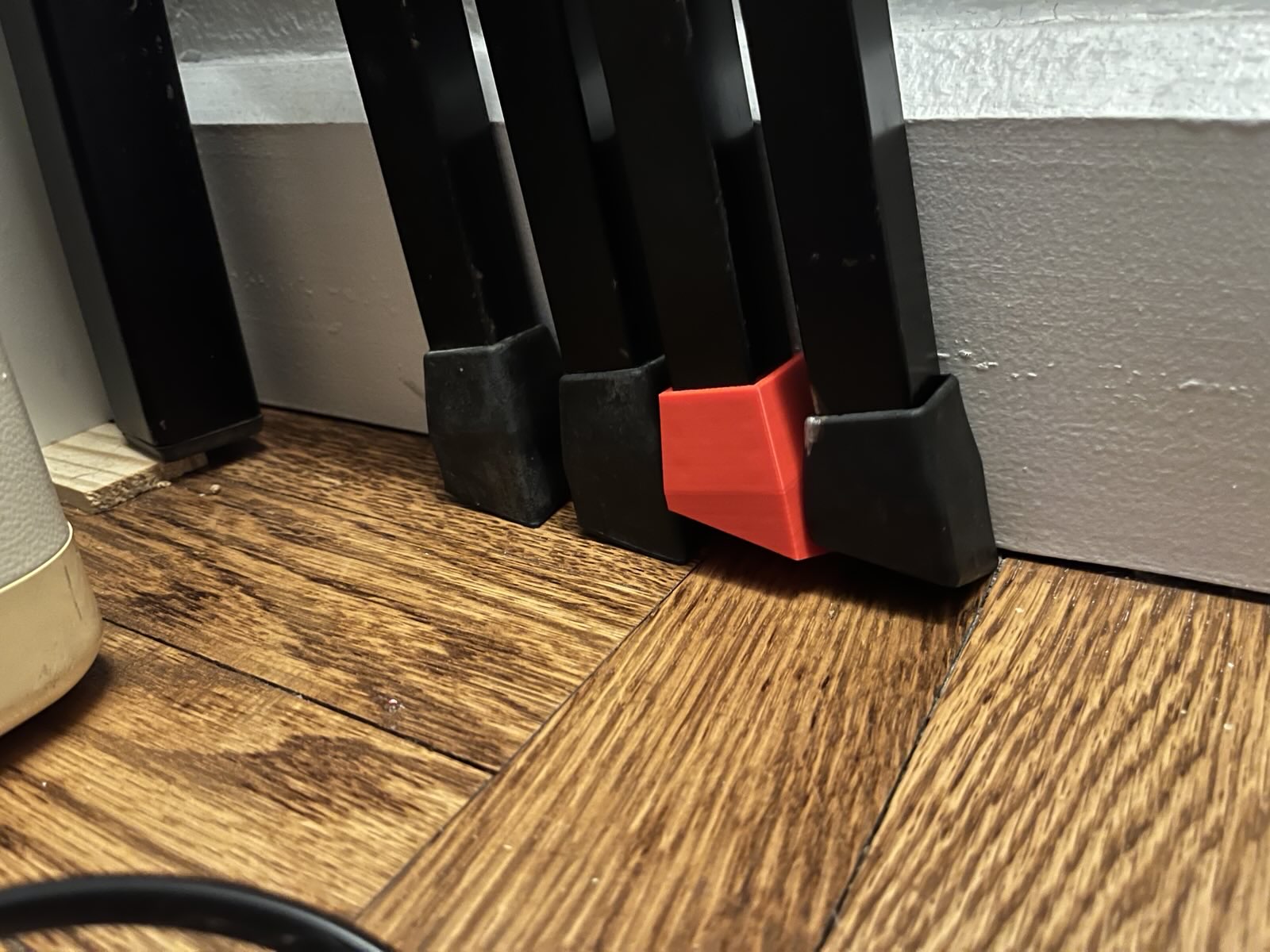
Meanwhile... If you have a keen eye you may have noticed another missing part. Because each leg splays out at an angle, each also has a rubber foot with a special shape to let it rest flat and provide traction. One of the legs was missing this foot.
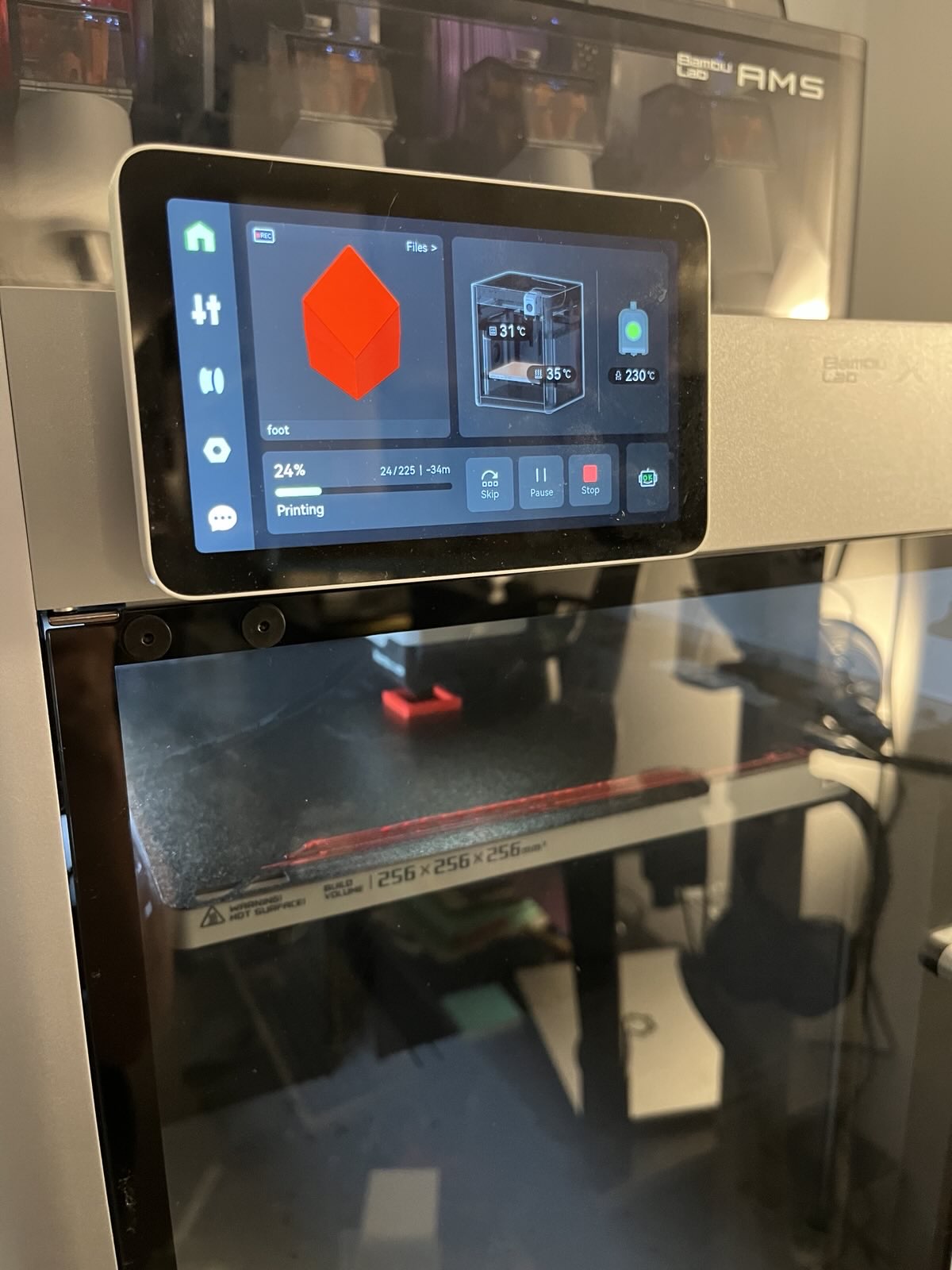
In this house we 3D print, so I dusted off my calipers, OpenSCAD, and trigonometry skills to make a replacement. I'll attach the OpenSCAD and final STL files to this post for posterity, but I definitely hit a point where the math looked right but the piece looked wrong, so I did some eyeball-based adjustments when tweaking the foot's resting face angle and a fudge factor to help the foot slip onto the machine leg.
Bambu X1C printing a foot in bright red TPU filament.Close-up of the four machine legs lined up against a wall. Three legs have black rubber feet and one has a bright red 3D-printed TPU foot.
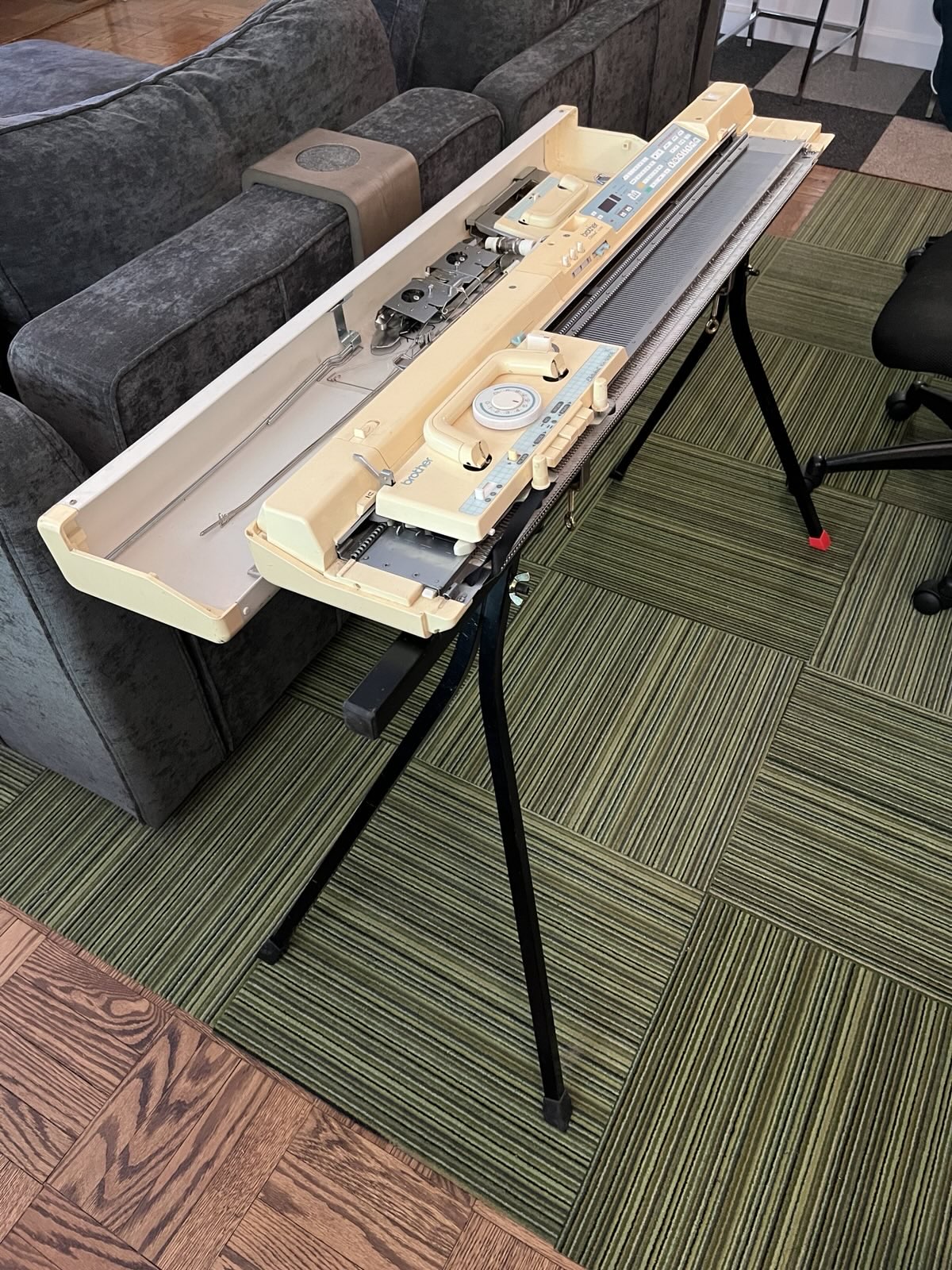
Now I can machine knit without taking up the countertop space. This reduces my anxiety about having the machine "out" for long periods of time as I practice skills or work on more time-consuming project.
Black metal stand with Brother knitting machine mounted on top ready to knit. The whole setup is up against the back of a sofa. The red 3D-printed TPU foot is visible on one leg of the stand.
Of course, there is floor space to talk about, but that is slightly easier to negotiate at this point.
One of my main goals with learning machine knitting is to replace the electronics on my Brother KH-930e with AYAB (All Yarns Are Beautiful) to create multi-color patterned knits of whatever sicko stuff comes to mind. But home knitting machines aren't a fire-and-forget type of machine. They require a lot of manual effort - from fine stitch work to good core strength - a lot of which requires practice for technique and feel.
First up: I ordered some pre-coned yarn (I'll cake later, when I know my machine works well), got the ol' machine out of storage and confirmed it all still moved and grooved, made some gauge swatches. And then... needed a project!
I decided to make a hat, following a combination of techniques from these KnitFactoryImpl videos:
That last one is for a very different machine from mine, but more clearly shows the steps and techniques.
Anyway, I made a hat!
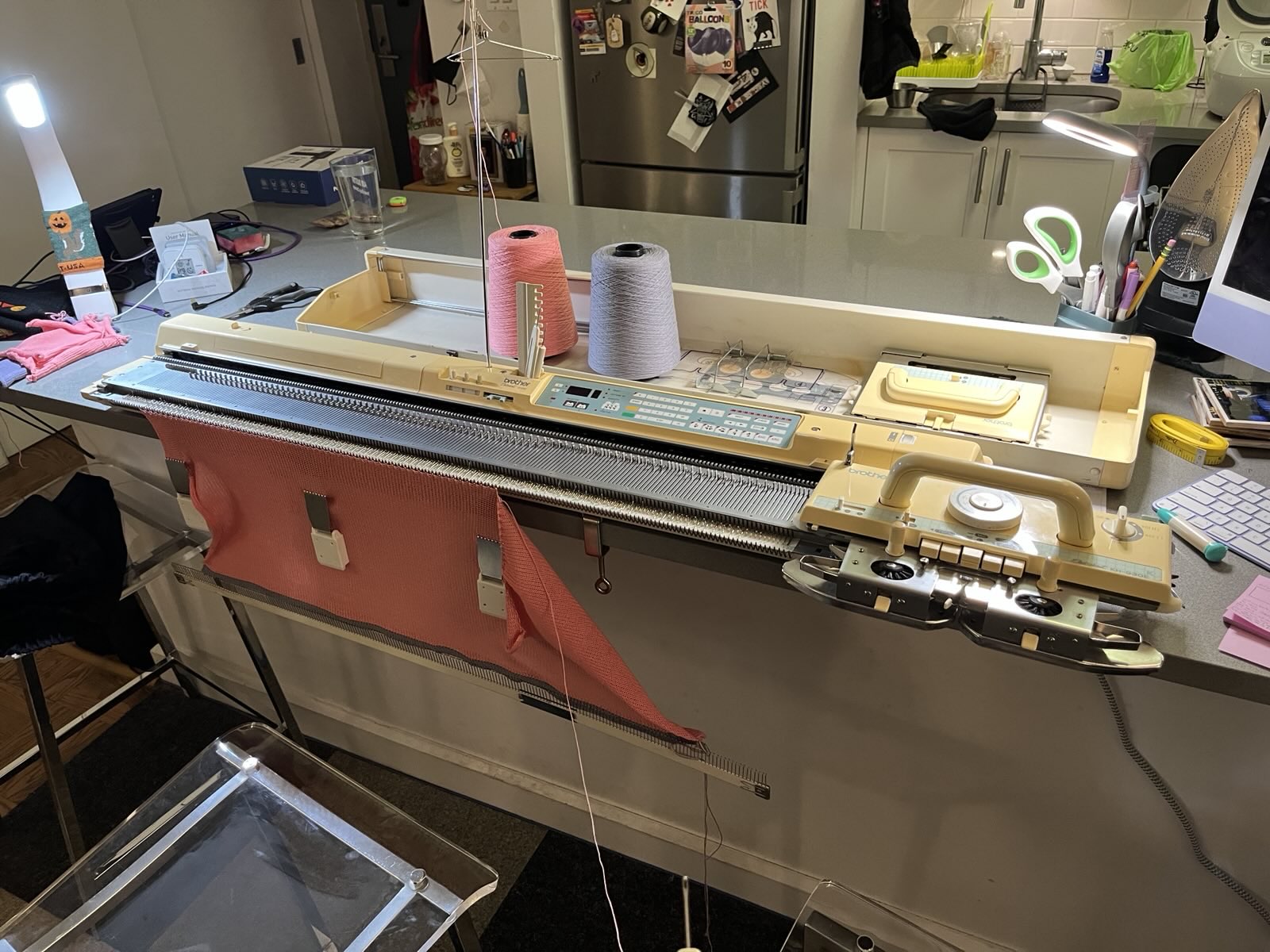
Brother KH-930 knitting machine mounted to a gray countertop and surrounded by accessories. A large piece of knitting takes up almost the entire bed. The piece is in the process of being gathered up onto a long tail to be sewn up.
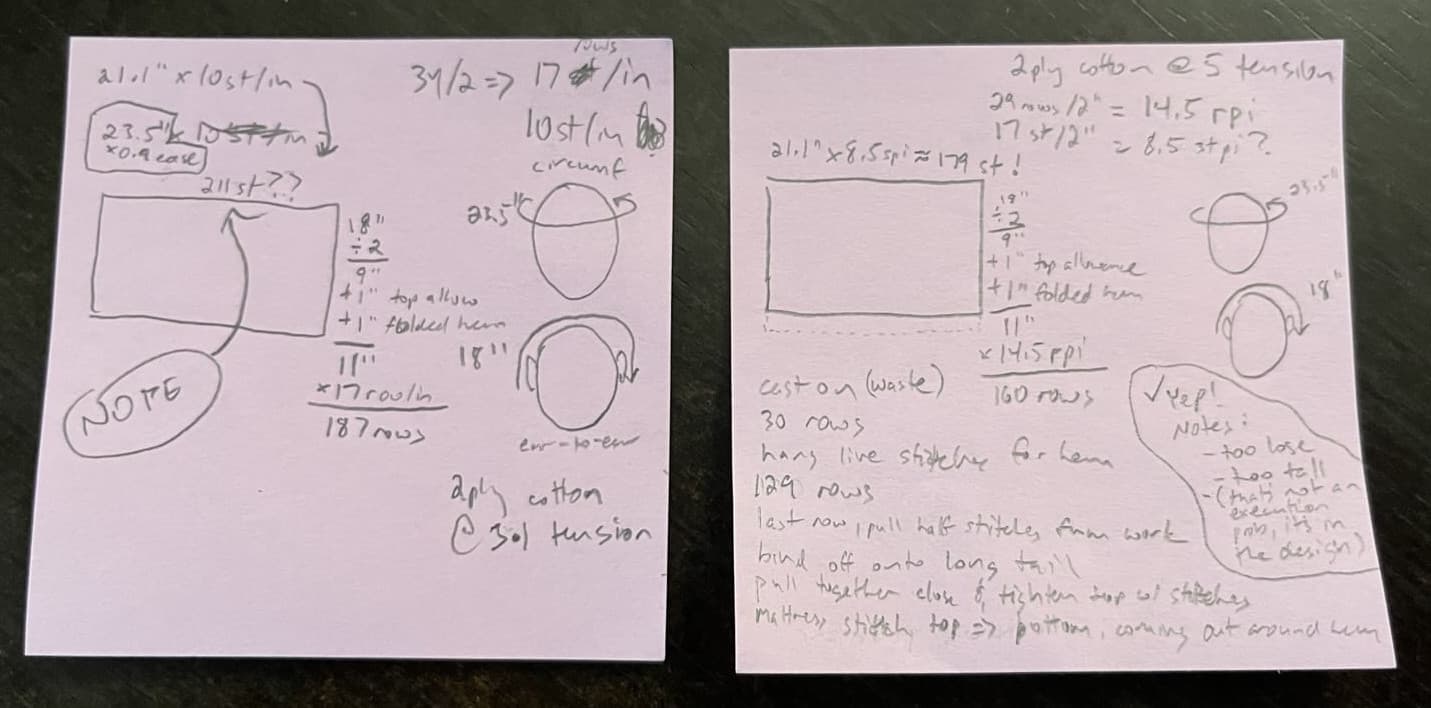
It was fun learning to do some of the pre-planning work, like measuring for a pattern, calculating stitches and rows, and writing out a pattern.
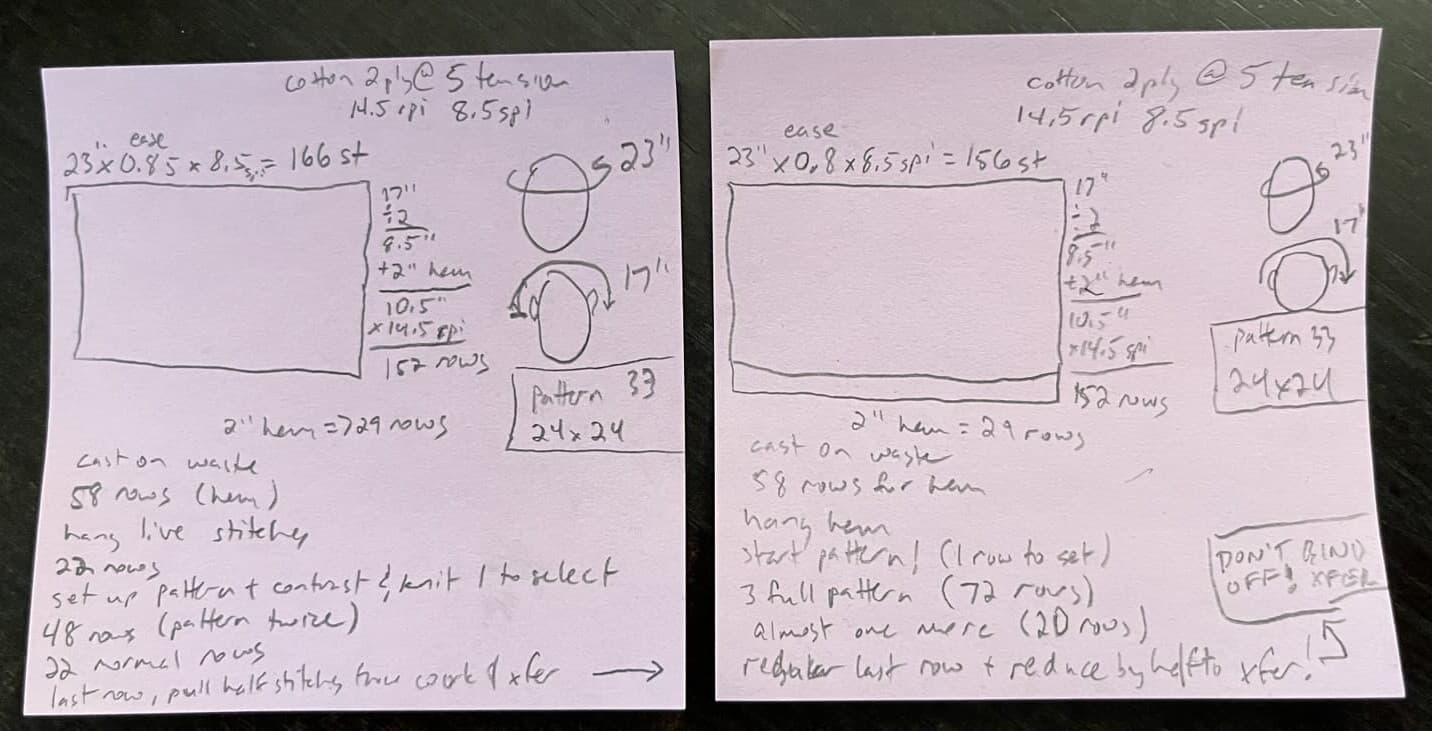
A hat starts off as a rectangle as wide as your head circumference and half as tall as the measurement over your head from the bottom of one ear to the other. The pattern on the left was calculated for a tighter tension and says 'NOPE' because it added up to 211 stitches, while the knitting machine only supports 200. The pattern on the right says 'Yep', along with some notes about the final fit.
When actually working the pattern on the machine, I also practiced hanging a hem, gathering up onto a long tail to make the pinched hat top, and mattress stitching the seam. Practices in patience, eyesight, and fine motor skills.
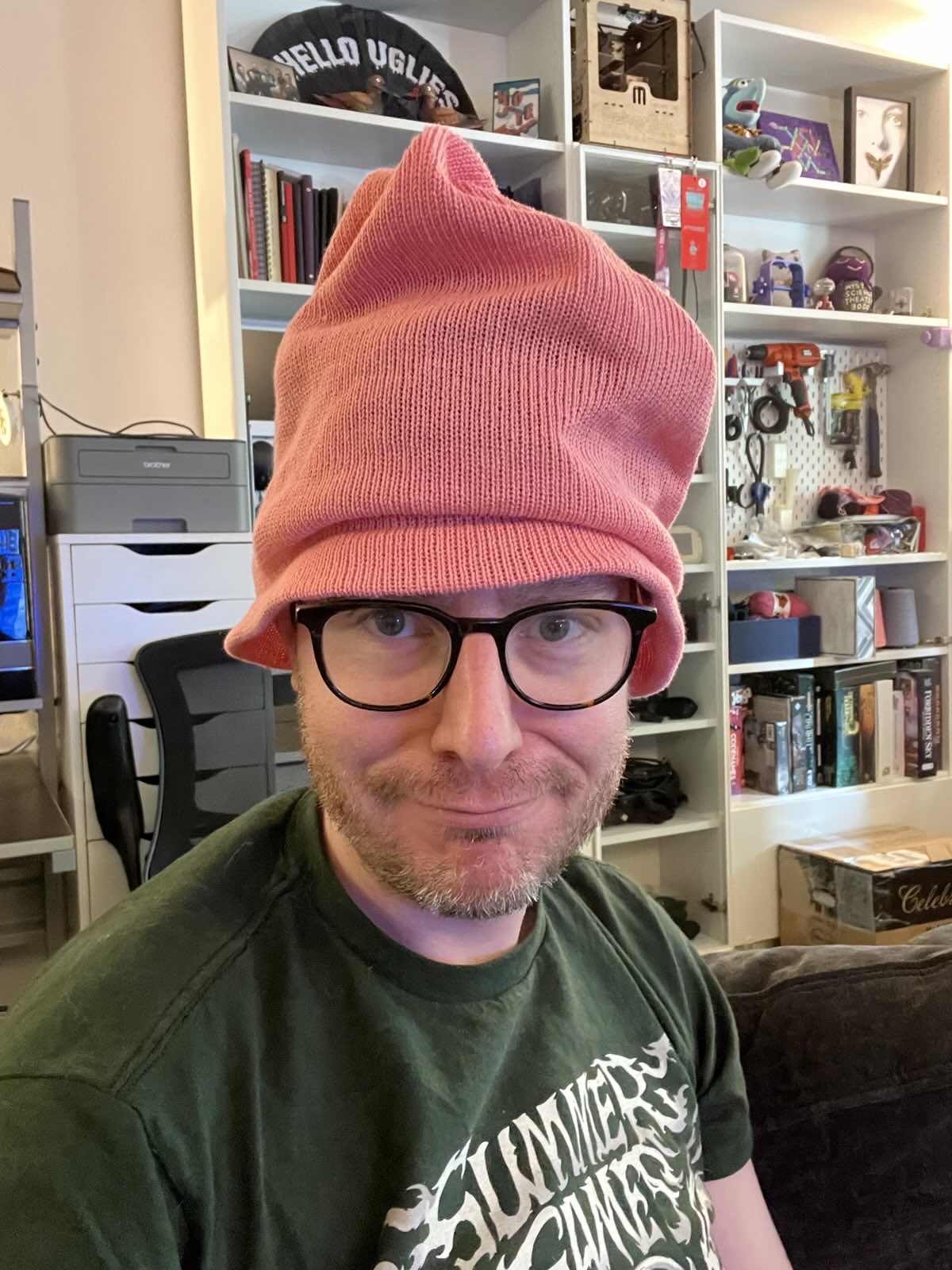
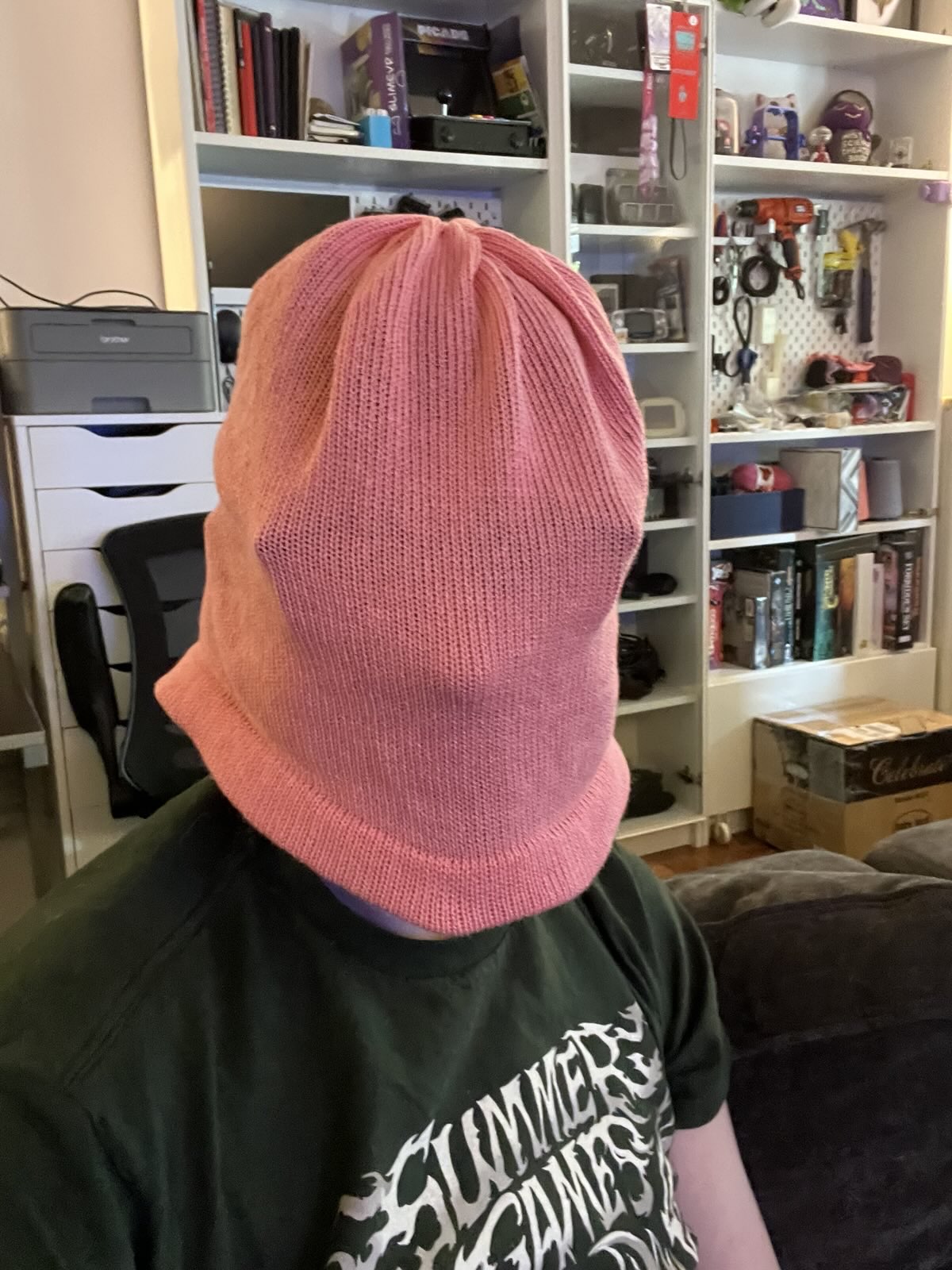
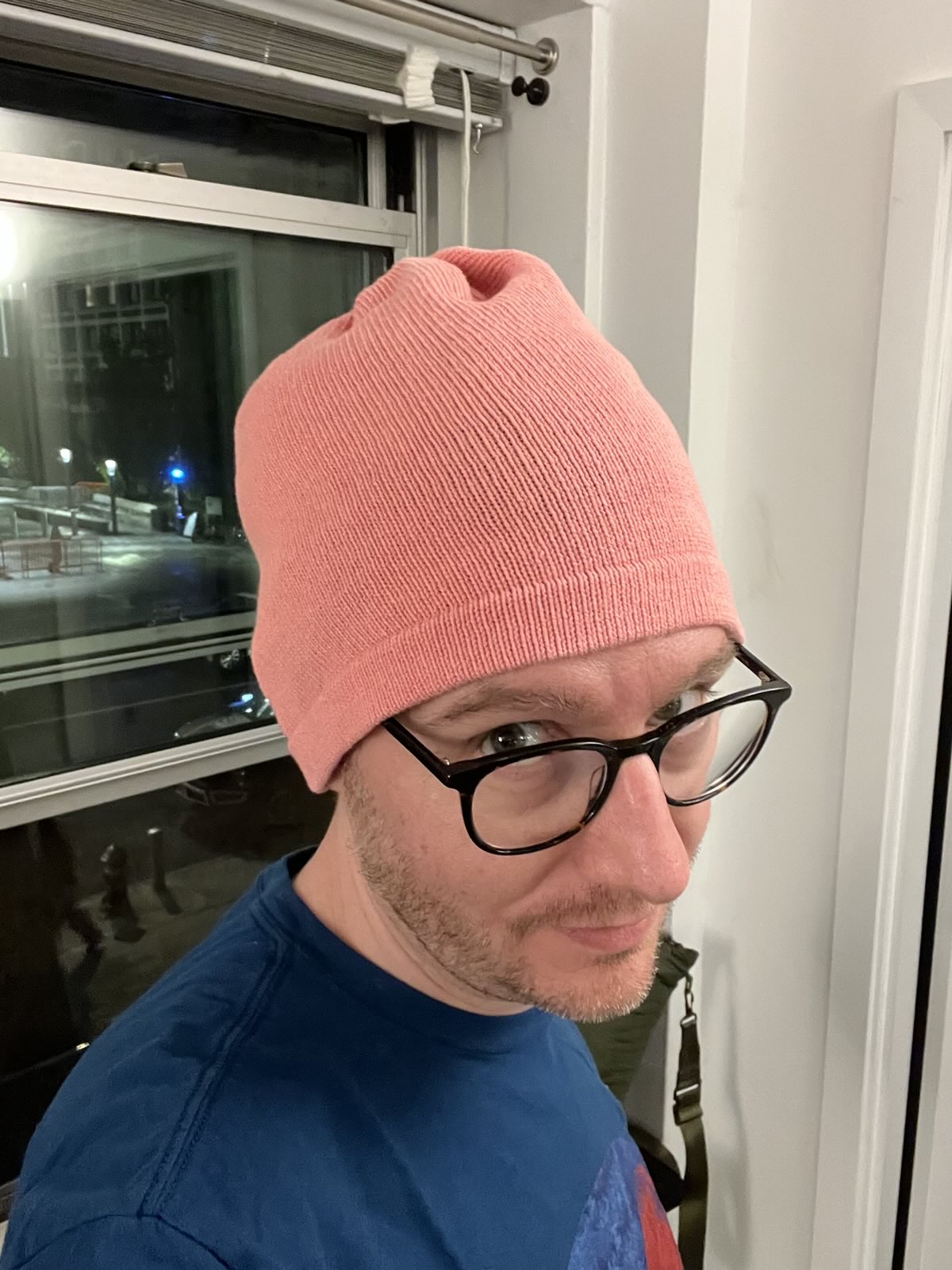
Me making a face while wearing my new pink hat, after make-up but before washing and blocking.Me with the hat pulled entirely over my face.Post-wash - it fits! Me in the pink hat, giving the camera a "would you look at that, it works" look.
I ran it through a load of laundry and it came out much better!
The fit seemed a little loose, but I feel like it sits on my head the way the Carson's sits on her head at the end of her video. I'm taking that as a success for process!
From here I thought a good level up would be to make a new hat with some design tweaks and, because I want to rush to get AYAB working some Fair Isle patterning using the Brother's built-in patterns. Consulting with Producer Amy, I decided to double the length of the brim without lengthening the hat overall. Amy picked a pattern, and I decided to try creating a stripe of it between the brim and the top of the hat.
On the left is the pattern I made from Amy's measurements that resulted in the hat below. On the right is the revised pattern for some time in the future, based on fit test and Amy's requests.
Something was not quite right with the knitting carriage. The "MC" button used for two-color Fair Isle knitting was stuck to the "T" button below it, which engages tuck stitching. The result is that the pattern came out all wrong and also this whole paragraph is foreshadowing for some later posts.
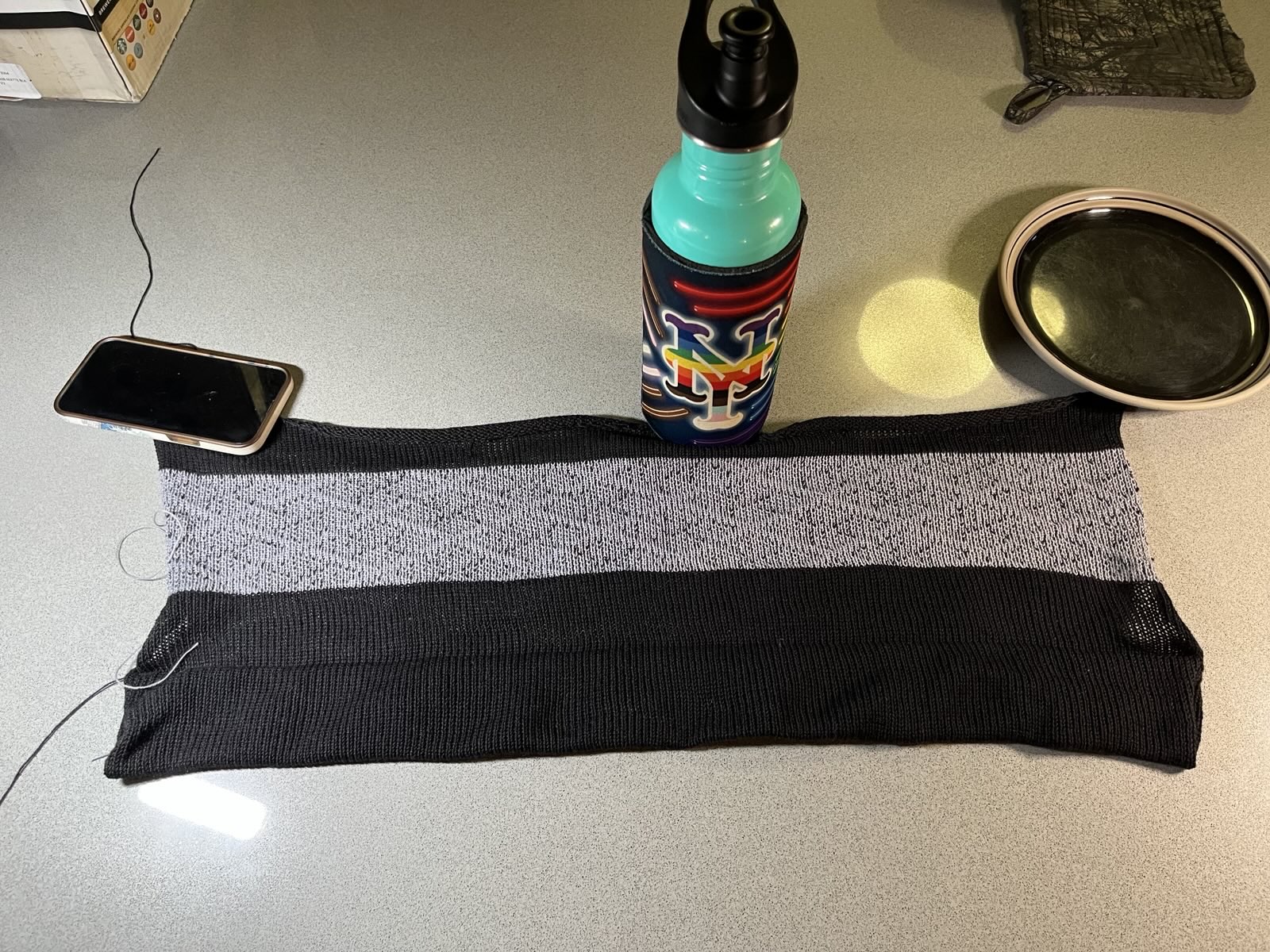
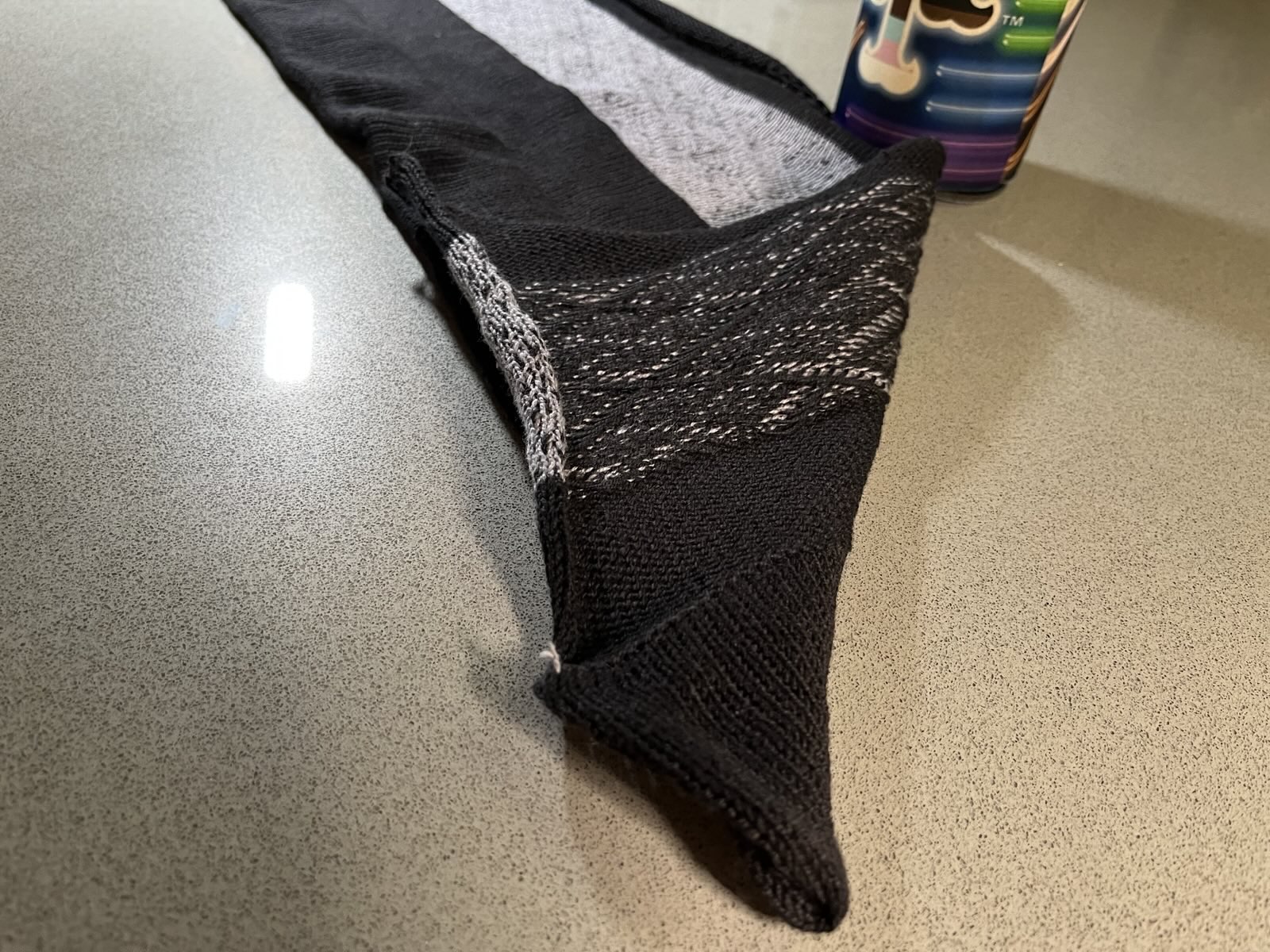
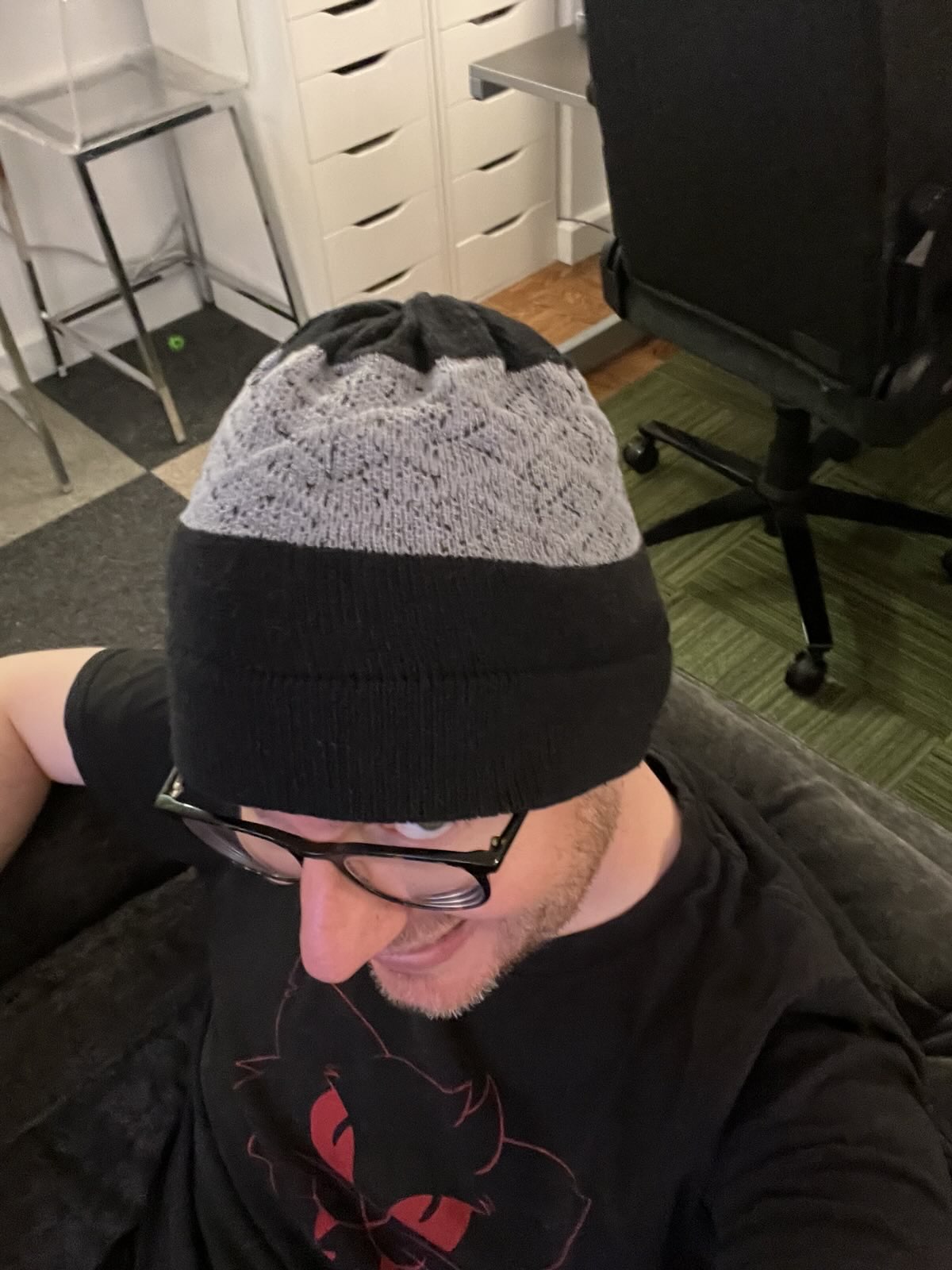
The hat rectangle fresh off the machine. It really wants to curl up so I'm using random objects from the kitchen counter to hold it flat.Flipped over part of the rectangle to show the reverse side of the pattern.Me wearing the finished and washed hat. The fit is good!
The pattern should be gray contrast on black to match the rest of the hat, but instead is mostly-gray with some black peeking through, as well as some interesting texturing from the machine treating the pattern as a tuck stitch.
Despite the patterning issue, I am pleased with how this came out. It's made of cotton rather than wool, so it stretches out a bit as it is worn, but it's still pretty cozy! Producer Amy requested that the next version have patterning from the brim to the top. I look forward to trying that again soon... when I am able! (That's still foreshadowing.)
Practicing some naive increasing and a bad rescue of a dropped stitch.
I have forgotten the first technique Elaine taught us for the day, but it let
us work in a second yarn by hand as each row is knit. Seems like maybe a cool
way to work in wires or conductive thread??
This chunky yarn! Pull half the needles forward and lay it across them. This also requires enabling the brush wheels on the knitting carriage (not shown).
The effect is subtle on the "knit" side (left photo), which is generally the outside. The bulk of the worked-in yarn remains on the "purl" side (right photo).
Next up, we learned about putting working needles in hold, aka short-rowing,
which allows you to “grow” sections of the knitting by adding rows just to one
section, while other parts of the work stay put.
A triangular section of yellow made by short-rowing in right-to-left. Note how the cast-on comb is now at an angle!I had to make another triangular section to balance it out. ⚖️
Next it was time for two-color patterned knitting with fair isle, powered by
punch cards!
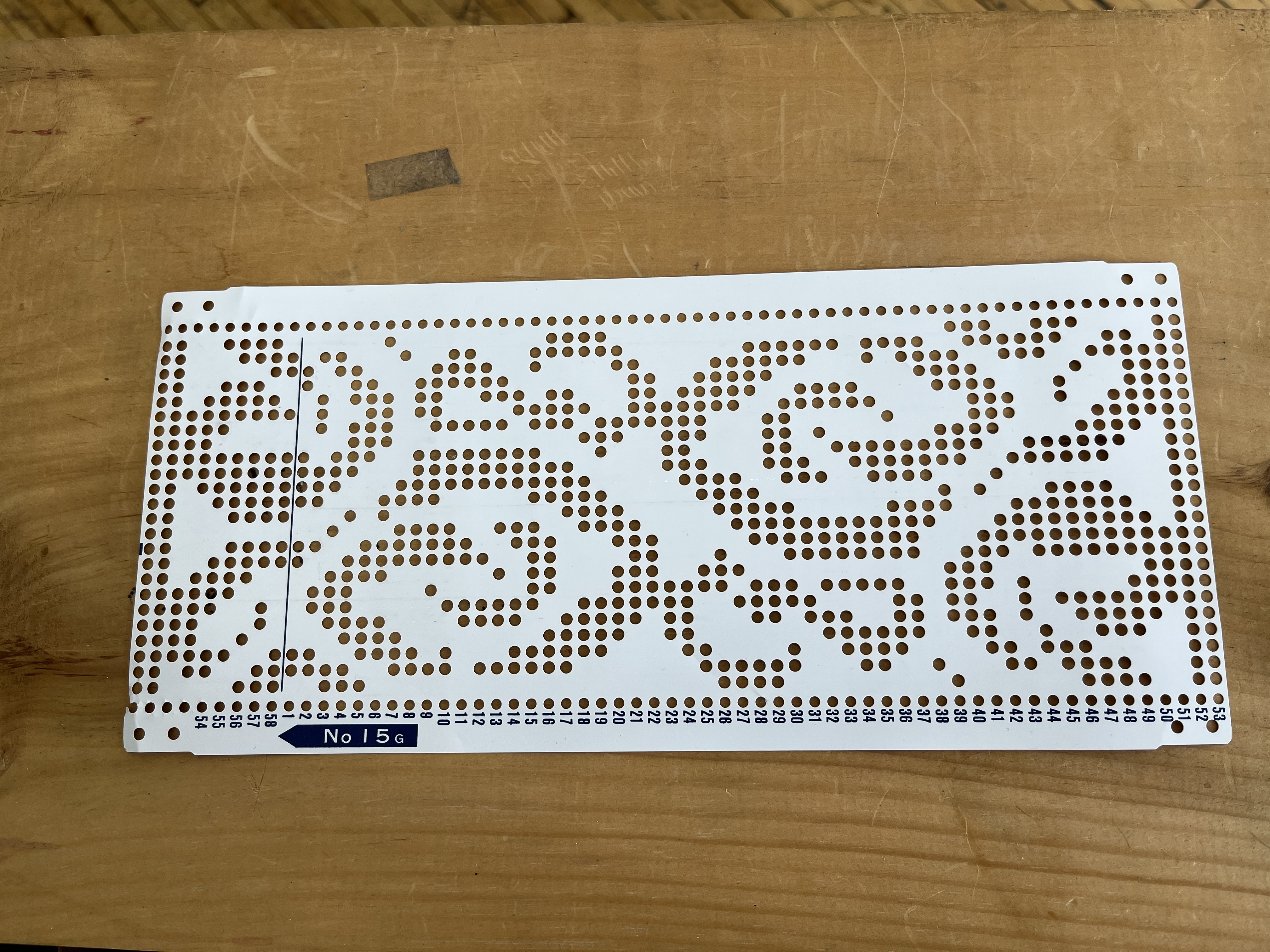
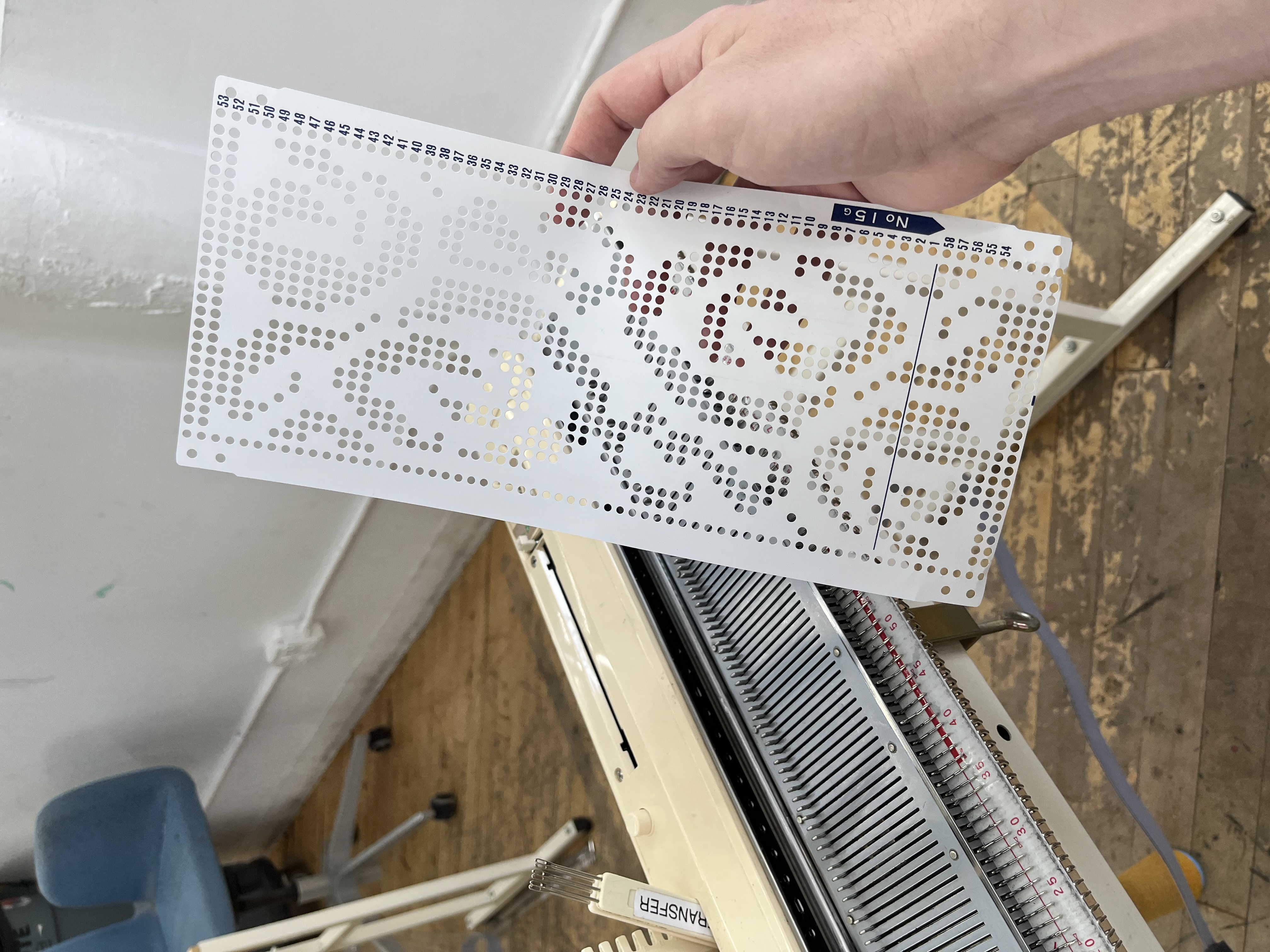
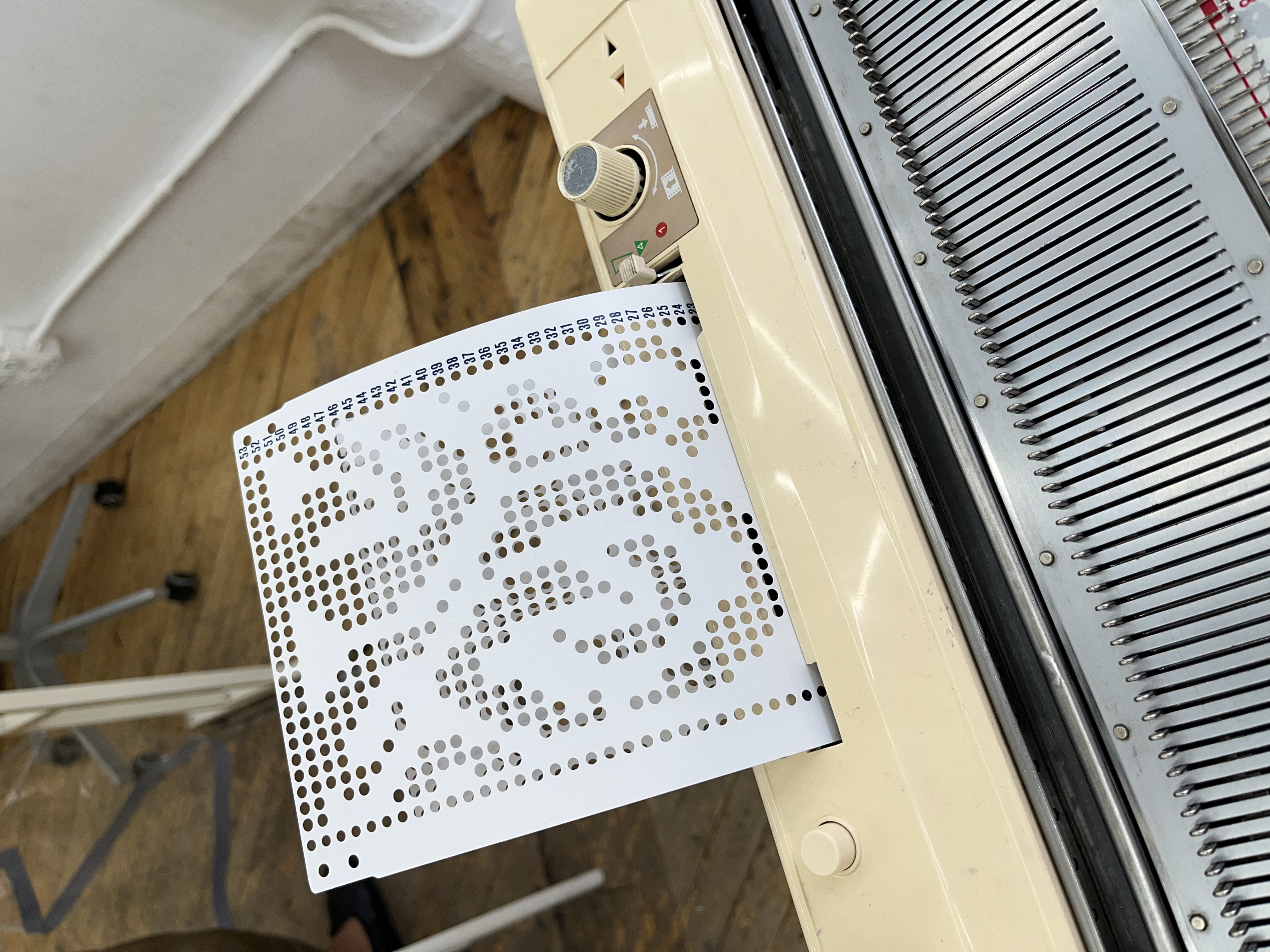
I grabbed this floral pattern. The arrow shows you which way it goes in the machine. Once it's fed halfway, you use plastic clips to join the start and end, forming a loop so the pattern repeats!
The knitting carriage needs several adjustments to begin following the punch
card pattern.
Start with the carriage to the left, turn the knob to 'KC', and knit one row in your main color from left-to-right. This will set the needles for the first row of the pattern.
With the needles set and the carriage on the right, Press the 'MC' button and add the contrast yarn.
Then… knit a bunch of rows! Here’s a little video.
My hand moving the carriage back and forth. The carriage clatters as it moves needs. The punch card reader clicks and advances as each row is finished.
When you’re done patterning, you can snip the contrast yarn, turn the carriage back knob back to ‘NL’ and disable the ‘MC’ button, then proceed knitting in your main yarn color as normal.
Fair isle knitting creates "floats" on the back (purl) side, which is what faces us while we knit. Seen from the correct (knit) side, the pattern is revealed! Also, it looks like I dropped a stitch at some point and produced a little snag here. Oh well!
After a lunch break, we spent most of the rest of the time practicing what we’d learned so far.
Near the end, Elaine taught a few important techniques that you do off the machine.
The diagram shows one way to make a "gauge swatch", which is required to find out how many stitches and rows produce an inch of finished knitting. On the right is an example of mattress stitching, used to join the edges of knit pieces together.
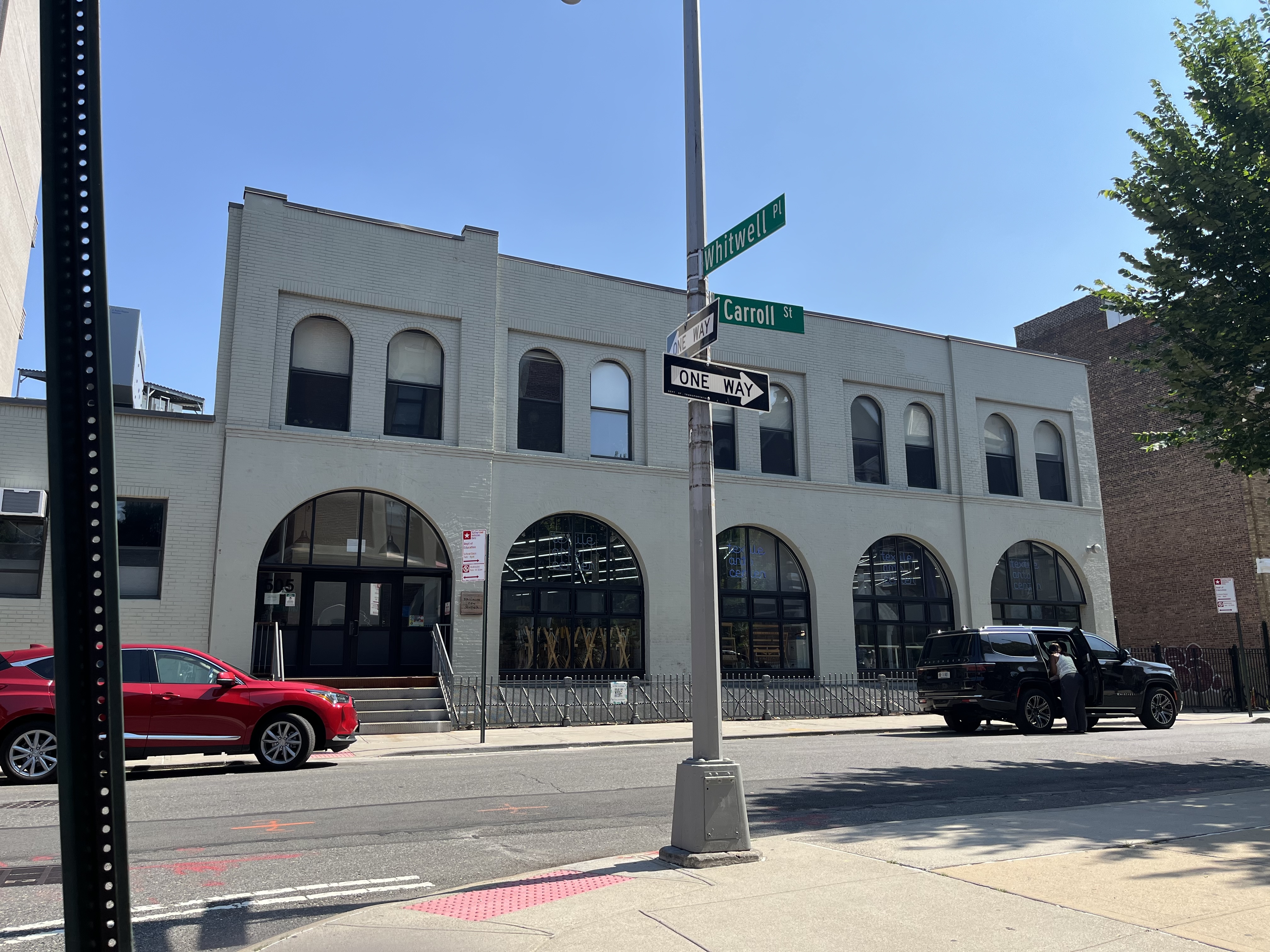
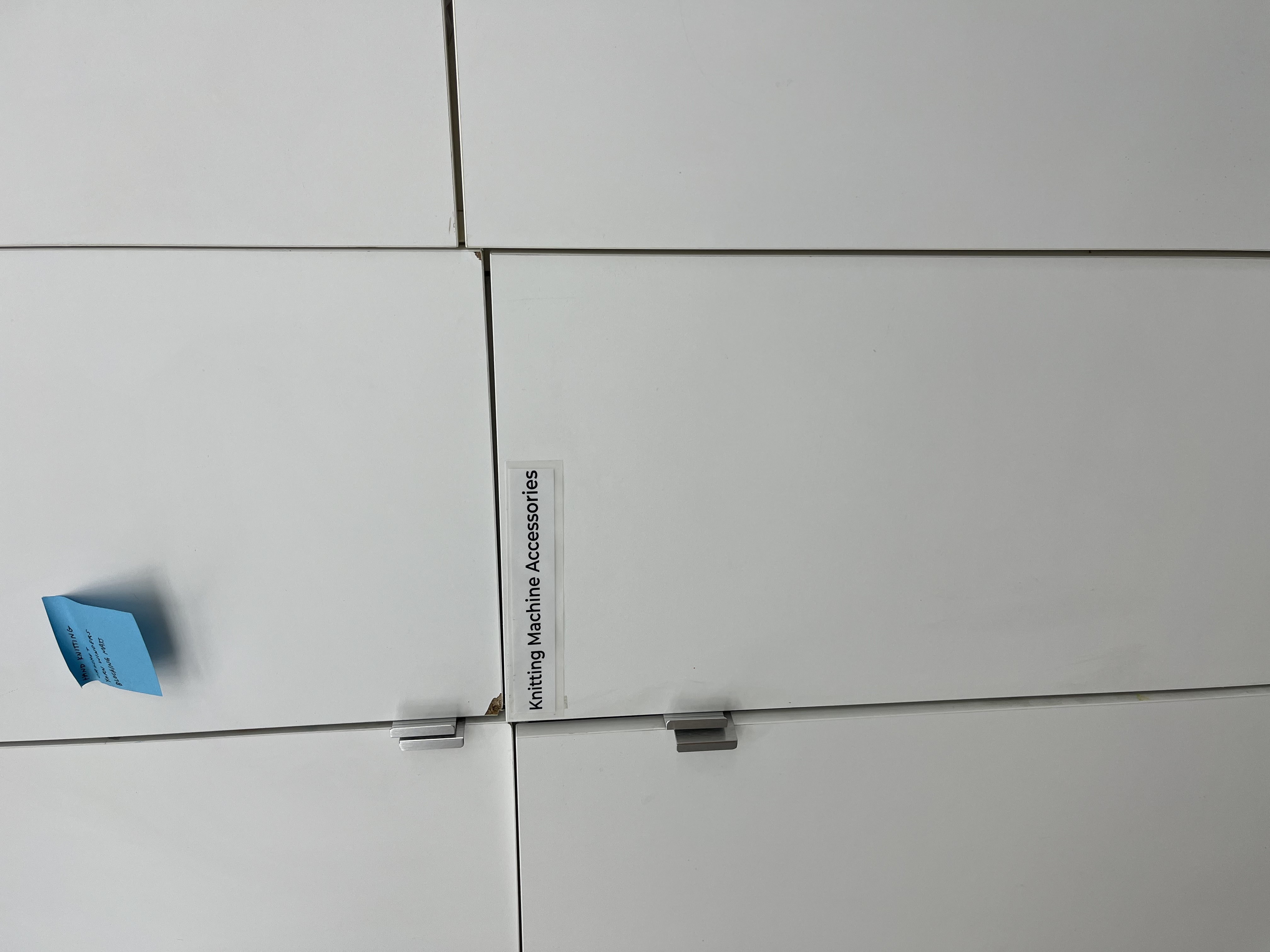
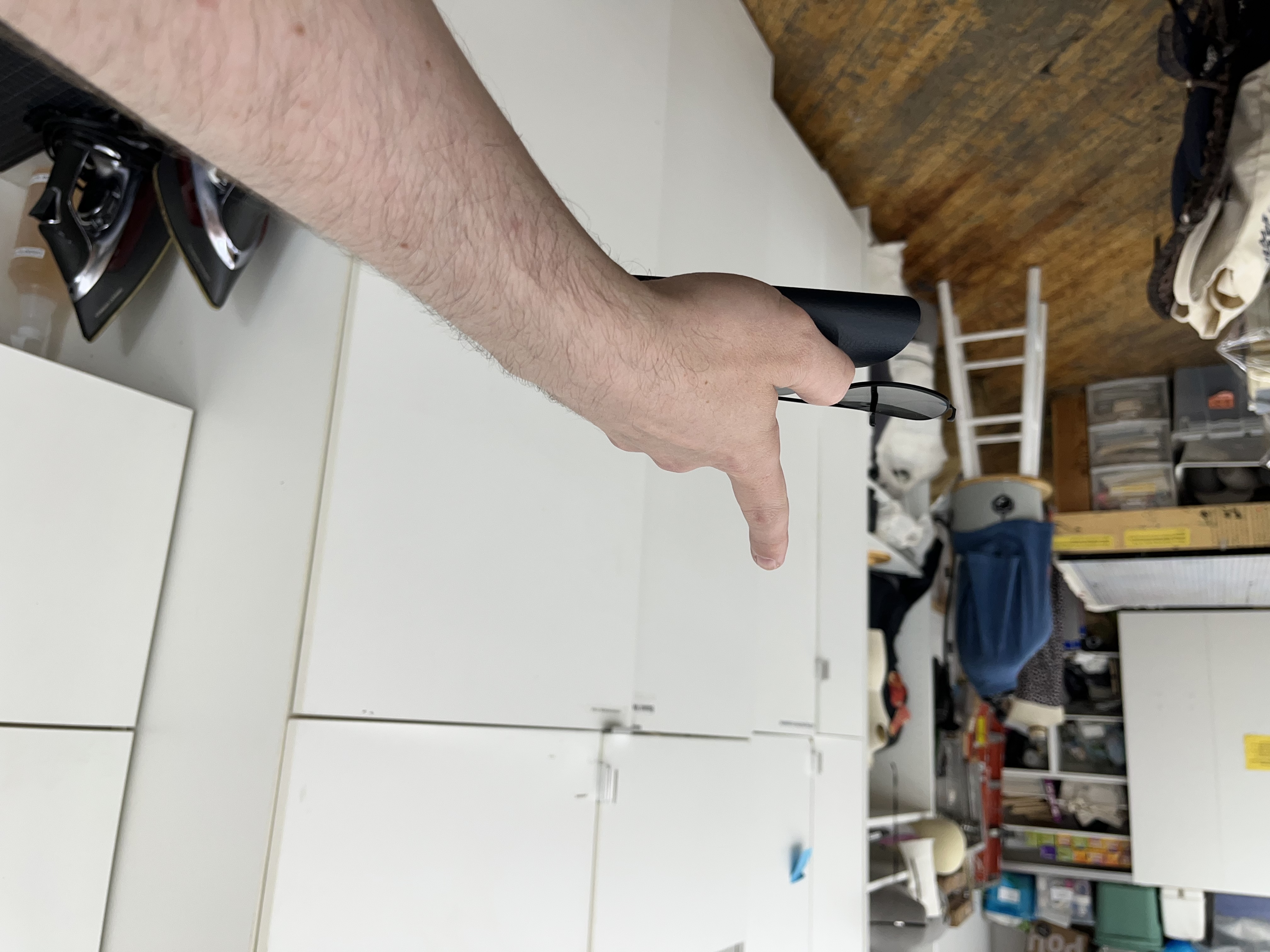
Note to self, or anyone who wants to book some studio time to do some machine knitting at the TAC:
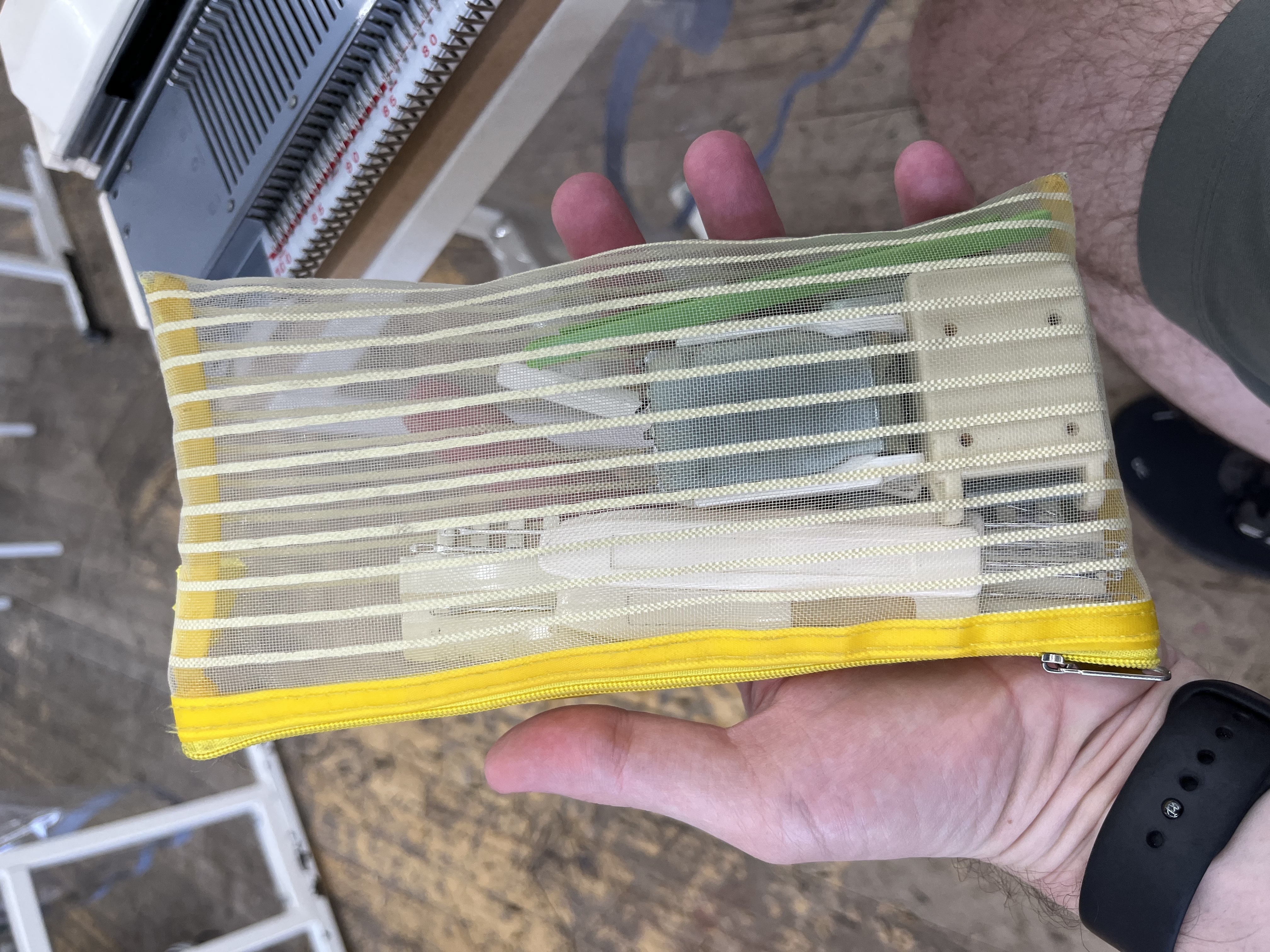
There's a cabinet for the knitting machine accessories and here are some context clues for finding them!
And that was the end of the class! I learned so much, but mostly that I have so much yet to learn.
Goodbye, new friend.
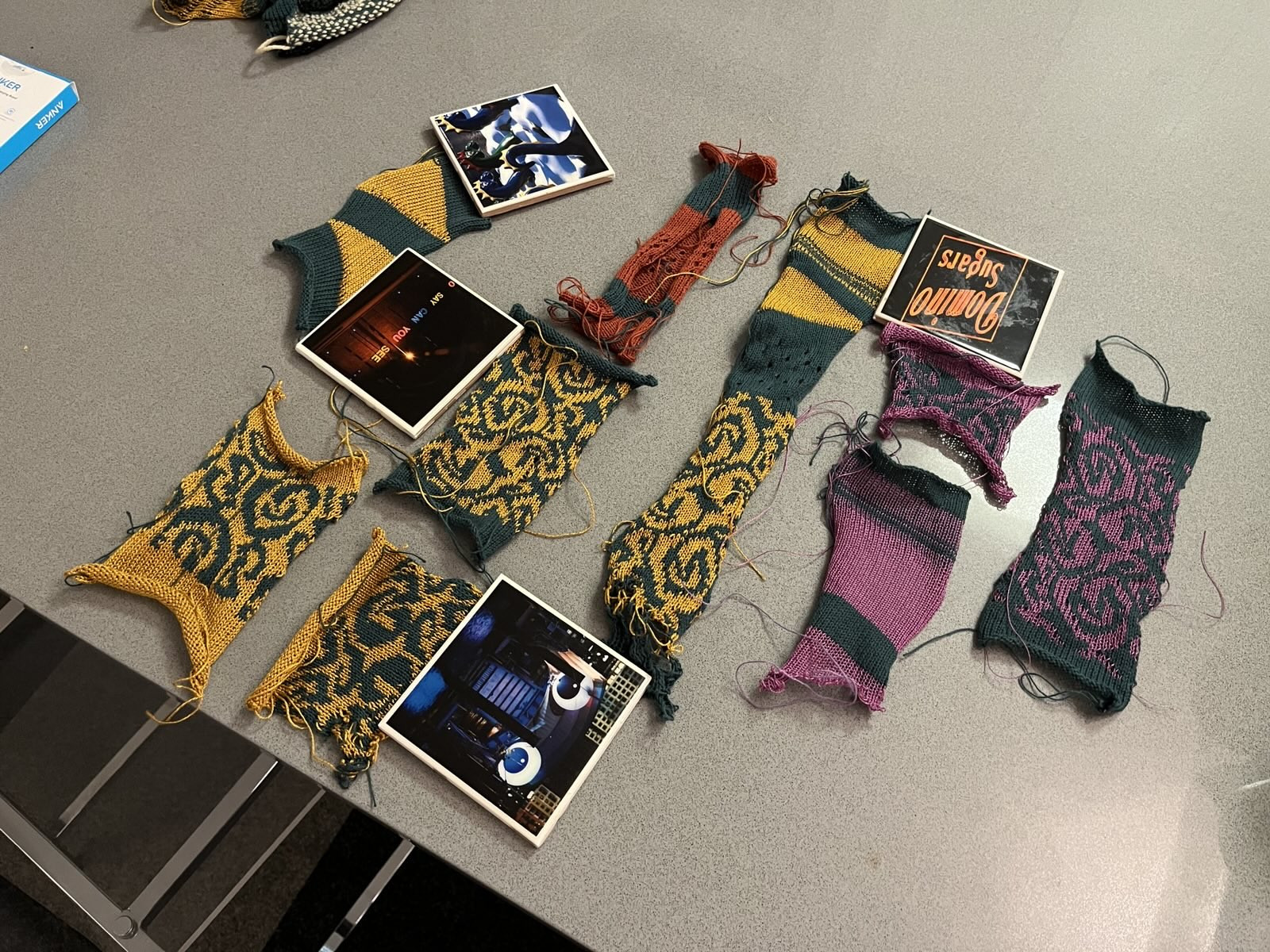
Besides the big swatch of worked-in yarn, here’s the rest of my swatches for the day!
What a haul!
From top-to-bottom, left-to-right:
Blue swatch with yellow short-rowed triangle sections.
Blue and red swatch partially mattress-stitched into a tube, with several lace holes.
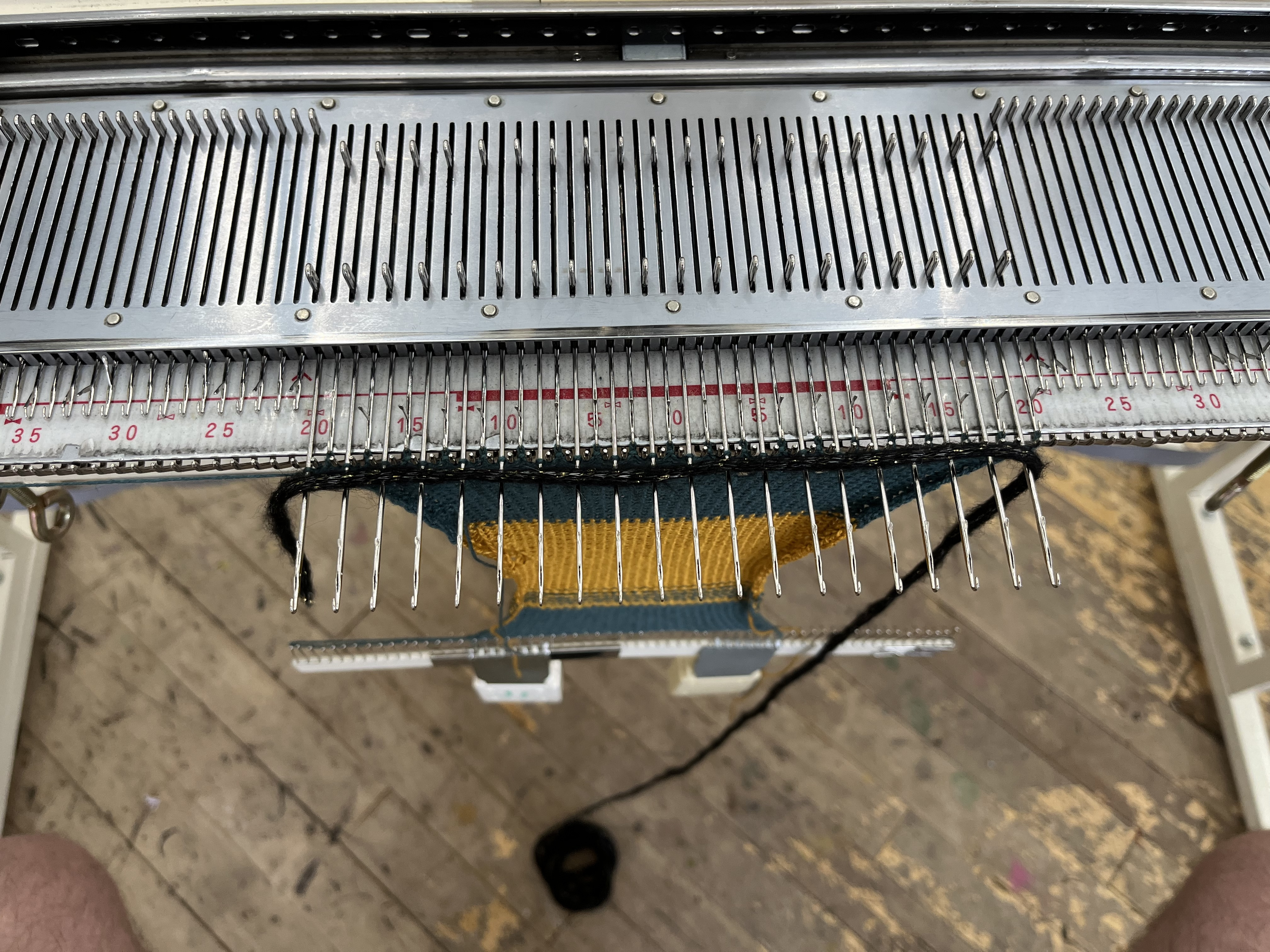
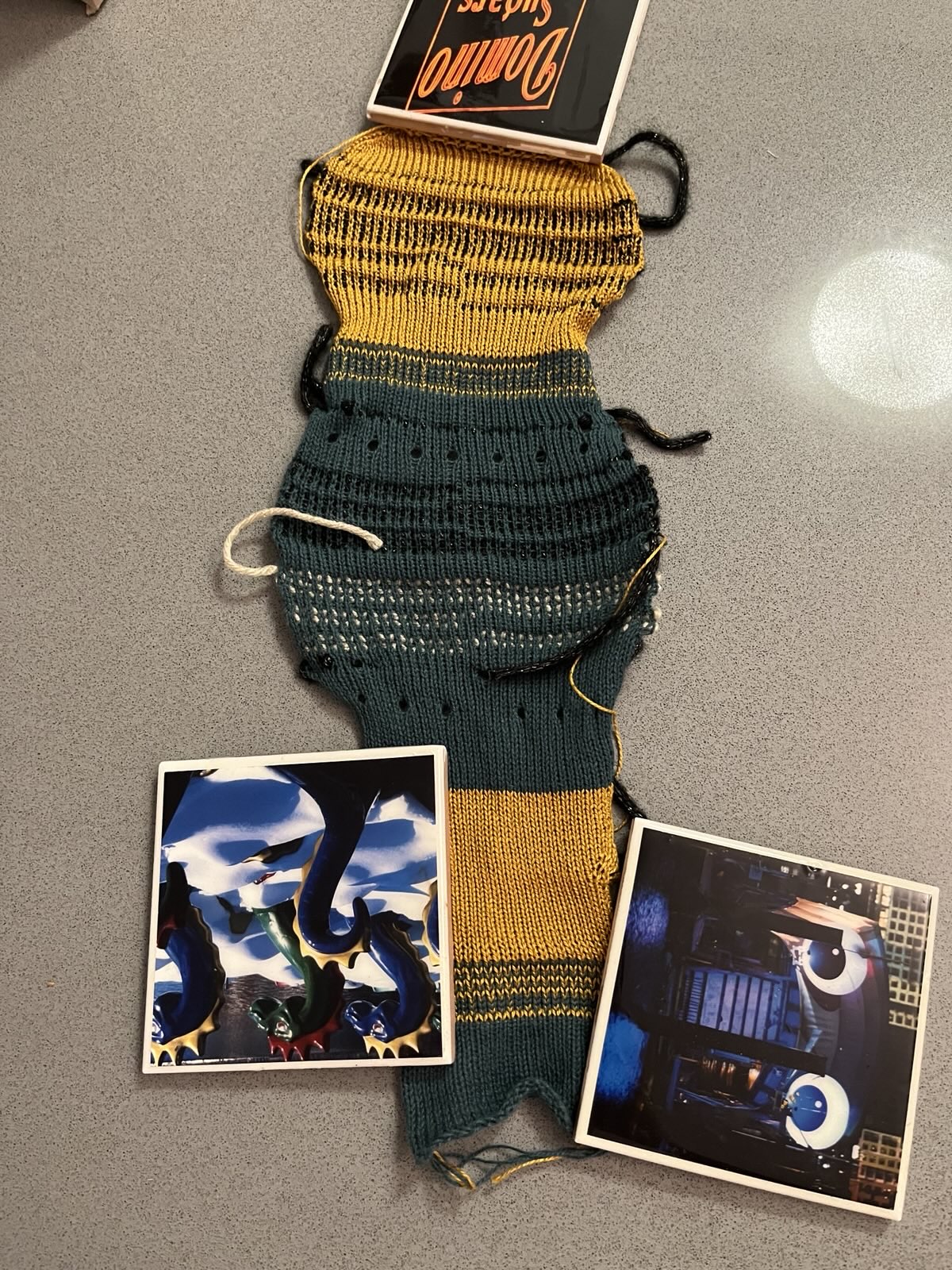
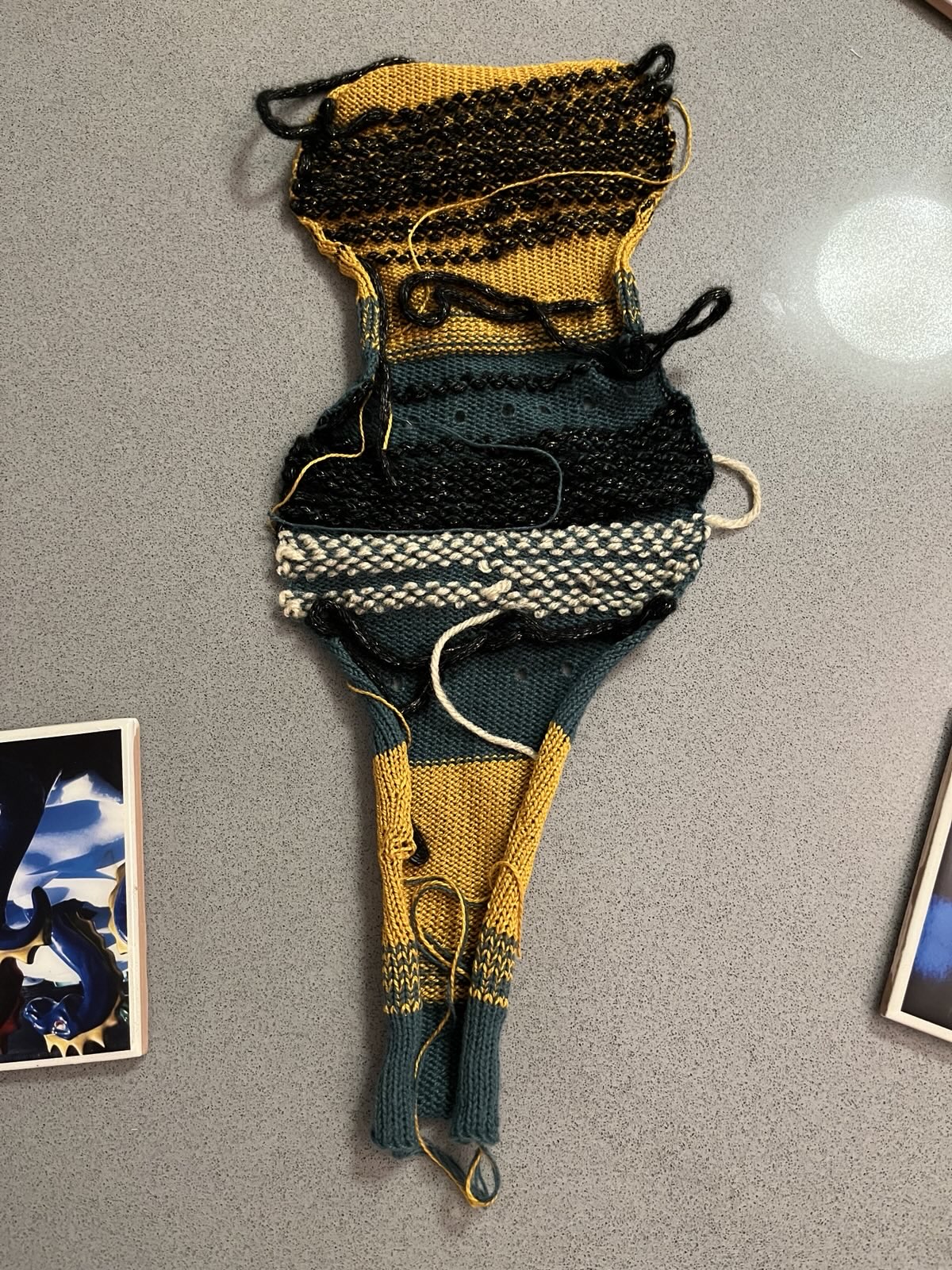
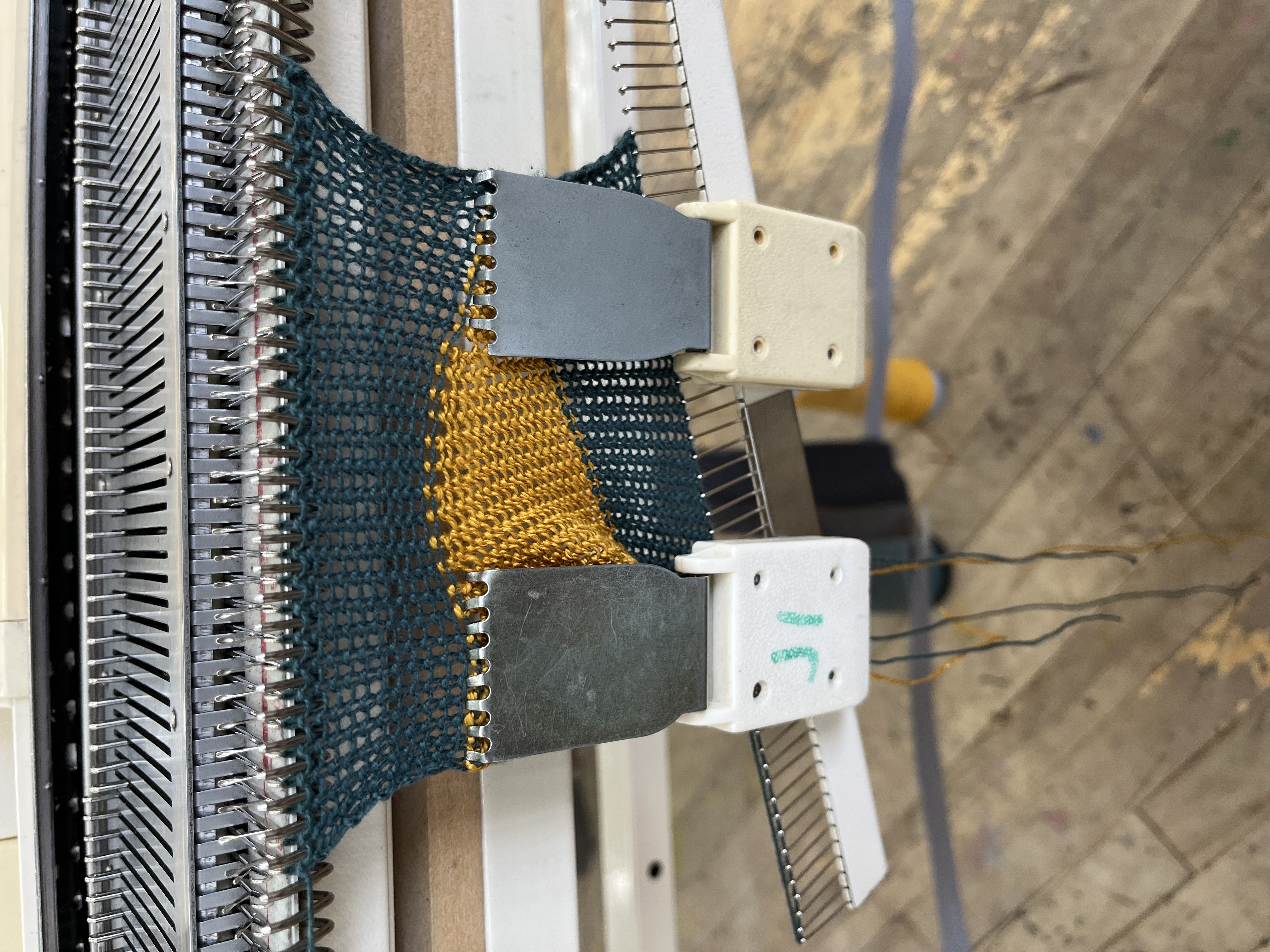
Long blue and yellow swatch with practice sections of short-rowing and lace, as well as a long section of floral fair isle pattern. The end of the piece is ragged from a failed bind-off.
Fair isle swatch with blue-on-purple.
Fair isle swatch with purple-on-blue.
Long purple swatch with sections of blue.
Blue-on-yellow fair isle swatch.
Yellow-on-blue fair isle swatch.
Short blue-on-yellow fair isle swatch with two ragged edges: one from removing the swatch without binding off, and one (I think) because I had a "weird" number of stitches compared with the pattern, leading to some edge stitches being dropped.
Will I continue my machine knitting journey?? Stick around to find out! Subscribe in your favorite feed reader, and so on, and so forth!
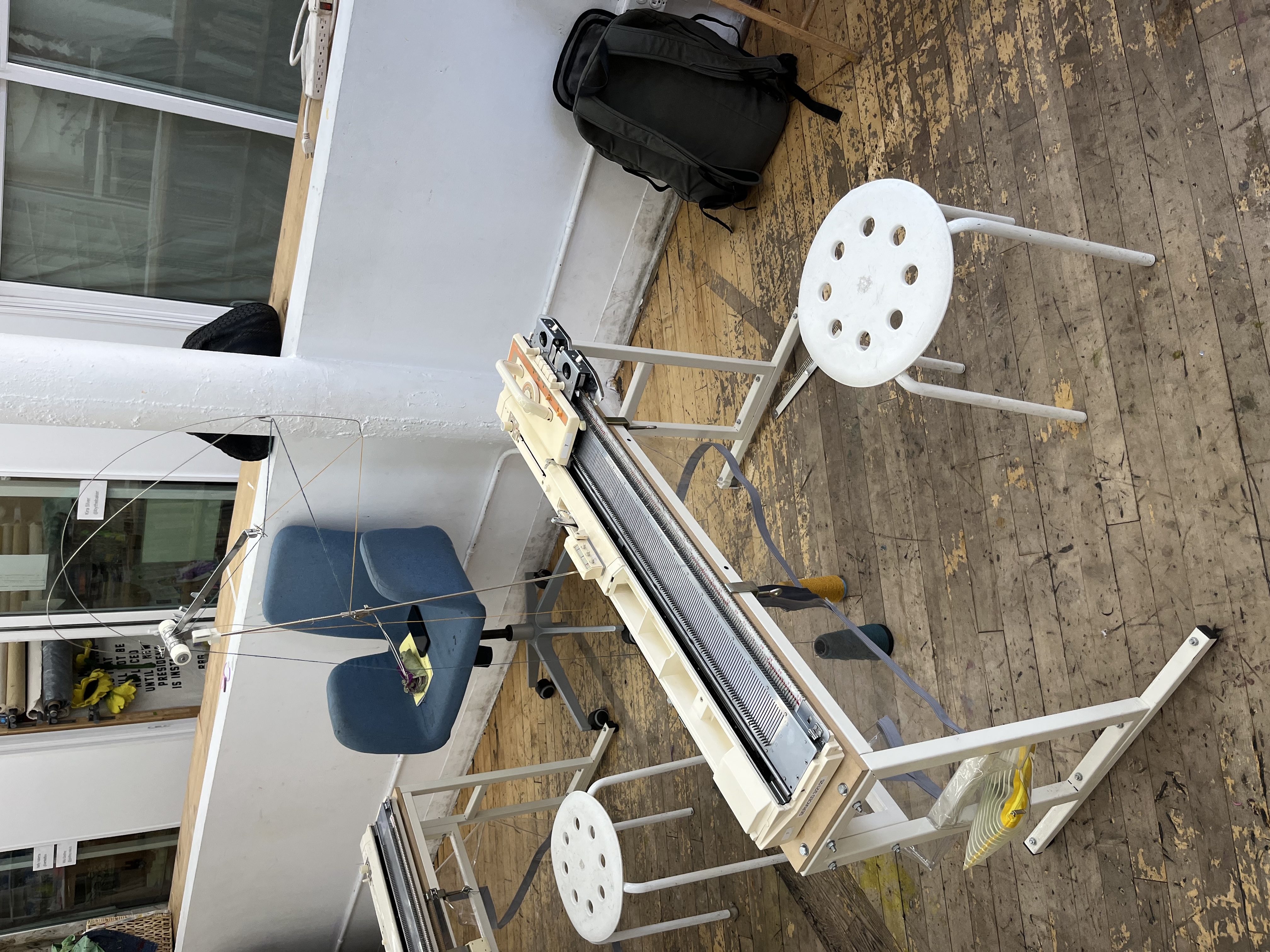
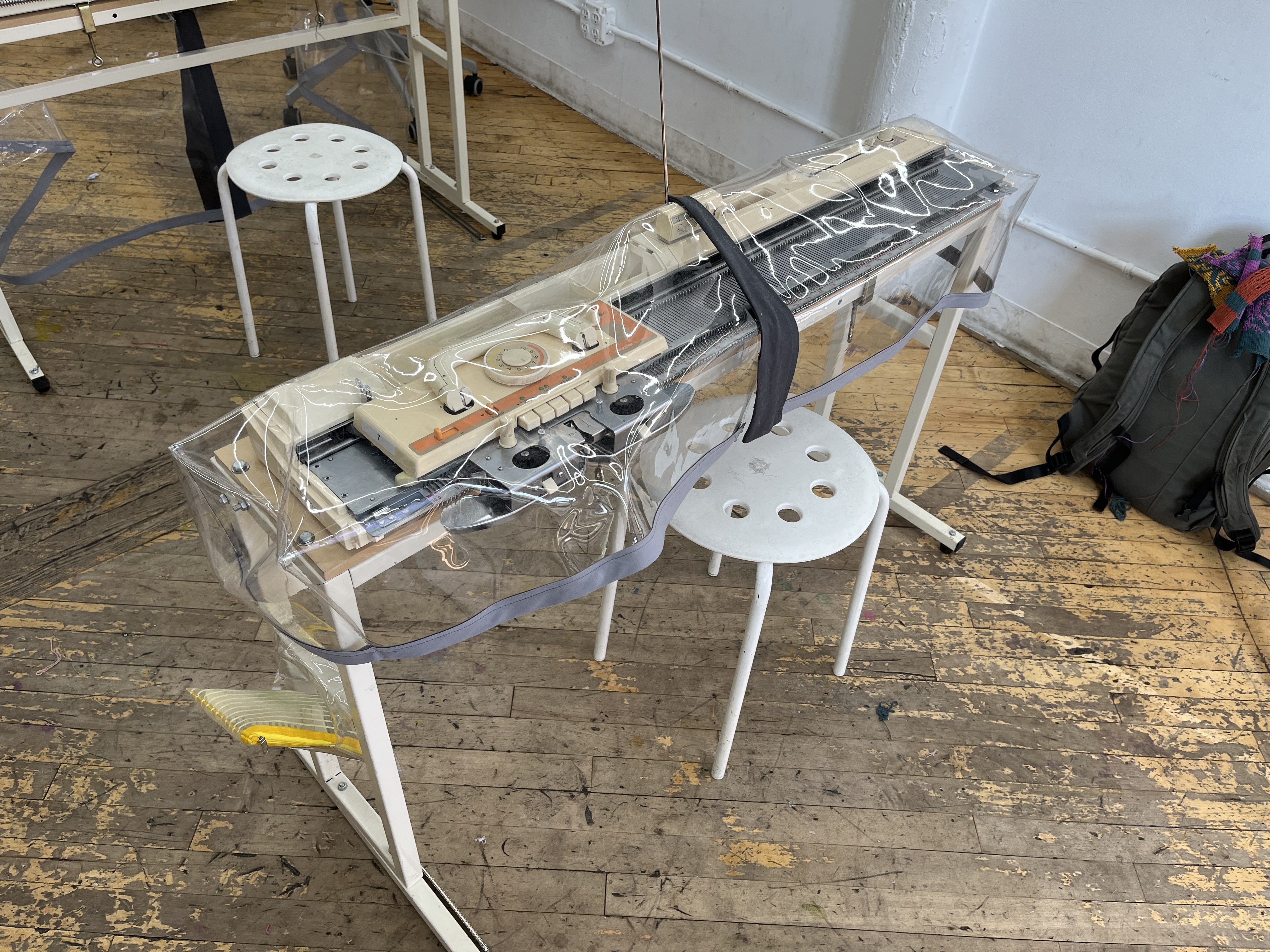
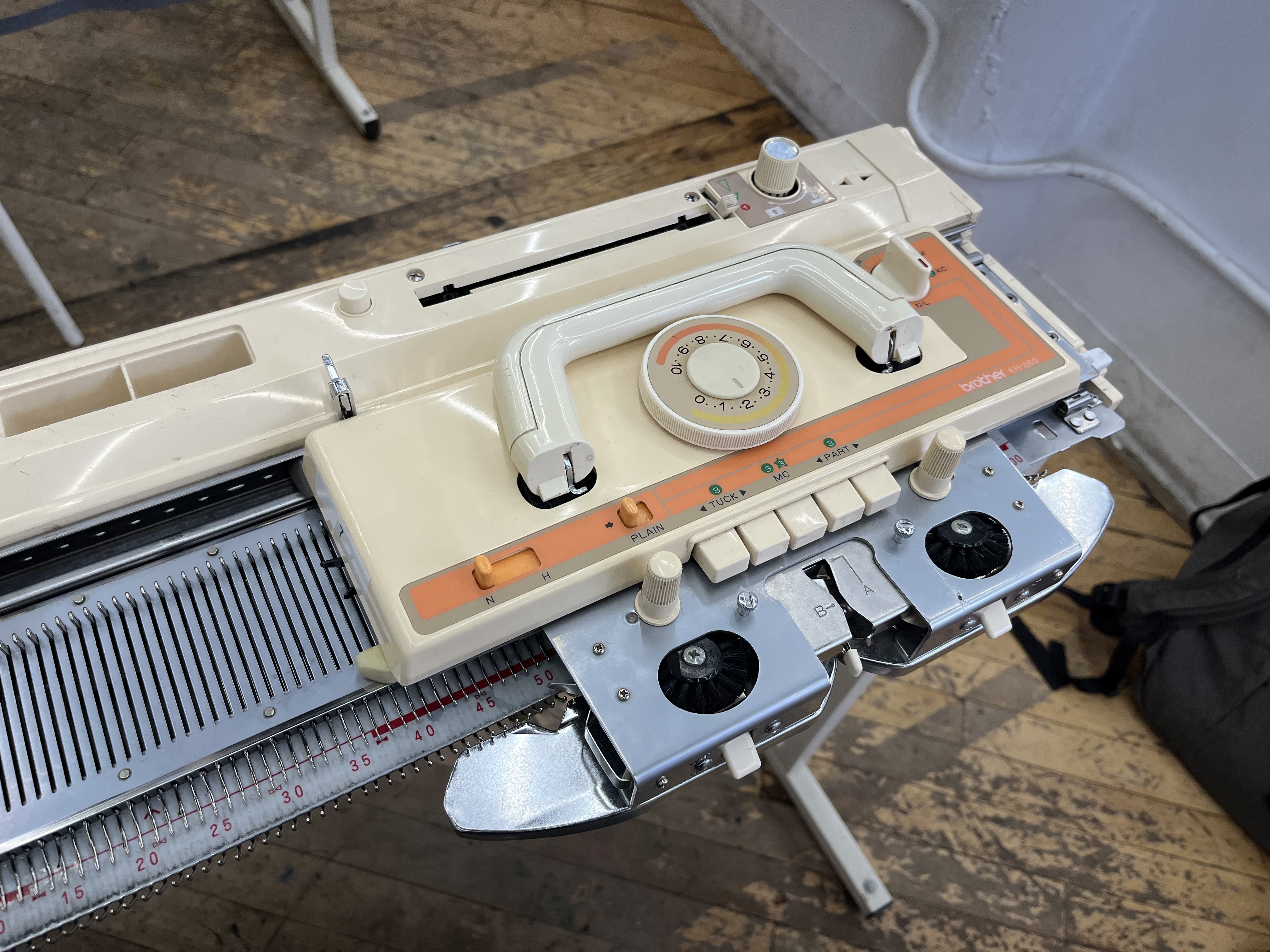
The parts of the machine (Brother KH-840s. Punch card reading cuties from the 1970s!)
Choosing yarn
Threading the machine with tension
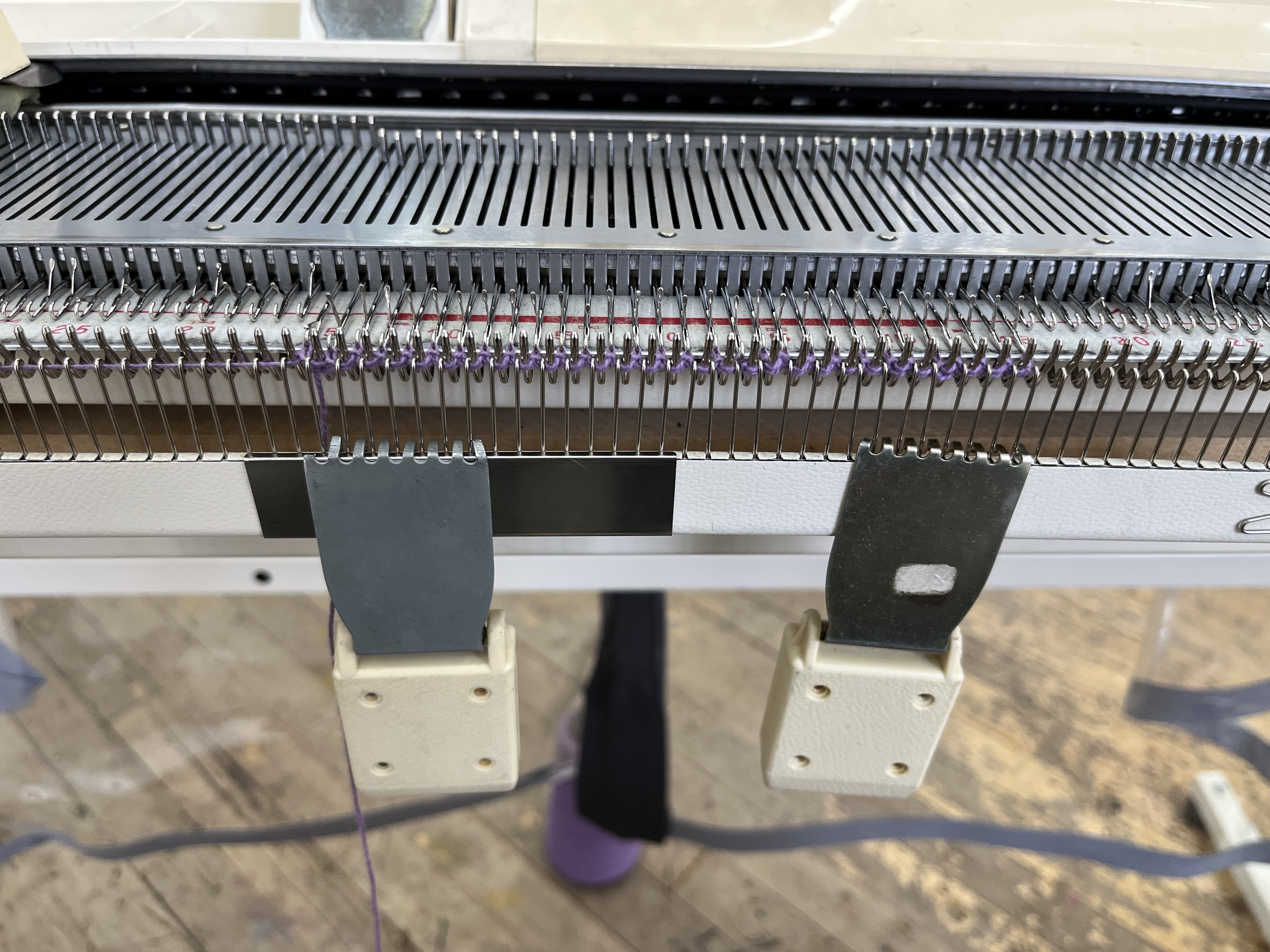
Casting on with "e-loops", comb and weights
Knitting rows, managing weights
Moving stitches horizontally and vertically, making holes and ladders
Blending colors and swapping colors
Increasing and decreasing the number of stitches not-at-the-edge
Casting off (the hardest thing we covered, probably)
We bought a knitting machine, a Brother KH-930e, back in, checks notes, =chokes= like 2011 or 2012?? Enticed by Becky Stern's post on on hacking the KH-930e. As it turns out, the electronics hacking was NOT the difficult part of working with one of these machines! After some rounds of buying replacement parts and maintenance, we got a couple of little projects out of it, but found it challenging enough to work with that we stopped messing with it. But, we still have it, and I'm excited to try again!
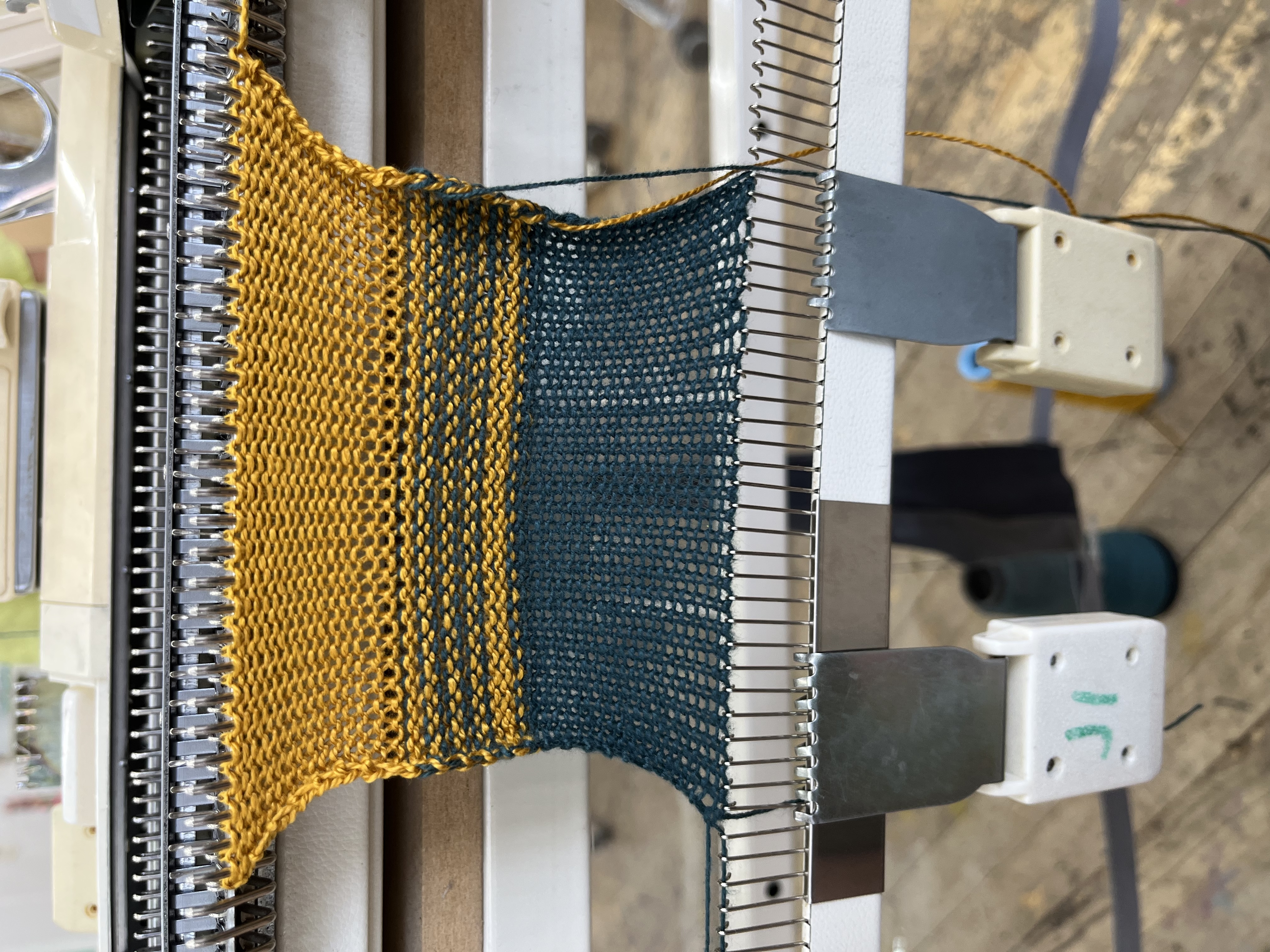
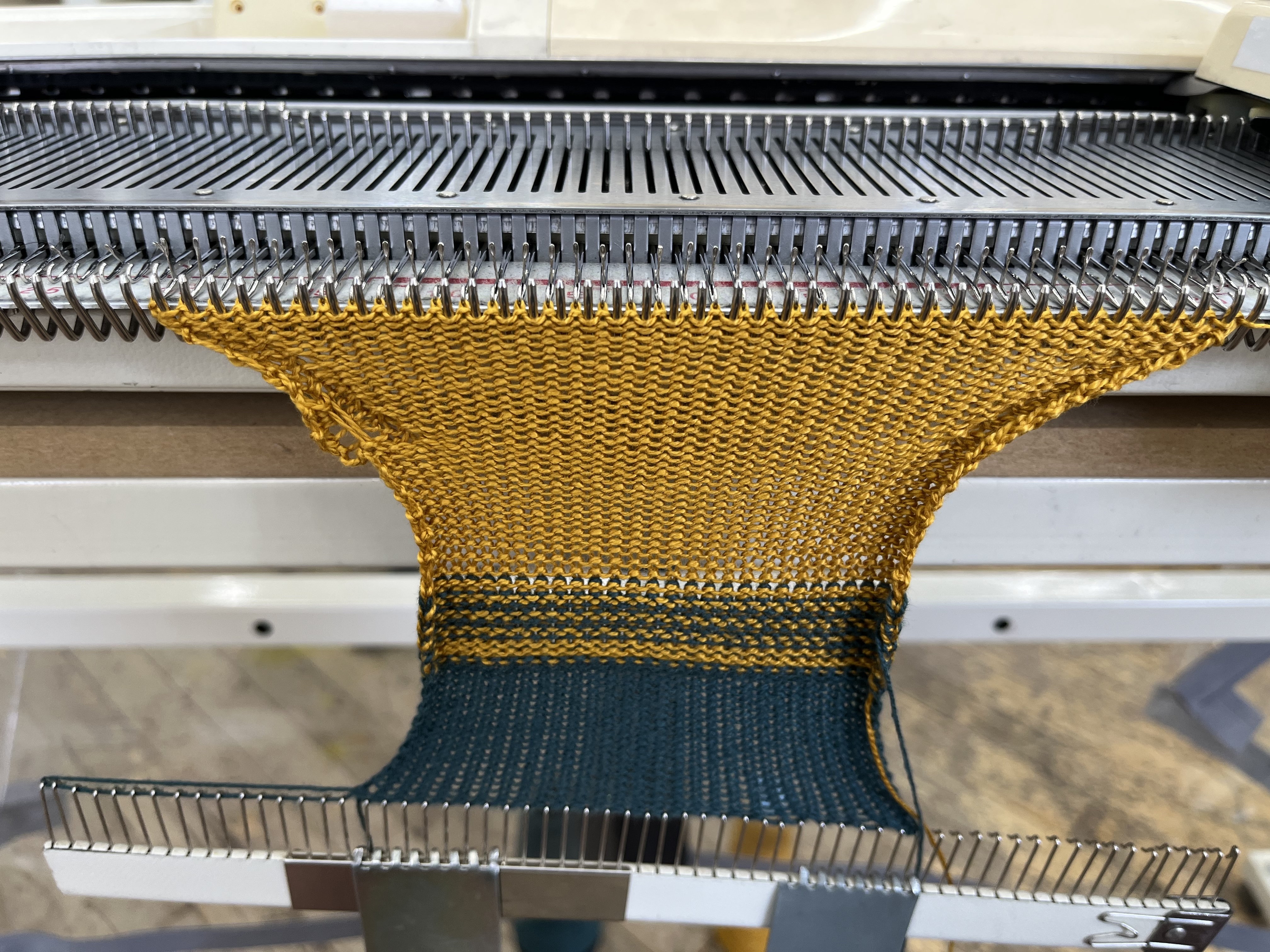
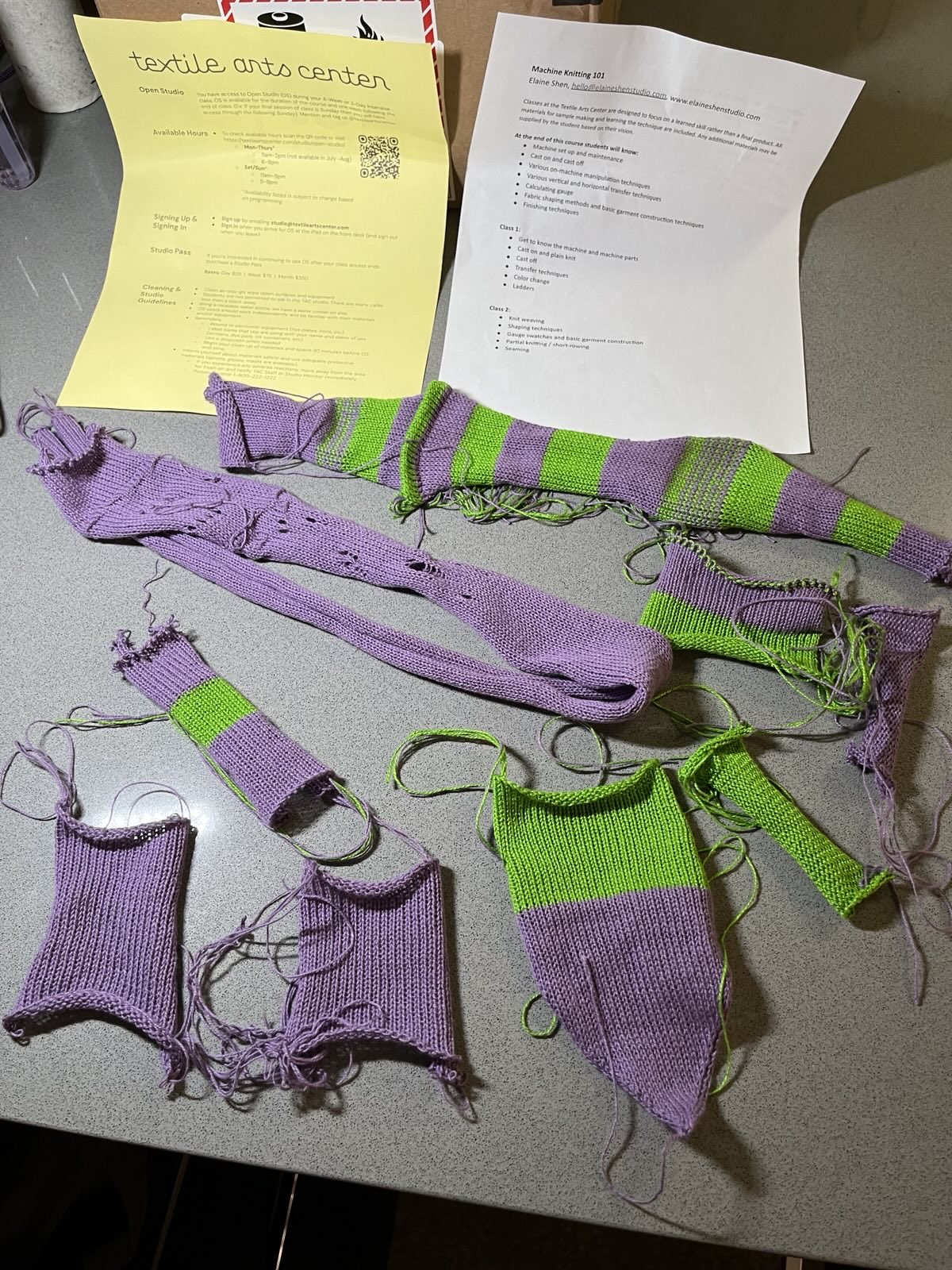
Here's a photo of the workshop syllabus, as well as some of my debris from today's workshop.
From top to bottom, left-to-right:
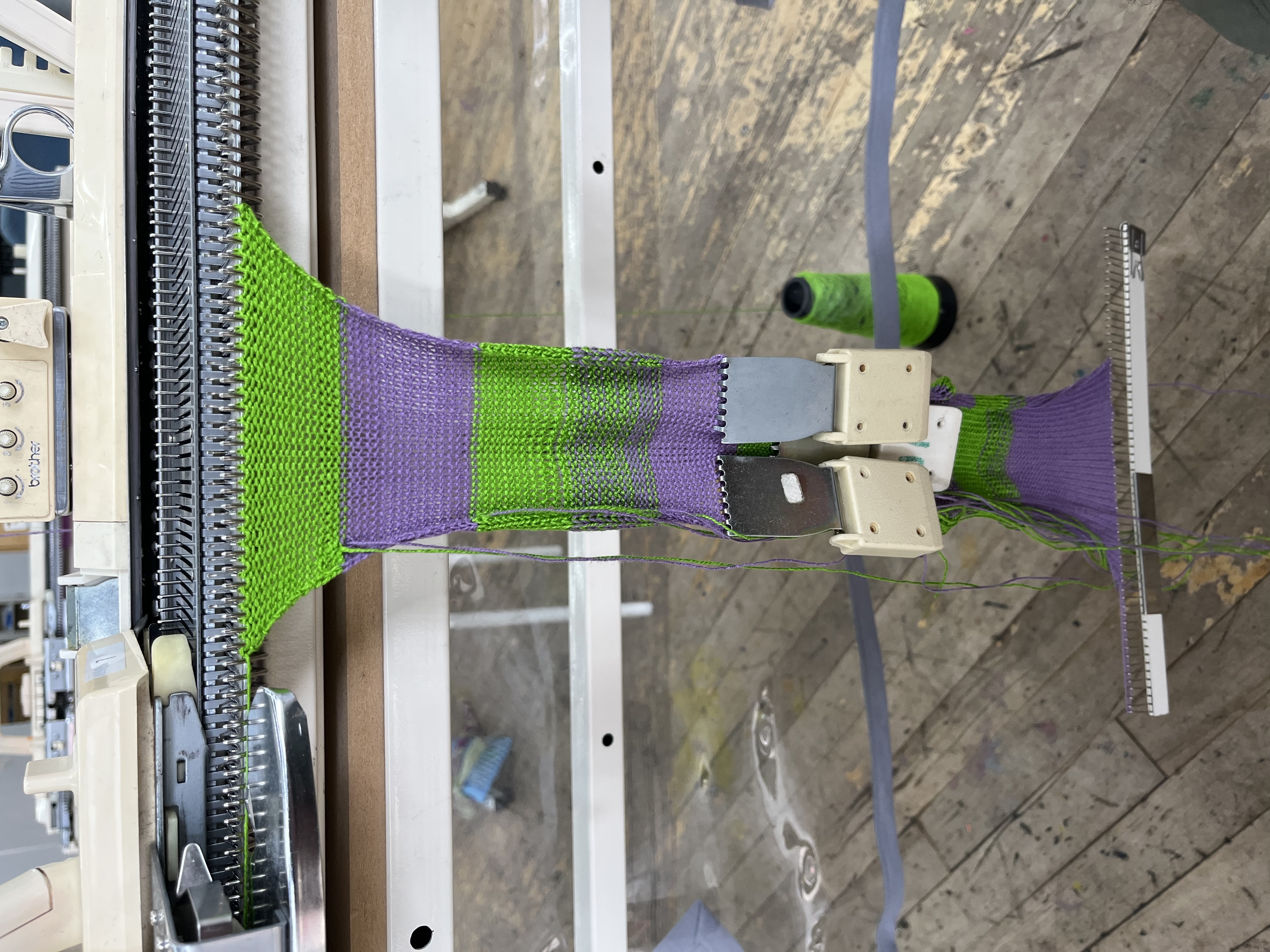
A long run of purple and green blocks, with a mix of clean color changes (where you cut one yarn and start antoher) and blending (where you knit with two yarns at once!). This run also includes a "flap" where I used vertical stitch movement to "close up" a small block of green.
A long run of purple yarn with holes and "wrinkles". These are tests of moving stitches horizontally (holes) and vertically (wrinkles).
An unraveling run with one block each of purple and green. A failed attempt at casting off.
A small unraveling block of purple. A failed attempt at casting off.
An unraveling run with two blocks of purple divided by a small block of green. A failed attempt at casting off.
A non-unraveling block of purple. My one success at casting off!
An unraveling block of purple. A failed attempt at casting off.
A run with a large green block and a large tapering purple block. Practice at increasing and decreasing stitches. I decreased down to one stitch lol.
A small unraveling block of green. A failed attempt at casting off.
Update from the future: here are some more photos from the day!
Thank you for reading. I hope to post more knitting projects. I hope to read your HTML Day creations!